Interesting Russian Weapon I Found: Club-K the cargo ship defense…

They have developed cargo/container versions of the widely-exported ship-based Club, or Kalibr, short-range surface-to-surface missile battery. The new weapon is codenamed Club-K. It comes on two easily transportable and mountable versions: one, hidden inside a standard 40-foot shipping container, and the other, inside a similar 20-foot one. These deadly containers can be deployed in ports. They can be installed on the decks of civilian ships, making them not that defenseless in the face of hostile naval forces.This is the greatest thing to be developed I have seen in a while and it will make bully countries think twice before they try to jump on someone’s back…

Fittingly, the world marketing is naming the system,“Pandora’s Box.” – When opened – you are in for trouble…

The average container-looking weapon system can be fired from a cargo ship, a train car, or a flat bed truck. By appearing externally as a simple unmarked shipping container, the Club-K can be positioned covertly, ready to unleash a surprise attack, probably firing simultaneously from more than one container.

This literally turns huge cargo/container ship into a super missile cruiser…

Here is the Russian weapon – The Club-K…

Or this as a extra tidbit to make you think…

The Russian weapon – Club-M…

I think Club-K’s are just perfect for those average Americans in the USA to deal with those damn drones that should not be there, flying in the skies of America. Fight fire with fire…

Post by Kyle Keeton
Windows to Russia…

5th BRICS Summit: BRICS Will Develop a Bank!

THE 5th BRICS summit ended yesterday with leaders agreeing to establish a development bank, while several agreements were signed to strengthen cooperation within the grouping and enhance engagement with other emerging and developing economies…

New BRICS chairperson and South African President Jacob Zuma told a media briefing early yesterday afternoon that following a report from the finance ministers, the leaders were satisfied that the establishment of the bank was feasible and viable…

This was after the consideration that developing countries faced challenges of infrastructure development due to insufficient long-term financing and direct investment, especially in capital stock, and constrained aggregate demand…

As a result, there was need for BRICS cooperation towards more productive use of global financial resources to make a positive contribution to the process…

“We have agreed to establish the new development bank. The initial capital contributions for the bank should be substantial and sufficient for the bank to be effective in financing infrastructure,” he said…

bricsThe development bank would be based on the needs of the BRICS countries which require about 4.5 trillion U.S. dollars over the next five years for infrastructural development, he said…

Zuma added that BRICS leaders had also in June 2012 tasked finance ministers and central bank governors to explore the construction of a financial safety net leading to the creation of a Contingent Reserve Arrangement (CRA) within BRICS countries…

Leaders agreed that the creation of the CRA with an initial size of 100 billion U.S. dollars was also viable subject to internal legal frameworks and appropriate safeguards…

“We direct our finance ministers and central bank governors to continue working towards its establishment. We are grateful to our finance ministers and central bank governors for the work undertaken on the new development bank and contingent reserve arrangement…

“We direct them to negotiate and conclude the agreement which will establish them. We will review progress made in these two initiatives at our net meeting in September 2013,” he said…

Agreements signed during the summit included one on green economy cooperation co-financing and another on infrastructure co- financing for Africa…

The leaders also launched the BRICS Business Council, which will provide business to business linkages within the grouping, while an agreement on the establishment of a BRICS Think-Tanks Council that was signed on March 11 was formally declared…

They also recognized the 5th BRICS Academic Forum and the role of academics in fostering dialogue…

Indian Prime Minister Manmohan Singh urged BRICS nations to promote the forum by allowing academics to share their unique experiences, particularly in the areas of energy, food security, education, health care, sustainable development, information technology and public service…

“Our roadmap of the future should focus on deepening of our existing cooperation.”

The foremost challenge facing the BRICS nations was to respond to persistent weaknesses in the global economy, he said…

“Recognizing that BRICS countries will remain key drivers to global economic growth, we should further sustain our growth by harnessing opportunities and investment ties between ourselves,” he said, adding that they should exploit their complementarities for their mutual benefit taking into consideration their unique resources and strengths…

Singh also highlighted the challenges of terrorism and piracy and said that it was incumbent upon the nations to use their collective voice and capacity to make an effective and meaningful contribution to these challenges and foster global peace and security…

Russian President Vladmir Putin said he hoped that BRICS nations would continue working on a professional level and called for the strengthening of technological and industrial markets while special attention should be given to expanding business ties.
He also encouraged the promotion of the green economy for sustainable development: “We will need to implement the highest environmental standards.”

China’s President Xi Jinping said the leaders of the five BRICS countries were full of confidence in the potential of the grouping saying that the countries shared broad common interests and that the establishment of the development bank would unlock the potential for BRICS cooperation…

He called for greater balance to the global economy and greater democracy in international relations, pledged China’s continued readiness to play a part in forging ahead BRICS ties and added that China had already established strategic partnerships with others…

Besides the summit proper, BRICS nations also signed bilateral agreements among themselves as they sought to cement relations within the context of the transcontinental grouping…

Addressing a plenary session earlier in the morning, Zuma said it was appropriate that the leaders celebrate BRICS achievements, including its further contributions to the strengthening of the global agenda to ensure a more equitable and prosperous world…

“The BRICS Forum offers member states the opportunity of amplifying voices for political, financial, economic and social interests around common goals and development agenda based on shared values.”

He said there was need to forge a paradigm shift in global relations and cooperation…

BRICS countries continue to power, stabilize and support the global economy. We, however, should remain vigilant to underlying weaknesses and risks in the global economy.”

He said BRICS countries would continue to consider crisis situations in the world and would coordinate closely as they sought to achieve global peace and security in line with the United Nations Charter…

The shared vision of integration and industrialization would remain at the core of BRICS cooperation, he said…

There was need for emerging countries to enjoy the fruits of their resource endowments by shifting from primary to industrial development and thus beneficiate their goods…

Shifting to his country, he said South Africa was keen to learn from the experiences of others and wanted to upgrade about 3.2 million youths into formal employment while enhancing skills development…

Post by Kyle Keeton
Windows to Russia…

In Russia – Putin-Xi summit: It was very productive…

hot-cup-of-coffeeChina has secured that oil and gas, that it needs so badly to continue its upward movement in the world. Russia gets to sell it to them and even get the money before delivery. You know, “Prepaid!” This is what I am thinking, over a cup of wonderful coffee…

This prepaid also includes opportunities for China to invest in Russian oil and gas. This is a huge win win for both countries. China needs that gas and oil to fuel the growth that has been happening for many years and their national security depends on a stable Russian supply of fuel. Russia has the same needs and so we have watched in the last few years, a beginning of a future powerhouse, Russia and China…

But oil and gas were not the only thing discussed, but were the only thing put to the media. The smoke and mirrors are up and as it has been for several years now. The shift of power in the wind has been happening. It is not a tornado wind, but it is a steady breeze that is blowing the giant ship in a different direction, even while the self-proclaimed captains do not even know it is going off course…

Russia and China realize after the last few decades, that the world is being driven off a cliff by the west. It is a run away train and the brakes are burned out. China has seen it coming, as Russia has also and they both fueled the end results as much as they can. America was so stupid that it never saw it coming and we have a saying to fit this issue…

“Give him enough rope and he’ll hang himself!”

Means: If one gives someone enough freedom of action, they may destroy themselves by foolish actions…

Now that definition is America and she gladly went along with it as she borrowed herself into a casket. All that is left is to nail the lid shut. War is done on many levels and actually the physical war is the least damaging war…

You say, “Lets just not pay that debt.”  You say, “Lets inflate our way out!” You say and you say and you say…

The bottom line is, “The debt will go, but the dollar will die with it and all your fancy debt driven fantasies will go to hell in a hand basket, with you!” America will be on the bottom of the credit default list and be hugging Zimbabwe, as everyone riots and wars across America. People do not like to loose all their material items and in America they have had so many toys that they think it is real life…

This is what China and Russia have expressed many times and this is what China and Russia have been secretly working on for years now. They have been relocating their base cores and moving assets to buffer the inevitable crash of the demons from the west. They do not want a sudden death of America and have supported the US and west in endeavors to increase the longevity of the western empire, as to allow a movement of assets. Remember when China bought US bonds? Remember when the US did not buy her own bonds? Remember when? Remember when?

I suspect that we in the US, will be seeing the government buying even more bonds than the 85 billion (a month) that they do now. I suspect that it will increase to 120 billion a month. That is hanging on that rope and starting to choke…

What makes me realize all this is happening?

BRICS…

They (BRICS) are building a banking system. This bank will not allow western influence nor members…

The BRICS are developing their own financial rating system to counter the corrupt western versions…

The BRICS will have a separate currency and it will be backed by gold and silver and other commodities…

The BRICS want a true “multipolar world” and that is just right…

The BRICS are creating a “geopolitical competitor” to the west and the fact that Putin made sure to express that it was not this fact, that we know it is this fact…

The icing on the cake is the fact that in the west they only see that the BRICS are western wannabes and are a threat to the western way of life…

I promise you that the rest of the world does not want to live like the debt riddled west and have the immoral values of the west hanging over their heads as they try to live a good life in the world…

But this western, “We are number one!” and “The would can not survive with out us!” and “We are god chosen to rule!” aspects will lead the world into war, a world war, of all world wars! This is not Libya with these aspirations, this is a bunch of strong countries doing this…

Yes the Putin-Xi summit: It was very productive…

Post by Kyle Keeton
Windows to Russia…

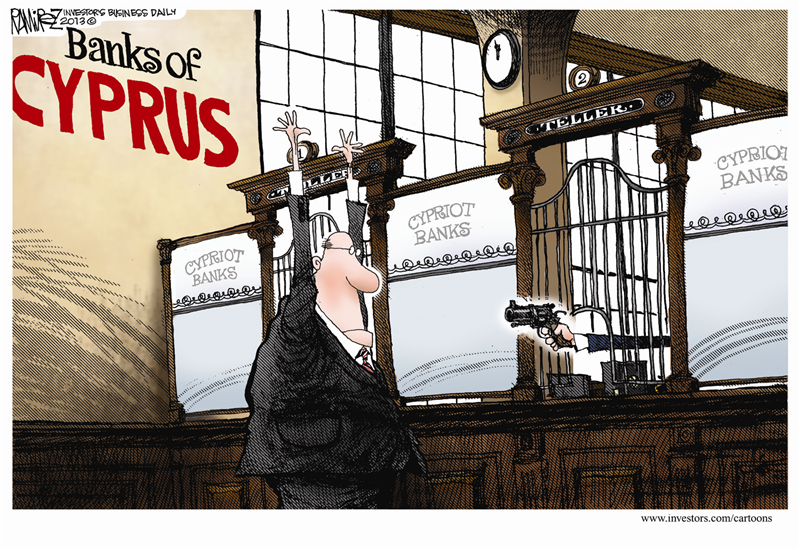
Simple and wrong solution of the Cyprus problem by Сергей Гуриев and Олег Цывинский…

The only rational explanation for the original plan of the Cyprus – is that German politicians do not like depositors Cypriot banks..

The financial system of Cyprus is so many problems within one column, they do not fit that column. Moreover, the situation is changing so rapidly that discussion is not in the current events in the newspapers but in the comments page. We have decided to devote this article to where it all began – with the first sentence of the EU “Tax Deposits” (At a rate of 6.75 and 9.9% for deposits up to and over 100 000 euros respectively).

To this proposal, the reaction not only Putin and Medvedev, but almost all economists – both Russian and foreign. Why? The point is not that we are talking about losses of investors. Cypriot banks in any case not be able to completely pay off its liabilities. Therefore, investors in Cyprus assets somehow lose some of their money. Can not avoid bankruptcy. But bankruptcy can be structured to effectively and fairly – and not set a dangerous precedent for other countries and banks. From this point of view “Tax on deposits” – a very bad decision.

First, the tax on deposits actually destroys the deposit insurance guarantee (Which in Europe apply to deposits of up to 100,000 euros). Deposit insurance – a key element of any modern banking system. Without deposit insurance banking system is much more susceptible to panic. Bank panic or lack thereof – a classic example of a situation that economists call the non-uniqueness of equilibrium. One such harmony – when all investors believe that everything is in order. In this equilibrium, there is no sense to run and take deposits, the bank quietly earns and pays interest on deposits. However, there is a second, poor balance – when investors are afraid that things are bad in the bank. They know that the bank invests in long-term assets. This is normal – this is the business of the bank. But if you must pay for all investors here and now, to liquidate the assets can only be big losses. In fact, to timely pay all depositors money is not enough. Depositors understand this and try to withdraw their money as soon as possible – not to remain last in the queue. Both internal consistency and balance are based on self-fulfilling expectations. If everyone thinks that things are bad, there is a bank panic and the bank does break, no matter how healthy it is. If everyone thinks that all is well, the panic and the bank will not be able to continue working.

It is in order to avoid the risk of panic retail investors, and invented a system of deposit insurance. “Tax on deposits” de facto cancel deposit insurance – and gives the signal that the EU considers such cancellation normal. It makes depositors of other banks, such as Spanish, to think that they too can lose money. The very thought may lead to the banking panic in Spain. They will take the money under the mattress or, for example, German banks are not so important – in any case it is about the Spanish banking system will cease to exist jiffy.

Of course, deposit insurance, and creates problems. Being protected from losses, investors are willing to trust money is more risky banks with higher rates. World Bank economist Asli Demirguc-Kunt and her co-authors collected data on deposit insurance around the world and showed that deposit insurance does increase the probability of bank failures. Therefore, deposit insurance, typically covers only a relatively small contribution (Holders who are less able to monitor banks’ risk and often take a decision to withdraw deposits on hearsay). In addition, it is necessary and banking regulation – the state limits the risks of placing banks.

The regulation does not always work – in all countries there are cases where banks do go bankrupt. In these situations it is very important the order in which investors lose their money. First, shareholders should be punished – and then the lenders and investors. This simple principle gives shareholders greater incentives to monitor the management of banks.

Lenders and large depositors also understand that in the event of bankruptcy and they are losing money (Or get them at once.) Therefore, they also have an incentive to choose less risky banks. It is this incentive to deprive the second disadvantage of the EU, namely, that the depositors of all banks are affected equally. This is a very dangerous precedent. It means that we should not take responsibility for the choice of the bank – still losing (“Tax on deposits”) are the same everywhere.

Third, the plan does not mean long-term solution, but just pretend that today “One-time” tax on deposits will be enough. As it is now, few believe. The main victim of the tax will be the reputation of European policy in the field of economy. Today it is a tax on deposits, tomorrow cancellation of international trade rules, the day after selective nationalization of enterprises? One of the main results of the macroeconomic research – the importance of reputation. After all, once lost it, reputation is very difficult to recover. And then no one will believe any low inflation, no attractiveness for investment, or in the future in the eurozone.

What to do? We have already mentioned, which is to deal with such problems, you can use the approach “Good bank – bad bank”, which has worked well during the banking crisis in Sweden in the 1990s. To avoid repetition, we describe only the main ideas of this approach. It is necessary to divide each ailing bank into good and bad. Good bank should get the remaining good assets. There also need to be translated insured deposits and liabilities to senior creditors. The remaining assets should be passed to the bad bank, whose shares will be shareholders and junior creditors original bank. Bad bank should not engage in lending – it’s just a management company of distressed assets. Her goal – eventually return to its investors if not all, but some means.

Main mystery – why the EU has formulated such a dangerous plan. If this plan was implemented, it would have wiped out all previous efforts to restore confidence in the European banking system. Moreover, the economy of Cyprus and its problems are minor compared with the effects of loss of reputation the European Union. The only rational (Albeit very strange) explanation – is that German politicians do not like to Cypriot banks and investors want to solve the Cyprus problem at their expense. Even if it will hit Europe itself. That says a lot about Russia’s image and its relation to Russia in Europe.

Authors Sergei Guriev and Oleg Tsyvinski – In order: Rector of the New Economic School and Professor at Yale University and New Economic School…

Post by Kyle Keeton
Windows to Russia…

The Cyprus Eurocrisis: The Beginning of the End of the Eurozone? by Nicos Trimikliniotis…

The Cyprus crisis is essentially a Eurozone crisis which threatens the very foundations of the European Union (EU). This small island economy, only 0.2 per cent of the Eurozone, is proving to be ‘systemic’ at the political, social and economic level. The Cyprus crisis is a manifestation of a deep crisis of democracy and equality in EU institutions, which subordinates the democratic will of the people to finance interests. More significantly, it is threatening the European integration project itself as it is only the beginning of a process.

In the early hours of Saturday, 16 March 2013, the Eurogroup resolved that the only way for Cyprus to receive its promised banking rescue was to impose a hair-cut tax on deposits including guaranteed deposits (i.e. under €100,000). This was an unprecedented confiscation of 6.75 per cent of deposits under €100,000 and 9.9 per cent for those with over €100,000. It amounted to shock therapy-type liquidation of the banking and financial services of a small island state economy with a banking sector that was (and is no more) 8 times larger than the country’s GDP.

The Cyprus Crisis: A Chronicle of Eurocrisis Foretold

The Eurogroup decision has already destroyed the finance sector; eventually, there will be an exodus of foreign, most notably Russian companies and deposits from Cyprus, despite the capital controls and emergency measures introduced. The Republic of Cyprus (RoC) is no longer an isolated island: it may prove to be deeply ‘systemic,’ triggering a domino effect for the periphery of the EU.

Cyprus, with its complex social and political history, has to be located within its turbulent regional context: it is the border zone of the EU with the Middle East and North Africa. The significant discovery of hydrocarbons off the southern coast of Cyprus and regional wars over the Middle East, the civil war in Syria as proxy war between Israel/West versus Iran and the repercussions for Lebanon, the Arab revolts and the recent Obama-brokered apology of the Israeli Prime Minister to Ankara for the Mavi Marmara massacre, an attempt to mend the regional rivalry between Turkey and Israel – all these recent developments have a significant part to play in the future of the conflict zones in the Middle East.

With the transformations in the political and economic architecture of the globe, the roles of global, regional and national forces in the area, its frontiers and fault-lines are also being transformed. Declining U.S. hegemony increases regional rivalries and redefines the fault-lines in regional geopolitical, energy and security contests.

The Eurogroup Decision on the Cyprus Crisis and its Global Implications

In the regional power games which are articulated within the context of Eurozone politics, the leaders of the Eurogroup seemed to have grossly underestimated and miscalculated some crucial factors.

Firstly, legal implications aside, the decision over the haircut of the guaranteed deposits was met with severe indignation by the Cypriot people and was condemned across the globe; it was simply politically and socially unacceptable, and accordingly unanimously rejected, causing a shockwave. It remains unclear whose initiative this was between the Cypriot authorities, the Troika or Germany. The fact remains that all parties agreed in the end.

Secondly, the decision has not only permanently damaged the country’s economy, but was also a huge blow to the confidence in international banking in the EU as a whole, unfolding a long crisis with no-one knows what end-result: international investors can no longer trust EU banks. The small economy of Cyprus has not only joined the southern European ‘PIGS.’ It was unfortunately selected as the ‘guinea pig’ for a sick experiment of the new ‘bail-in proposals’ contained in the relevant draft Directive.[1] The draft directive provides:

“The bail-in tool whereby the bank would be recapitalized with shareholders wiped out or diluted, and creditors would have their claims reduced or converted to shares. … To this end, banks would be required to have a minimum percentage of their total liabilities in the shape of instruments eligible for bail-in. If triggered, they would be written down in a pre-defined order in terms of seniority of claims in order for the institution to regain viability.”

This was essentially a shock therapy treatment that left everyone stunned. As the Economist remarked:

“The biggest question Cypriots are asking is perhaps the hardest of all to answer: why are they having to resolve all this in a single weekend? After all, Cyprus asked for a bail-out last June. And a country can hardly change its business model and restructure its two biggest banks in just two days. It will be a long time before Cypriots forgive this week’s blunders of the Eurogroup and of their own parliament and government.”

Perhaps we can now understand what the recent smears accusing Cyprus of being a money laundering country were about. They were preparing the ground for the ‘treatment’ to come. The fact that the driving force were Dutch and German political leaders is quite remarkable: Germany has an estimated €50 to €60-billion ($65-billion to $78-billion (U.S.)) stemming from illegal activities such as blackmail, drugs or arms trading, while the European Commission has launched an infringement procedure in response to Germany’s reticence and non-pursuit of money-laundering that might enable the funding of terrorist activities.[2] Interestingly, Russian investors bank with German and Dutch banks such as Rabobank, Deutsche Bank, ABN AMRO Bank etc.; so targeting Russian investors in Cyprus makes a lot of sense.

Third, as the Troika’s decision, a sword of Damocles, hangs over Cyprus, either scenario within the current Eurozone/EU regime will prove to be nightmarish. However, for the ‘EU partners’ it may well prove to be the beginning of a meltdown of the Eurozone, deeply wounding the EU integration project. The so-called ‘optimistic scenario,’ i.e. under duress a ‘new deal,’ as a desperate damage limitation exercise to avoid bankruptcy would mean that the Republic of Cyprus would be transformed into a protectorate of unending economic and social austerity. The Eurogroup proposal has essentially dissolved the country’s offshore banking industry. Cypriot banks hold €68-billion in deposits, including €38-billion in accounts of more than €100,000 – enormous sums for an island of 1.1 million people. It is estimated that the decision on Saturday, despite its rejection by the Cypriot Parliament, has slashed the Cypriot GDP by up to a quarter; unemployment is expected to rise to 20 per cent (currently it already stands at 15 per cent and 57 per cent for under 25s). We are talking about an economic and social crisis reaching proportions as high as those that resulted from the Turkish invasion in 1974, which left the county and people divided by a barbed wire with 34 per cent of its territory under the control of Ankara.[3] The so-called ‘pessimistic scenario’ is that Cyprus will be forced out of the Eurozone; a new Cypriot pound would be massively devalued and living standards would drop dramatically over night. But in the long run (i.e. in the next five years) the country might well bounce back, as happened with Iceland.

Unaccountable Bankers

In the case of Cyprus, at the heart of the establishment was the banking system, particularly the two big banks that are closing now or being restructured as per the second Eurogroup decision following the Cypriot Parliamentary rejection of what was on the table: Laiki Popular Bank is already wound up; deposits of the Bank of Cyprus will receive a haircut of over 40 per cent. The pro-EU Greek-Cypriot economic and political elites, who were fully committed to EU integration, benefited from the network of business and services around the two major banks – professionals such as lawyers, accountants, financial and insurance consultants as well as politicians and media tycoons were all in their pay roll. EU accession in 2004 did little if anything to make the bankers accountable; on the contrary, the so-called institutional ‘independence’ of the Central Bank, that made the Governor of the CB accountable to the ECB rather than having any democratic accountability to the people who would be immediately affected, has made the bankers more unaccountable. A large part of profits of the years 2004 to 2008 were invested in the financial sector where rates of return on capital were increased. In 2009, three billion Euros were given to the banks to boost liquidity in response to the crisis. Instead of fixing the long-term problems of the sector and providing the Cypriot economy with its badly needed liquidity, they chose to take high risk investment in Greek Bonds in the secondary market. During the crisis years, private banks invested heavily in Greek bonds with speculative intent and following bad advice from the Cypriot Central Bank.[4] As a result, the RoC banks were downgraded by international markets.

Cyprus entered the Eurozone in 2008, four years after accession. Private consumption was the growth engine of the Cypriot economy during the recovery years 2004-2008, although the average real wage did not increase. This apparent contradiction was resolved through plentiful lending to workers’ households. Consumer spending and residential investments were fueled by loans to workers, although the purchasing power of their wages remained constant. Therefore, at the end of this period (2008), profitability was high after five years of constant wages and income redistribution, workers’ households were highly indebted, private consumption was approximately 20 per cent higher than in 2004, residential investment and banking profitability were at historical highs, and the current account deficit was unsustainable. The recovery and boom of the years 2004-2008 achieved its exploding profits and financial euphoria at the cost of a historically high current account deficit and the high debt burden of households. These are the reasons that the RoC economy is now in a process of adjustment with falling real wages and domestic demand, slow growth and exploding unemployment, decreasing imports and a current account deficit.

It is a paradoxical fact that it was during the time when AKEL was in Government that the first austerity measures were introduced: a pre-agreement was forced on Demetris Christofias. The agreement was reached between the Cypriot government and the Troika as regards the terms of the bailout agreement and the measures introduced, even while the Memorandum of Understanding was still being negotiated. The terms included salary cuts and pay freezes in the public sector, an increase in the retirement age, and an increase of the working hours of teachers as well as a number of other measures.

Many experts and scholars repeatedly warned at the time that the most serious threat to economic growth derived from the exposure of the two larger banks to the Greek crisis – the only way out was public ownership and control of these banks. Now this is forced on the RoC for reasons related to the IMF, ECB and German agendas. But the options have significantly shrunk: unless there is systemic transformation within the EU, if Cyprus has any hope for equitable recovery and growth it has to depart from the TROIKA-driven austerity programmes, risking being forced out of the Eurozone.

The Return of the Social Question to Politics

Contrary to the prevailing media coverage about Cyprus, there is a vibrant civic and political culture which cannot be ignored by the elites. From 1 March, the right-wing leader of DISY (Democratic Rally), Nicos Anastasiades took office, carrying a fresh mandate that in any other EU country would be tantamount to the ‘right’ to bulldoze through Parliament the deal he agreed in the Eurogroup.

Not in Cyprus; the deal was seen for what it was – not only illegal but also socially unjust, forcing small earners to pay for the Bank haircut. However, the decision heavily damaged the economy of the country as it amounted to a forcible liquidation of the financial and banking sector by shock therapy. Anastasiades’ authority has been badly wounded as a result of submitting to (if not actively encouraging) Eurogroup instructions, but also for his obstinate address to the nation that the package had to be approved, come what may. No one believed him, not even the MPs of the party he presides over responded to his call.

It is questionable whether he will recover any of his lost authority. He no longer commands a steadfast Parliamentary majority, as he has lost support from the small nationalist parties EVROKO and the Green party, and even his main coalition partner DIKO is shaky. Mr. Anastasiades is now presiding over the worst crisis since 1974 and is pushing for the kind of austerity measures that have wrecked governments throughout Europe. More importantly, we have seen unprecedented mass mobilizations and a process of radicalization of the middle classes and working-class people, who are now bearing the brunt of the crisis.

Cyprus has a tradition of organized trade unions, a workers and peoples’ movement built around AKEL (the continuation of the Communist party of Cyprus) in alliance with PEO, the Pancyprian Federation of Labour, being the largest force.[5] A proper reading of the role of the Left (i.e. AKEL and its allies) within civil society reveals an alternative perspective on the potential role of civil society in the modernization and the development of Cypriot/Greek Cypriot political culture. Historically, the Left played a crucial role in Cyprus’ own route to modernity in the twentieth century. But the contest for hegemony between the Greek Cypriot and the Turkish Cypriot elite resulted in a distorted public sphere and has shaped civil society accordingly.[6]

The right has been organized around nationalism; the right-wing trade union SEK (Confederation of Workers in Cyprus) is in a difficult position as it has allied itself with the President. Public sector trade unions and mostly banking unions have already been out on the streets.

The notion of an alternative strategy beyond the Troika and outside the Eurozone is only now emerging. As AKEL is no longer in power and having successfully presided over the EU Presidency for RoC in the second half of 2012, the party is capturing the public mood. It is playing a leading role in the revolt following the Eurogroup decision which outraged 7 out of 10 Cypriots.[7] There has been a similar mood amongst the Turkish-Cypriots for some time now, as they face their own austerity program imposed by Ankara.[8]

It is early days yet, but a more militant public mood seems to have been triggered as the RoC enters the era of austerity. What can be termed as the ‘social questions’ are featuring more strongly than ever and endowing our society with a new politics of protest.

Bursting the Bubble of the Cyprus Economic Miracle:
Destroying an EU tax haven and its runaway banking

Post-1974 development in areas under the control of the RoC was depicted as an ‘economic miracle,’[9] and indeed the growth rate in the post-1974 years particularly in the early years after the war up to the late 1980s was remarkable, The exhaustion of the model marks the end of a strategy of accumulation as the RoC is nearing the limits of ‘development’ and convergence with the countries in the Eurozone.

The ‘economic miracle’ was structured by a number of ‘external’ factors such as the Turkish occupation of the north since 1974. This fact, together with a concerted effort by Government, political parties and trade unions, created the conditions for economic growth subsequently experienced in Cyprus based on the massive expansion of ‘mass tourism.’

Despite these socio-economic transformations, up to 1974 the post-colonial social class structure retained essentially the same pyramid of wealth and income: the church continued to be the largest land-owner and expanded its commercial activities, whilst at the same time there was a growth in the Greek-Cypriot commercial classes. An abrupt change occurred in 1974 – the Turkish military invasion and occupation of the north and the mass expulsion of Greek-Cypriots in 1974, by default created the preconditions for rapid (capitalist) ‘modernization,’ in what Harvey (2004) refers to as conditions for “accumulation by dispossession.” In spite of the severe drop in the GDP during 1973-75 and the sharp rise in unemployment and mass poverty, cheap labor was provided by Greek-Cypriot displaced persons, forcibly expelled and living in government refugee camps. The conditions of rapid development were therefore reminiscent of nothing so much as the early industrialization of western Europe. This fact, together with a concerted effort by the government, political parties and trade unions created the conditions for the development that was subsequently experienced in Cyprus.

The process of tertiarization has continued undeterred, shaping Cyprus as a ‘paradise-like destination’ for tourism and a modern EU tax haven. De-industrialization is now setting in as the industrial output to GDP has dropped from 18 per cent in the early 1980s to less than 11 per cent in the late 1990s. The signs of a slowdown began to show as the over-dependence on financial and service sectors made them more susceptible to fluctuations. The post-colonial ‘developmental state’ took the lead in development and encouraged private investment.[10] Economic growth continued until it was hit by the economic crisis in 2011, yet it was apparent that it was approaching the limits of growth finding itself up against a technological frontier as the limitations of the ‘mass tourism model’ became more apparent.[11] The dependence on tourism has receded from 22 per cent in 1990 to less than 10 per cent in 2012. Nevertheless, the process of tertiarization continues unabated due to the dominance of the service industry in the economy.

Examining the economy and society of the small island of Cyprus, one is struck by a number of crucial features.

First, Cyprus as a “border society”[12] is well-integrated in the regional economic system; in this sense it is also a border economy, operating as a bridge and a hub in the eastern Mediterranean. It is a southern European economy open to the west as a European Union (EU) member since 2004, which is connected to northeast Africa, Middle East and Asia, drawing on the labour reserves, tourism and financial services exported from its neighbors. It is listed as one of the high-income island economies, an off-shore financial center with associated tourism.

A second feature is the de facto divide, which generates multiple “states of exception” and contradictions in what can be described as a “non-border” of the EU[13] tearing the country apart. The so-called “Green Line” is not only a buffer zone, but a ceasefire line that since 1974, has been patrolled by one of the longest standing UN-stationed peace-keeping forces. The United Nations Force in Cyprus (UNFCYP) has been in the country since 1964. This situation is even today, after the end of the cold war, considered by all interested actors to be unsustainable and unacceptable and may threaten the stability of the southern flank of the North Atlantic Treaty Organization (NATO) and the wider region.

The situation is simultaneously perceived as a “deluxe partition,” a tolerable compromise in the absence of a settlement and a “mini cold war” in what the UN has described as one of the world’s most militarized zones. In this multiplicity of paradoxes, the evidence of growing economic interdependence[14] as well as the various initiatives from trade unions, teachers and activists in the Buffer Zone groups are worthwhile projects which counter the overall disappointing picture in the quest for reunification.

The third important feature is the centrality of migrant labor, which makes the country comparable to the southern European and Mediterranean island economies.[15] On both sides of the barbed wire, precarious migrant labor is a crucial feature in the accumulation regimes and the developmental models, which is radically affecting economic development and society at large. There are similarities in terms of the exploitation patterns; however there are crucial differences in the regulation and market operation of the migratory system, but this is beyond the scope of this paper.

The fourth feature is the specific mode of tertiarization of the economy: the motor of the economy is the service-based economy organized around financial/banking services and tourism. Paul Krugman is right to spot the three key characteristics which have allowed for prolonging the “Cyprus economic miracle” from the 1980s into the new millennium but which has now turned sour: ‘runaway banking’; a big domestic real estate bubble; massive overvaluation. In general the country’s economy is based on services: mostly financial services, tourism and education.

However, it is the long-lasting banking crisis that has generated the immediate problems. Cyprus ‘runaway banking’ is based on offshore money, low tax, high rates and good opportunities for tax avoidance/evasion. It has an English-law-based system of regulation and implemented the main EU and international regulations on banking and money laundering control and many double taxation bilateral agreements. With the collapse of Beirut as a financial centre in the early 1980s, its geographical location, good relations with its Arab neighbors and with the eastern bloc and later the collapse of the USSR and its allies allowed the sector to grow massively. The financialization of the 1990s and 2000s allowed for the growth of its finance and offshore sector.

With its accession to the EU in 2004, the RoC managed to preserve a competitive tax regime of 10 per cent for international companies, allowing it to compete favorably with other EU tax havens (Liechtenstein, Gibraltar, Luxembourg and the British Isles). This bloated sector became all too powerful and unaccountable – as the globalization and EU deregulation programs steadily allowed this to happen. Banks took high risks for huge returns, fat-cat directors made massive bonuses, various professional companies all benefited as well (accountants, lawyers and financial advice, services etc). Almost 78 per cent of all school leavers continued their studies beyond secondary education, of which 42 per cent attended higher educational institutions abroad and 36 per cent in Cyprus.

These banks expanded their business massively to Greece, Russia and Ukraine. Then came the crisis, with huge government injections to boost liquidity, but with the former Cyprus Central Governor failing to fulfil his role and the Government which faced pressing internal problems and as a result dried up the local market. Overall, we can say that there are three important conclusions from the dramatic events that brought a small and divided island to the attention of the world stage.

Conclusion

There will be a lasting legacy of the Cypriot popular mobilization against the Eurogroup and their own newly-elected President’s decision which generated the first unanimous Parliamentary rejection to the Troika-imposed austerity program: the ‘guaranteed’ €100,000 for the deposit had to be ‘re-won’ if the EU power-elites were to keep their word. This immediately triggered mass solidarity.

How will it affect Cyprus, the Eurozone and relations in the eastern Mediterranean? This is a region which has assumed greater significance recently with a renewed interest by all global and regional powers (such as the USA, the EU, Russia, Turkey, Egypt and Israel) as the discovery of gas reserves and the upheavals in the Middle East are causing new turbulence and polarization.

Mainstream or hegemonic discourses on ‘good economic governance’ often gloss over and obscure the ‘social question.’ It was the neoliberal governance model relating to the banking and finance sector that generated the massive bank debt crisis in Cyprus, threatening the robust economy of a country based on services. The Troika ‘recipes’ have not only sunk the RoC economy into crisis, but are likely to cause a major social crisis of the same proportion to the crisis in Greece.

The public debt of the RoC was relatively low (65 per cent) compared to the Euro area average (88 per cent) or the corresponding debt of Germany (82 per cent), France (85 per cent), or Italy (120 per cent) at the beginning of the crisis. However, the public debt ratio in Cyprus is set to rise as the government seeks international lending either from third countries or from the EU financial stabilization mechanism in order to finance the banking system’s recapitalization requirements and the budget deficit and debt refinancing needs. The banking crisis in Cyprus is mostly related to the Cyprus banks’ exposure to Greek public bonds and to the expected bad debts of the subsidiaries of Cyprus banks operating in Greece. This is set to modify dramatically both the public debt level of the Cyprus economy and the future prospects for economic development.

Cyprus needs a broader vision based on new principles of governance, to break down the ethnopolitical barriers and economic interests that generate and perpetuate its structural problems. Planning for an alternative model of economic and social development with due consideration of environmental protection taken into account means learning from the past, knowing that a continuation of the existing mode of economic and social organization will inevitably lead to renewed limitations and constraints in the not too distant future.

The institutional framework for the achievement of such objectives, which is made more complicated in a federal state context, must be robust. Embarking on an alternative path of sustainable development is a complex and ambitious objective that requires not only an appropriate institutional and governance framework but also political and social struggles to support it, challenging the resistance of vested interests.

Essential steps in the direction of an alternative sustainable model of economic development include moving away from the speculative, profit-seeking private banking system to social development banking which includes the cooperative banking sector, and moving beyond the mass tourism model. It means giving priority to knowledge-intensive industries, extending social provision, and protecting the environment. The issue of the democratic accountability and good governance of the banking sector is crucial.

Cyprus can certainly learn from Iceland when it decided to allow the banks to go bankrupt, fundamentally, and not taking on public debts to rescue the banks. It must protect the depositors who put their savings in the banks, but allow large bondholders, shareholders, and large deposit holders, to take the shock: the banking and financial sectors are completely distinct anyway. The domestic economy must be protected and particularly small deposit holders and businesses.[16]

The bubble which has maintained within it the bloated Cypriot middle classes and the many sections of the working-class who enjoyed high salaries and privileges, in stark contrast to the lower echelons of the working-class (migrants, precarious workers) – has burst. Cypriot people seem to have little choice but to struggle, inside or outside the Eurozone. This is a struggle for Cyprus – it is also a struggle for Europe and the world that is worth believing and living in. •

Nicos Trimikliniotis is associate professor in law and sociology, at the University of Nicosia.

Bibliography:

  • Christodoulou, D. (1992) Inside the Cyprus Miracle, the Labours of an Embattled Mini-Economy, Minneapolis: University of Minnesota.
  • Constantinou, M. C. (2008), “On the Cypriot States of Exception,” International Political Sociology (2008) 2.
  • Harvey, D. (2003) The New Imperialism, Oxford: Oxford University Press.
  • Ioakimoglou, E., Arestis, P., Bilias, Y., Kalosinatos, P. (2011) The Competiveness of Cyprus economy after the adoption of the Euro, Nicosia: INEK-PEO.
  • Panayiotopoulos, P. (1995) “Cyprus: The Developmental State in Crisis,” 1995, Capital and Class, No. 57, pp. 13-53.
  • Panayiotou, A. (1999) Island Radicals, PhD dissertation, Santa Cruz: University of California.
  • Panayiotou, A. (2012) “Border dialectics: Cypriot social and historical movements in a world systemic context,” in Trimikliniotis, N. and Bozkurt, U. (ed.) Beyond a Divided Cyprus, A State and Society in Transformation, Palgrave.
  • Stavrakis, Ch. (2012) Econmy in Politic & Politics in the Economy, Nicosia
  • Trimikliniotis, N. (2001) “Europeanisation and Modernisation: Locating Cyprus in the Southern European Context,” The Cyprus Review, 13(2).
  • Trimikliniotis, N. (2009) “Exceptions, Soft Borders and Free Movement for Workers,” Rethinking the Free Movement of Workers: The European Challenges Ahead, Minderhoud, P. and Trimikliniotis, N. (eds.), Nijmegen: Wolf Legal Publishers.
  • Trimikliniotis, N. (2010) Η Διαλεκτική του Έθνους-Κράτους και το Καθεστώς Εξαίρεσης: Κοινωνιολογικές και Συνταγματικές Μελέτες για την Ευρω-Κυπριακή Συγκυρία και το Εθνικό Ζήτημα [The nation-state dialectic and the state of exception – sociological and constitutional studies on the Eurocyprian conjuncture and the national question], Athens: Savalas.
  • Trimikliniotis, N. and Bozkurt, U. (ed.) (2012) Beyond a Divided Cyprus, A State and Society in Transformation, Palgrave.
  • Trimikliniotis, N., Ioakimoglou, E. and Pantelides, P. (2012) “A Political Economy of Division, Development and Crisis: Envisioning Reunification Beyond the Cyprus Economic Miracle,” Trimikliniotis, N. and Bozkurt, U. (eds.) Beyond A Divided Cyprus: A State and Society in Transformation, MacMillan Palgrave, New York, pp. 217-247.

Endnotes:

1. Proposal for a DIRECTIVE OF THE EUROPEAN PARLIAMENT AND OF THE COUNCIL establishing a framework for the recovery and resolution of credit institutions and investment firms and amending Council Directives 77/91/EEC and 82/891/EC, Directives 2001/24/EC, 2002/47/EC, 2004/25/EC, 2005/56/EC, 2007/36/EC and 2011/35/EC and Regulation (EU) No 1093/2010 /* COM/2012/0280 final.

2. According to figures issued by the OECD’s Financial Action Task Force (FATF), other countries do investigate more thoroughly and detect crimes four to 20 times more frequently than German authorities do, see www.dw.de/germany-a-safe-haven-for-money-laundering/a-16343313.

3. For more on Cyprus see Trimikliniotis, N. and Bozkurt, U. (ed.) (2012).

4. Former Finance Minister Stavrakis (2012) went further claiming that the Governor of the Bank had advised bankers not to buy RoC bonds and buy Greek bonds.

5. There are some small organizations to the Left of AKEL influenced primarily by Greek groupings but they do not have any significant mass support.

6. See Panayiotou 1999; 2012.

7. According to an opinion poll by Insight Market Research (IMR) – University of Nicosia.

8. See Trimikliniotis and Bozkurt 2012.

9. See Christodoulou, 1992.

10. See Panayiotopoulos 1996; Trimikliniotis, 2001.

11. See Ioakimoglou et al, 2011; Trimikliniotis et al 2012.

12. See Panayiotou, 1999.

13. See Constantinou (2008) and Trimikliniotis (2009); (2010).

14. See Economic Interdependence in Cyprus, Main findings and recommendations, (accessed March 23, 2013).

15. See Trimikliniotis, 2001.

16. See Lapavitsas “Cyprus Should Let the Banks Go Bankrupt.”

Post by Kyle Keeton
Windows to Russia…

Cyprus – Russia – European Union did they work out something?

I told Sveta this morning that Russia worked things out and now we wait to see what all was laid out on the tables. For Putin has been busy with the EU and Cyprus…

I very much doubt any significant Russians will lose any money in the Cyprus issue. The EU will make a secret payment (or something or another) to Russia and Russia will compensate the key people affected and all will be happy…

Unless they (EU) fail to do as they have promised… (Big issue here!)

Remember, these headline haircuts are only in place to placate the German electorate in the mainstream press (to get Merkel re-elected).  What goes on behind the scenes will be something quite different and as illegal as what they tried to do large scale…

Does anybody believe Russia would be staying this quiet (Cyprus was here and Putin has communicated with the EU and Russia silenced the war drums!) if their citizens really had to bear any great financial loss?

Putin has also told the Russian government to refinance the Cyprus debt from several years ago, so that it will help out the situation in that aspects…

cyprusI also see that Russia has quietly whispered that it will move in and do what needs to be done if this falls through and the EU fails at its attempts. It dawned on me that Russia has the EU over a barrel-head and the silence proves it. Russia is waiting for the EU to do what she says she will do…

Bottom line is that Cyprus is history and the banks all over the world will never be looked at the same again. This will happen again and if they open the Cyprus banks back up, if they open the banks, is the best they have right now to hope for. They will most likely run and drain all the cash they can to keep this from happening again. Banks can not be trusted and “That is That!”

One day we will all be looking at this scenario, because the west is flat busted, broke, immoral and too self-centered to care about anything but the almighty fiat cash, that they shove on us as real money…

Funny how all through history, “Governments (Any governments!) come before people! Even if they started out differently! Like ours in the USA!”

Sp blame it on the banks, corporations or governments, because they are all the same in the end…

Post by Kyle Keeton
Windows to Russia…

Update: The EU has already dropped the ball and is letting things get out of hand. Russia has expressed the problem and now we watch and see what happens. Remember that Russia was asked to step aside and the EU would handle this. Russia is seeing that the EU may not be able to handle it…

A Russian Winter…

I am still in pain from having dental work done, so I will write a short article about the snow that never ends in our part of Russia. I will write an article about all the dental work that I have had done and about the costs. I am very pleased, but as always I really dislike dental work and nothing has changed on that part in my life. So lets talk about a Russian Winter and yes I know it is spring, but you would never know that from what we are seeing…

There are three reasons for becoming a writer: the first is that you need the money; the second that you have something to say that you think the world should know; the third is that you can’t think what to do with the long winter evenings: Quentin Crisp…

Oh how true that quote is (Except the money part!) and hence writing in Russia has just been normal and come naturally. For the Russian winter is the longest winter I have ever endured or seen in my life…

IMG_20130325_135508

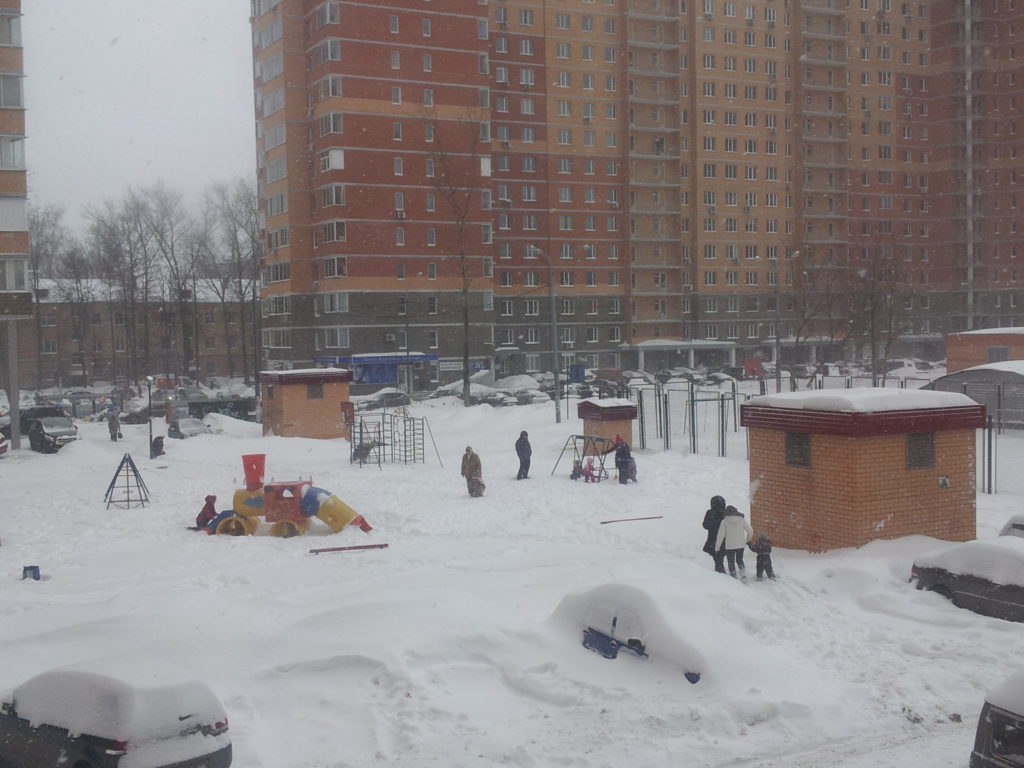
Out come the kids! In about a half hour from this image, from when it was taken, this playground will be full of kids, moms and babushkas. It is snowing like crazy and it is -12 C as I write this post. I said the other day that no matter what the conditions are, the little ones are taken outside and they play for hours. It does not matter what is going on in the world…

100_8481

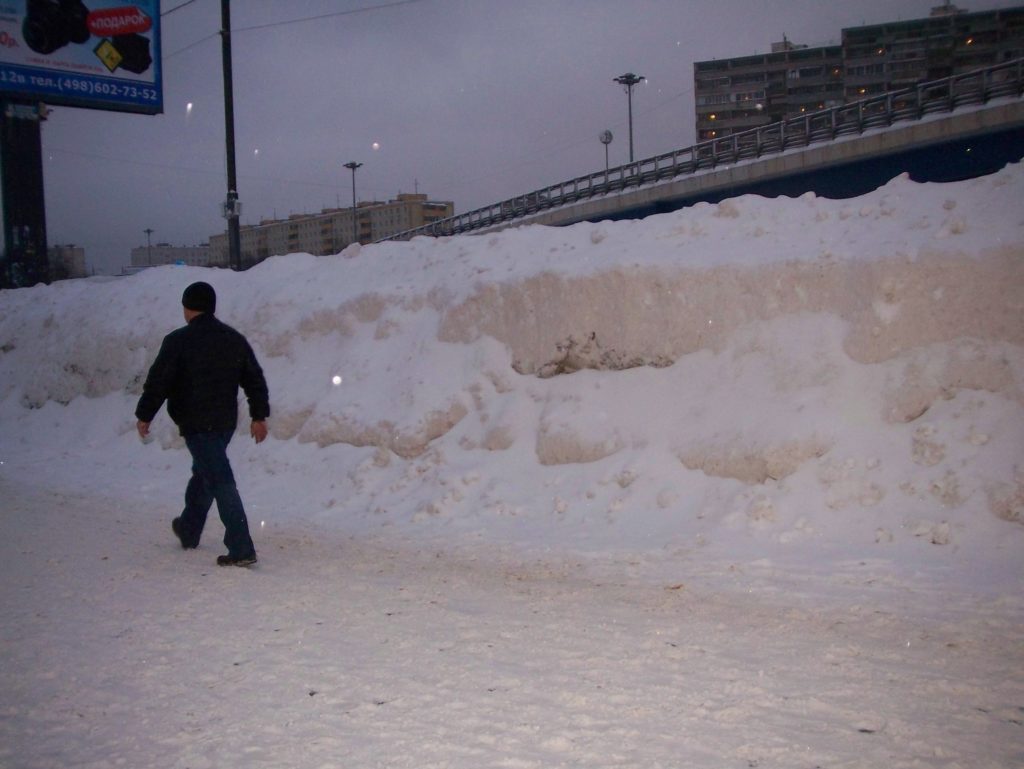
The first photo does not make you understand what it is like here. I am shooting the picture from our balcony and I am much higher looking down on the world. The second picture is what you see as you walk around. You walk below the snow level and we are definitely running out of room to put the snow…

Moscow as I have said before, melts the snow from the roads,  but most people in Moscow walk and this is what they see. They see a city that is strangling from too much snow. I have watched it snow for two days straight and it looks like a few more days are on its way…

To put it in perspective. The car that you see in the first photo all most buried, in the middle bottom. That car is siting on about a meter packed ice and again the car is disappearing from sight. By tomorrow you most likely will not see the car until spring! Oh wait – it is spring… 🙂

The train in the playground amazes me! It is not attached to the ground and it seems to float on the snow. It always looks like it will be buried and the next day, like a boat in the water it just seems to appear back from drowning in the snow. But notice the swing sets! They use to be taller than I am by a lot, but now I tower over the top bar. They have huge holes under them as the kids swing and cut a path out in the snow. Like I said, “Russians play outdoors in all weather!”

Oh by the way! The snow from the very first snow in our winter is still here. That is the interesting thing in Moscow. The stuff never melts for months and months…

I just love Russia…

Post by Kyle Keeton
Windows to Russia…

Metro / Subway Being Built in Moscow…

Construction workers with jackhammers broke through the wall of a new tunnel 84 meters below the surface in order to connect two lines under construction: Kalininsko-Solntsevskaya and Arbatsko-Pokrovskaya…

This is a cool video and shows what happens below the city deep in the ground. The Moscow Metro is most likely one of the deepest metros in the world and work being done on it is never ending. For you can never stop working on one of the busiest metro’s in the world..

Post by Kyle Keeton
Windows to Russia…

BRICS = New Bank…

I touched on this several times and now it is becoming clearer than mud now. The BRICS will develop their own spot in the world and “damn to be” to the western world and her jealous tendencies. The BRICS will be setting up a banking system of their own…

I see the things that made life good in the past developing in the attitudes of the BRICS and that is a good thing for a better world. The world has become lopsided and unsteady as it is being pushed and pulled by a few strings and those strings are going to break sooner than later…

BRICS is made up of Brazil, Russia, India, China and South Africa and the strong rumor has it that BRIICS could be soon to happen, with the addition of Iran and or it could become BRIIICS with the addition of Indonesia. Now I think that they need to come up with a better name as it seems to be growing at a exponential rate. Besides this name was given by the western worlds – Goldman Sachs. So it could be expounded on and made better…

So many things are happening around the world, as countries aggregate towards other countries, in an attempt to become more self-reliant against the impending downfall of the Western Empire as it does a death spiral into the black hole of debt…

I feel that the new BRICS banks are set up based on gold? Or similar backings… (Oil, Gas, etc, etc and etc!)

Post by Kyle Keeton
Windows to Russia…

Rosneft – TNK-BP – Putin – Russia – Evil – Chicken Little…

Russia’s Rosneft Surpasses ExxonMobil To Become World’s Biggest Oil Co…

I am sure that I am not the only one in Russia who is reading the western press right now and I am sure that I am not the only one laughing at the folly that is dancing on the pages of western media. Here is what I read as it is coming from the west amidst the cries of anguish and misery…

Heaven help us and how in the Hell did that happen? OMG the sky is falling and we never knew it was happening, or at the very least we tried to ignore it happening and that always works: You Know! Right?

How silent we stayed, as we hoped it would never happen and how much we wished that God would strike Russia dead and bury her in a pile of rubble! As she thwarted our efforts to stop the deal of a lifetime that would put Rosneft on top of the world of energy…

But now that the silence we enveloped the whole world in about this deal, to cover our underhanded dealings to cause it to fail. That silence is no longer necessary, as we lost. We will now moan and groan and bemoan and wrench our hearts in hate, dislike, spitefulness and now we will tell the world about how bad Russia is and how bad things will get in Russia and why, oh why, Russia is doomed to fail as a country, just because they are who they are! They are Russia and that is evil…

My God! Did you not know that Putin is the “god” in charge of Rosneft? My God in Heaven! Did you not know that now the world will be held under an umbrella of evil that extends from Moscow and eats at the very fabric of western goodness and perfectness that has been won only by hard and honest work, by democracies just trying to make a better world…

Do you understand that Russia is a failed country and is only held up by the fact it has oil and gas in such plentiful amounts, that countries like America and Britain are forced to deal with the hated Russia for pathetic resources that mean nothing in the long term of life. We just want you to understand that without the west, Russia would collapse into a pile of dung and rot in the sun at any given second…

oh_crap_the_sky_is_fallingDo you understand that it was nothing that we did to cause this shift in oil power on the planet? The fact that we pushed TNK-BP into a corner, through lawsuits, fines and games of blame over the Gulf Oil Spill in 2010. Have nothing to do with this whole happening’s! For someone had to take the blame for our shortcomings and political issues of incompetence. TNK-BP had the extra money and we are taking it as is our right to do, whenever we feel like it…

Why should that issue create a condition, that allows Rosneft – TNK-BP – Putin – Russia – Evil – Chicken Little, to all get together at the same time and cause the poor west to have issues of decadence…

Besides: Vladimir Putin Is The New Shah Of Oil and how much more terrible could it be then that in the world? Right?

Now that is what I am hearing by the western media and it is a true sign of decay in the consortium we call the west…

Post by Kyle Keeton
Windows to Russia…