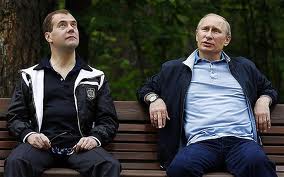
In a detailed interview to state and private channels, outgoing President Dmitry Medvedev has summed up the results of his work and outlined prospects for the so-called ruling tandem.on 26 April 2012 (RIA Novosti / Vladimir Rodionov)
MARIANNA MAKSIMOVSKAYA (REN-TV): Good afternoon,
Mr President, thank you for the opportunity to conduct this live interview, which will be the last one of your presidential term. We hope everyone will find it interesting.
DMITRY MEDVEDEV: Good afternoon, and thank you. I would like to welcome all of you and all our viewers.
Let’s get started.
REN-TV: Mr President, you have been using absolutely liberal vocabulary during your entire term as president. You said that ‘freedom is better than no freedom’ and your Go Russia! article amounted to a liberal manifesto.
I want to ask you about your work. Have you accomplished what you wanted? Do you think Russia has become a more liberal country during your presidency?
DM: Freedom is such a unique feeling that each person understands it in his own way. Of course, freedom also has some objective aspects but generally speaking it is based on our feelings. I have once said in a speech that we are only free if we can say about ourselves: I am free.
Let’s look at what has happened in the past few years. I think we have made real progress in expanding civil liberties. Yes, someone may believe this movement is too timid, while others believe it has become inordinate, they say ‘we shouldn’t go so far, everything was all right before’. But, in my opinion, we have made substantial progress. I will not make comparisons to the early years [of modern Russian history], but will just refer to some events of the past few months.
Let’s ask the people who participated in the recent political rallies if they are free of not. No matter who they support, the right, the left or the centre, I am absolutely confident that the vast majority of them will say, ‘Yes, I am free because I am here, I have my views, I do not like many things, or, maybe the other way around, I like almost everything, and you can’t take that away from me. But I am free’. Freedom is the way people perceive themselves, and in this sense, we have accomplished a great deal.
ALEXEY PIVOVAROV (NTV): If I may, Mr President, I would like to steer this philosophical question towards the economy. The economic slogan of your presidency has been Modernisation and Competitiveness, as we all remember. Are you happy with the way these slogans have materialised? I can even narrow down the issue: during your presidency has Russia become more or less dependent on hydrocarbons?
“We have made real progress in expanding civil liberties. Someone may believe this movement is too timid, while others believe it has become inordinate. In my opinion, we have made substantial progress.”
DM: Yes, this is a very important issue for us because one of the major risks usually mentioned in connection with Russia is our dependence on hydrocarbons. If we look at different assessments, two major risks are usually identified: demography and an excessive dependence on the export of raw materials.
To be honest, I am not entirely satisfied with what we have achieved over the years. I did not have any illusions that within four years we would give up the export of oil and gas, and it would not have been a good thing. Just because we are a country with the biggest reserves of raw materials and we supply a huge number of countries with hydrocarbons. However, we needed to diversify our economy. On the whole, we have been making progress at a reasonable rate.
I can tell you that over the past four years, the production of industrial and capital goods, and production in the main industries have grown by about 50%. The production of radio-electronics has grown by 30%. That’s a good result. However, if we talk about our export balance, hydrocarbons still make up 70% of our exports and only 5% is the sales of equipment. Therefore, the diversification efforts should continue. In fact, that is the focus of our economic modernisation programme.
Let me remind you that the programme contains five elements: the space, IT, the nuclear industry, and many other very important areas, including the production of pharmaceuticals. If we can move forward in modernising these five key sectors and a few others, we will be able to achieve economic diversification.
If we talk about macroeconomics, we can see that the current situation contributes to it because we have the smallest inflation in the entire 20-year history of our country. Last year it was 6%, and over the past 12 months it was 4%. We have a very good correlation between debt and gross domestic product, almost the lowest among all developed countries: about 10%.
Under such macroeconomic conditions, we can diversify our economy. I have absolutely no doubt about it. This is a challenge for the coming years, and a task for the new Government.
ANTON VERNITSKY (CHANNEL ONE): I would like to ask about the reforms.
DM: Go ahead.
“If we talk about our export balance, hydrocarbons still make up 70% of our exports and only 5% is the sales of equipment. Therefore, the diversification efforts should continue. In fact, that is the focus of our economic modernisation programme.”
CHANNEL ONE: The former militia became the police during your presidency. The form is new but the content has remained the same, even though the personnel has undergone unscheduled attestations. The whole country has heard of the sadists from the Dalny police station. Similar reports about the beating of detainees are made almost every day. Yesterday a similar report came from Volgograd. Perhaps the time has come to reform the police as well?
DM: You know, I think no one should expect that we will have a brand new police force or a new Interior Ministry agency six months after administrative changes are introduced because the police has a new name but the people working there are still the same.
Yes, some police officers – a considerable part, in fact – did not pass the attestation. 200,000 people were dismissed from the Interior Ministry agencies. However, that does not mean that everyone else instantly became different. This is the first point.
Second, we must not judge the overall level of the legal system, of law and order by the actions of individual scoundrels. Their actions have been given a principled assessment. In all such cases, criminal cases are opened and the law enforcement officers are taken into custody. This is the way it also happens in other countries.
We are currently at the very outset of the process. It’s not an easy task. We’re not a tiny country, like the one people sometimes hold up as a model and say: “Let’s just get rid of everyone and hire new police officers.” Would you join the police force?
ANNA SCHNEIDER (ROSSIYA): Do you mean Georgia?
DM: I don’t mean anything. That’s what you said.
I’m saying that we’re not a small country where you could do something like that. We’re a big country. We have nearly two million police officers, together with the civilian staff. That is a huge army. It takes a large number of people working for a single federal agency to ensure law and order across the entire territory of the federal state. These people cannot be changed by issuing orders. They need to be educated. And I think it is a very positive trend that all such cases are becoming public and transparent.
After all, let’s be honest, such problems have existed before but nobody knew about them. Why not? First, society had a more detached attitude to them, and second, the communication means we have today did not exist. Now, everybody knows about every case of misconduct, not to mention a crime. That’s good. Potential offenders will be afraid, and those who have committed offences will go to prison.
ROSSIYA: Could we continue with the theme of going to prison? I would like to ask about the personal liability of officials. Take Interior Minister Rashid Nurgaliev. What is his personal responsibility for the Interior Ministry reform and the incidents at specific police stations? What is your response to the demands to dismiss Minister Nurgaliev?
Rashid Nurgaliev is just as an example because there is a feeling that when we have a major emergency, a terrorist attack or an industrial accident, it is always the low- to medium- ranking officials who get the blame but never the top officials.
DM: I cannot completely agree with this because in many cases when crimes were committed the people who bore the responsibility were at the level of Deputy Minister, and in some cases even higher.
As for the Interior Minister, he takes full responsibility for the situation within the Ministry, and he understands this. He is also responsible for the implementation of the reform, just as I am responsible as the President and Commander-in-Chief.
Furthermore, the ministers’ fate is clear: on May 7, all the ministers will submit their resignations. That’s all there is to it.
“Corruption must be fought on a mental level. Committing a corruption offence should not only be terrible but it should evoke other emotions as well: it must be seen as improper. Only in this case will we rout corruption.”
ROSSIYA: But a resignation is not the same as a criminal investigation. Is resignation the most severe punishment possible?
NTV: And don’t forget this is a planned resignation.
ROSSIYA: Yes, especially a planned resignation.
DM: True, it is a planned event. Let me tell you this. If we dismiss a minister for every single incident, we will never be able to put together a strong team because we all understand the conditions in the country, the problems of our political system, the economic situation. Therefore, if we dismiss a minister for every case of misconduct, the system will collapse. I’d like to finish this point: yes, it is a planned event. But if you ask me whether a resignation is the worst punishment possible, I can tell you this: for many officials resignation is much worse than liability. So I think that dismissing an official should always remain an instrument of the state’s response to certain issues.
Let me remind you that during my term in office 50% of the regional governors were replaced. Try to think of some other period in our history when the rotation of officials was so quick. Some left because their term in office expired, others left on their own free will because they saw that things were not working out for them. In some cases, even when people submitted their resignations they did not do it voluntarily but because I told them: ‘Sorry, guys, things aren’t working out, so see you’. I’m not even talking about certain cases when investigations were launched against the heads of regions. Let’s not forget about that.
MIKHAIL ZYGAR (DOZHD): Mr President, to continue with what you said about the resignation being the most terrible punishment for some officials, there is a feeling that the fight against corruption is mostly just talk.
We have heard a lot of allegations and sometimes even accusations against high-ranking state officials. Your former Chief of Staff Sergei Naryshkin said that corruption in Moscow under Yuri Luzhkov was outrageous. And so what? There have been no consequences for Mr Luzhkov. This is not the only case but again, Luzhkov is a vivid example. We all know many examples of governors and other senior state officials against whom there is a strong prejudice and mistrust in society. However, there has been absolutely no response from the authorities.
This isn’t only true of corruption offences but also concerns cases of unethical behaviour. But a person’s reputation has no affect on his political future. Volgograd Governor Sergei Bozhenov became famous throughout the whole country with his trip to Italy, yet we have no doubt that his reputation will not affect his brilliant political career in the future.
Why is there no response to society’s demands? Why has the fight against corruption had no real results?
DM: Mikhail, I realise that it is the media’s duty to state one’s position categorically, and that is absolutely right. But your statement was not completely accurate.
I have just told you that I dismissed 50% of governors. Some of them left precisely because, for example, there was not enough evidence that they had committed a crime. The presumption of innocence has not been abolished; it is still in force. On the other hand, in some cases, I have had to make this decision for a variety of reasons (when I had reports from the Investigative Committee, and there were other materials too): to summon the colleague in question and say, ‘Look, you should resign or it will be worse’. This is the first point.
Second. Criminal cases have been opened against a number of former governors. It is a mistake to believe that there are no criminal cases. This is not true – cases have been opened. I will not interfere with the prerogatives of the investigating authorities. If you want, look up the facts, they are all there, in the press.
Third. If we talk about the number of corruption-related offences, their number, both registered and those being investigated, has been increasing every year. Currently the Investigative Committee has 17,000 corruption cases involving state officials. That does not mean that there should be free online access to all this information. Although I did receive such a proposal at an Open Government meeting. They said, Let’s do it like this: as soon as a criminal case is opened, information on the official involved should be posted online. But this is a controversial issue.
CHANNEL ONE: It makes some sense.
“Judicial reform doesn’t mean the dismissal of all judges. It means creating conditions in which the conduct of judges is determined only by the letter and spirit of the law – and nothing else.”
DM: It makes sense that people should have the information but once again: there is such a thing as the presumption of innocence. If the case is dismissed in the end, this will cause problems.
The Investigative Committee has established the existence of 53 organised crime groups that committed corruption offences. So it would be a massive exaggeration to think that nothing is being done.
But if we look at the results, I will agree with you there: the results are still modest. Why is that? Frankly, because officials are a corporation, they don’t want others to interfere in their business. This does not mean that they are criminals. On the contrary, officials are citizens just like us. But we must create such conditions for the state apparatus that it will not be able to turn right or left, and its behaviour will be regulated by relevant rules: the law on state service and regulations for officials. In addition, they must learn a particular culture. After all, when we talk about corruption, note that the level of corruption is very different in the so-called advanced economies – I say so-called because Russia is also a developed economy, although we have more problems. Compare the level of corruption, for example, in Scandinavia and southern Europe. Why is it so different even though the standard of living is fairly close? Because they have different habits, different history and a different mentality.
Therefore, corruption is also a set of stereotypes, and corruption must be fought on a mental level. Committing a corruption offence should not only be terrible but it should evoke other emotions as well: it must be seen as improper. Only in this case will we rout corruption.
DOZHD: I think it would be logical if the people to tackle corruption at a mental level were not ordinary members of the public but, perhaps, the top state officials. You say that the fight against corruption has yielded results but they are just not very noticeable, and you even explain that this is because officials are a corporation. In other words, they do not hand over their own; instead, even if they don’t sabotage anti-corruption measures, they certainly obstruct them.
DM: I’m sorry, Mikhail, but this is not limited to state officials. That is why we have divided corruption cases into two groups: major corruption offences, which involve high-ranking officials and which irritate the people the most…
DOZHD: It’s on a massive scale.
DM: It is on a large scale. But everyday corruption is on an even larger scale. Let’s not forget about it. When it comes to corruption offenses committed by teachers, when it comes to corruption in the medical environment, that poses an equal danger to society. But we are used to it and people don’t feel remorse about giving money to teachers and doctors when that money is extorted. At the same time, corruption among officials bothers everyone. I’m just saying that the corporation doesn’t just protect officials; the corporate environment exists in other places too.
DOZHD: It’s just that we all know about everyday corruption.
DM: But we don’t fight it.
DOZHD: You know, everyone does it in their own way. Some people fight and start by changing themselves. It would be good if everyone started with themselves.
DM: Mikhail, do you bribe traffic policemen?
DOZHD: No, I have never done it in my life.
DM: So you’re fighting. That’s what everybody should do.
DOZHD: On the subject of fighting: there are people, and we all know them, who are more interested in the fight against corruption than state officials, because it is difficult to fight oneself. Perhaps you should have from the start backed the people who publish incriminating materials online (we all know their names)? Perhaps you should have appointed Alexei Navalny, for example, the head of some anti-corruption committee, and maybe then the fight against corruption, not from within but on the outside, would have been more successful.
“We must increase the share of new modern military equipment to 50-70 per cent by 2020, to acquire new missiles, new armoured vehicles, new communications and everything that is necessary for ensuring defence and security.”
NTV: Or, for example, you could have launched investigations on the basis of his publications, since his name is widely known.
DOZHD: Yes, at least you could have responded somehow to the materials that are published.
DM: I just want to ask for one thing: let’s all agree that no one has a patent for the fight against corruption. We are all interested in it and we are all civil society activists in this sense, at least those of us sitting around this table. Most of you probably have a page on the social networking sites, or at least you follow someone, which is basically a positive thing.
We talked about the situation at the Interior Ministry and said that a huge number of cases are now becoming public knowledge. Why is this? One of the reasons is the new information space.
The same goes for corruption. It has become much easier to talk about it because it has become easy to find information on any such case. This does not mean, however, that everything written in the social networks is the truth, because you know how easy it is for feelings to escalate. It is a separate technology and, incidentally, it is quite manageable. But it is possible and necessary to rely on civil society activists.
Only I would not recommend that anyone is made into an icon, because some of these activists are real fighters against corruption, driven by entirely altruistic motives, but others have a political agenda, sometimes it is even a political gamble for them, when the anti-corruption rhetoric simply conceals a desire to boost one’s political weight. Incidentally, I do not condemn it because that’s what political competition is all about. But this is not philanthropy. This is political competition and should be treated as such.
My general attitude is simple: the more corruption offenses are revealed online, the better it is for the cause of fighting corruption, because whatever you say, the authorities at different levels should respond to it even if they don’t like it, including facts about procurement and facts about corrupt behaviour. Therefore, on the whole, it is a good thing.
But the state must lead in the fight against corruption, which is the way it is all over the world. And we, as citizens, must help the state in its efforts.
REN-TV: Mr President, may I narrow the broad topic of corruption to a specific area, because it is true that it is a fact of life for the whole country, and we all know it.
DM: Marianna, is it a fact of life for you?
REN-TV: It is true for the whole country, and I am a citizen of this country, so how else could it be?
NTV: Only Mikhail does not give bribes.
DM: Yes, he is a saint.
REN-TV: Probably.
DOZHD: Not at all.
REN-TV: He’s not a saint.
You have repeatedly criticised the judicial system and have even voiced some criticism about the Khodorkovsky case, although that didn’t lead to any changes. Mikhail Khodorkovsky has not been pardoned, his case has not been reviewed and he has not been released.
You have raised judges’ salaries, you have introduced more lenient punishment for economic crimes, but I am sure that no one will say that our judicial system is independent. A wide variety of agencies use judges to address their own various issues. Ordinary people do not believe that they can find justice in court. Such a judicial system slows everything down: the economy and politics. Why did you not launch a radical reform of the judicial system? Is four years too short a term or were there some other circumstances that made it impossible to undertake such a radical reform of the judiciary and to make our courts independent?
DM: I will try to answer your question. Four years is certainly not a very long time. Indeed, there is only so much you can accomplish in four years, but changes have been made in the judicial system, and they will continue in the future. In my view, we have improved the overall discipline in the judicial system, we have created the so-called disciplinary court tribunal, and currently disciplinary boards are being established to monitor judges’ behaviour.
But, friends and colleagues, you should realise that when people talk about judicial reform, this cannot be understood too literally. What does it mean to reform the courts? Does it mean kicking out all the judges? But courts have a continuous flow of cases and justice must be served every day. You cannot get rid of the judges, especially since many of them have impeccable work records. And where do you want recruit new judges?
Therefore, judicial reform doesn’t mean the dismissal of all judges. It means creating conditions in which the conduct of judges is determined only by the letter and spirit of the law – and nothing else. So that if a judge gets a phone call, he doesn’t say ‘Yes, all right, we’ll take care of it’. Instead he reports it to his superiors that such and such an official telephoned and asked for a certain decision on a particular case. That is how it is done all over the world. If someone approaches a judge, the judge immediately reports that he has received a request from a state official (which is almost impossible there) or one of the lawyers on the case (such attempts are sometimes made). After that the lawyer is disbarred and I don’t need to tell you what happens to the official.
This must become the judges’ responsibility, but it should be done in such a way that judges can follow these rules without being afraid to report that they had received a phone call from the regional or federal authorities, or from somewhere else, or that businesspeople have approached him and offered money – that happens as well. Therefore, there must be the right conditions.
As for the future of the judicial reform, I am absolutely sure that it will move forward. It is not enough to have the right legislation to create a modern court system. We have made significant changes in recent years. Our courts have reached a world level now, if you will. We must create a model of behaviour, and we must make sure that all judges follow it.
REN-TV: But for now, it’s likethe famous quotation (as with the police, incidentally), “I don’t have any other writers.”
“We are in the process of changing the way our armed forces recruit servicemen. Our objective is to recruit 85% of servicemen by contract, and conscript soldiers will account for 15 percent.”
DM: Yes, it’s true. “I don’t have any other writers,” it is true for all of us. Because to prepare a qualified judge, five years of university education is not enough – you also need five to seven years of practice. Do you understand what a judge is? A judge is not even a lawyer or a prosecutor; he’s the person who decides the fate of another person: he’s the one who makes the final decision. So his training, his qualification is extremely important.
Now with regard to how people perceive the judicial system. I do not think that if we went to another nation and ask people whether trust their judicial system, everyone would say, “We trust it one hundred per cent.” There would be different opinions as well. But here isan interesting fact. Our population, our people, do not like to go to court. Only 5% of decisions in civil matters and 15% of sentences in criminal matters are appealed. Perhaps some people do not appeal because they do not believe in the judicial perspective, but the truth is, it’s not all that complicated. It means that a significant proportion of people receiving thoserulings feel they are either just or, at the very least, acceptable.
REPLY: Or they understand that they cannot do anything more, and do not believe in the system.
DM: As I said, some of them do not believe in the justice of this system.
DOZHD: After all, we have statistics: the acquittal rate in Russian courts is lower than one per cent.
ROSSIYA: A minimal percentage; there is a strong accusatory bias.
DM: I think here I will wholly agree with you on the following: you see, it is also a reflection of a mind-set. Over the course of decades (I simply know this as a law school graduate, a law school faculty member, and a practicing lawyer), judges had just one patternin mind: any acquittal was seen as a sign of low-qualitywork.
NTV: But he will be responsible, the judge.
DM: Not the judge – the investigators are now the ones responsible. The judge is above it all.Nevertheless, the judge must still separate his or her own perceptions from those of the investigation and the defence. The judge should be above the process.
I can tell you this bit of professional but interesting information. When I was still a student, there was a theory that we should not have adversary proceedings – as they do everywhere in the world – where the prosecutor competes with the lawyer, when the defence counsel competes with the prosecuting counsel. Why? Because they all personify socialist justice.
You see, this is something that really sits very deeply. I hope that with every year, we will have more and more acquittals, because that is absolutely correct. We should not shy away from them. They are not a sign of bad work by investigators; they are a sign of something else: that the judge was not shy to end things and state that there was not enough proof to declare the defendant guilty. Either the judge or the jury. We have that problem.
NTV: I would like to continue. Marianna mentioned Khodorkovsky’s name. Just recently, the Presidential Council for [Civil Society and] Human Rights concluded that submitting an appeal for pardon is not mandatory to be pardoned. This week, you pardoned Sergei Mokhnatkin; he left prison yesterday. He sent you a request for pardon, although he did not admit his guilt, and we know he stated that he would fight to reverse his sentence.
Mikhail Khodorkovsky has said many times that he will not make a request for pardon. It is clear that there probably cannot be a pardon without a request. But I want to anglethis question slightly differently. Don’t you feel that Khodorkovsky and Lebedev’s lengthy prison sentences represent a kind of problem for our nation – perhaps they really could be pardoned even without a request?
DM: Alexei, you yourself began by saying that it cannot be done, and are now asking if, maybe, it can?
DOZHD: The Council for [Civil Society and] Human Rights said it is possible.
NTV: As President, could you…
REN-TV: The Constitution…
DM: That’s right, Marianna.
REN-TV: The Constitution is more important here.
DM: Yes. We have article 50 of the Constitution, which states that each sentenced prisoner has the right to request a pardon. That is in the Constitution. In other words, it is mandatory to send a request. Moreover, that same article states that the sentenced prisoner has the right to seek a review of his sentence, but that does not mean that the court itself should initiate the process without a corresponding request from the prisoner. It should always be initiated by the prisoner, anywhere in the world. And with all my respect for certain colleagues who signed the corresponding papers, these papers are not based on either the Constitution or the spirit of the law. We can talk about pardon, but it should be connected to the will of the individual in question, the sentenced prisoner.
“The minority voice deserves our full attention but let us not forget about the construction supported by the majority. Democracy all around the world is about the majority’s decision, which becomes the general and binding decision for the entire country.”
I’m going into to wilds of jurisprudence now, because I find it interesting. Let’s just imagine: the President pardons someone who did not request a pardon, while at the same time the sentenced prisoner is seeking full rehabilitation, i.e., recognition that he or she is not guilty, then what happens? The President has granted a pardon, but the blemishessentially remains on that person’s record. And in this case, it turns out that in doing so, the President has infringed upon the desire of that individual for a blanket pardon – unless, of course, he or she was the one who requested it. In other words, the President wedged himself into the process of a person trying to prove his or her complete innocence. So in my view, this position is legally and factually groundless.
But returning to Khodorkovsky and certain other people who are incarcerated, I can say one thing. You see, we should generally ask ourselves why we have so many people in jail. Do we really need – under current conditions, in the 21st century, – that many people convicted and put behind bars? When I was beginning my work as President, we had about one million people in prisons – one million people. In the time that I have been working, this number has decreased by 20 per cent, and today, we have about 800 thousand.
You know, when I receive documents requesting a pardon (incidentally, I pardoned not just one person you mentioned, there were more people pardoned), I am sometimes simply surprised: a person steals a mobile phone and gets a two-year prison sentence, or fishes seven carps out of a pond – a real case, by the way – and is sentenced to eighteen months. What is the point? An individual who essentially committed something between an administrative offence and a crime is imprisoned for one or two years, and comes out a hardened offender with a criminal jargon and a criminal mind.
NTV: Who certainly does not believe in the justice system.
DM: Yes, this is a problem in the justice system. And then, we spend more money on these individuals’ social rehabilitation: we find them jobs and tell them that they can try to lead a different life. So this is truly a national problem and concerns not only Khodorkovsky, Lebedev or other specific individuals; it affects an enormous number of people who serve out prison sentences.
But in this specific case, to make sure I don’t fail to answer your actual question… The answer to the question about Khodorkovsky and others is in the answer to the previous question: the case cannot be reviewed without a request. That is my firm position.
REN-TV: Mr President, here is a very important legal issue. In current practice, the President pardons only those who admit their guilt (and incidentally, this is true for early release on parole as well).
Just now, you yourself set a precedent with Sergei Mokhnatkin: he did not acknowledge his guilt, just as Mikhail Khodorkovsky does not acknowledge his. So according to existing practice, it looks like Khodorkovsky cannot be pardoned, because he doesn’t recognise his guilt. But now, you have pardoned Mokhnatkin, so the precedent has been set.
DM: I will explain this position in greater detail, since everyone is so interested in it. I hope it is also of interest to today’s audience.
The issue of requesting pardon is based on article 50 of the Constitution, and the President cannot work outside the Constitution. I think this is clear to absolutely everyone.
If we are to discuss the admission or non-admission of guilt, then this is based on a Presidential Executive Order. And in this sense, I have always said that the President has the right to deviate from his own Executive Order when he feels it is right to do so. In this particular case, there were rather serious arguments that could be treated as an indirect admission of guilt, but that is not the point.
This lies in the hands of the President. The question of admitting or not admitting the guilt falls under the President’s authority and has to do with the Executive Order currently in force. That’s my answer.
CHANNEL ONE: In that case, I have a question on another topic: the military reform.
DM: Go ahead.
CHANNEL ONE: I recently saw the Ministry of Defence’s latest reports, which were that thick. They say that military hazing has changed radically and is declining. We know that service members’ compensation is growing. We do segments on the Vremya programme about how the issue of housing for service members is being resolved.
As President, you have always championed high military expenditures (including in your speech two days ago): we plan to spend around 20 trillion rubles on army, right?
DM: Even more than that, but through 2020.
CHANNEL ONE: Still, these are enormous expenditures.
As the future prime minister, will you take as firm a stance with the future Finance Minister, arguing that military expenditures should take precedent over spending on science, education and medicine?
DM: I will be even firmer. I will just choke the money out of him. (Laughter.)
“Every year, I changed rules concerning the political system. Let me remind you, that included the political parties’ access to mass media, lowering the threshold for State Duma elections, and changing procedure for granting authority to governors.”
You know, Anton, I never said that the army has priority over education, or conversely, that education takes precedence over the army. That just isn’t even a serious conversation. I simply said one thing: that we have to reform our Armed Forces so that they are powerful and efficient, so that the people serving there are highly motivated, so that these people love their nation and understand whythey are serving in the army. That is why we have earmarked such a large amount of money.
In addition, we understand that until recently, our weapons have remained almost unchanged since the Soviet period. And as Commander-in-Chief, I have confirmed this repeatedly. Incidentally, the conflict unleashed by Georgia demonstrated this. We had to change our armaments quickly.
And now our challenge is as follows: we must increase the share of new modern military equipment to 50-70 per cent by 2020, to acquire new missiles, new armoured vehicles, new communications and everything that is necessary for ensuring defence and security.
But these expenditures should not be thoughtless; they should be aligned with our industry, which should, first of all, provide us with high-quality products, and second, handle that money. If we feel, for whatever reasons, that there is a problem, it means we will get back to this issue.
As for education, it is no less a priority than defence spending. You mentioned the figure of 20 trillion. Let me remind you, it is 20-something trillion through 2020. Meanwhile, the yearly-consolidated budget for education is two trillion rubles. Every year.
In other words, this is a significant amount of money. And by the way, it has also allowed us to change some important issues within our educational system in recent years. But defence and security will always be among the government’s priorities, and my priorities, if I continue to work in corresponding positions.
ROSSIYA: Mr President, I would like to ask you about the army and about education from a more personal angle. As far as I know, your son Ilya will turn seventeen this summer…
DM: That is correct.
ROSSIYA: And so, the army and education are both issues that should interest you not only as president, but also as a parent. Do you think that all young men in Russia should serve in the army? As for your son, what university and profession did he choose, and what do you, as a parent, think about the National Final School Exam (EGE) and the education reform in general?
DM: Let me talk about military service first, as it is a serious matter. Under our Constitution, this is the duty and obligation of our citizens, but the question is, what form this duty and obligation should take?
We are in the process of changing the way our armed forces recruit servicemen, and I think these are the right changes. Our objective is to recruit 85% of servicemen by contract, and conscript soldiers will account for 15 percent.
ROSSIYA: What are the respective proportions now?
DM: It’s completely incomparable. Of course, at the moment, conscript soldiers still make up the majority, although the number of contract servicemen is growing.
Our armed forces must be comprised of professional servicemen. This is a completely normal demand of modern life. At the same time, we will retain conscript service as a partial option so as to have reservists and give opportunities to people who want to devote their lives to serving their country in the armed forces, let them go on to become contract servicemen, and some of their number might then become officers or follow some other security-related career. This is all part of this constitutional duty.
But we also have universities that set the rule that their students should be able to complete their course of study without interruption. There are two completely different views on this issue. The students, their parents, and many others, think this is the right approach, but some of the military officials and other people do not entirely agree.
My position is straightforward. I think that we need well-qualified specialists. Interrupting one’s studies can have a very negative effect in some cases, though not in all. If you take a look at our higher education system today, to put it delicately, it is somewhat bloated. I think we have more than 1,150 universities today. I remind you that during the Soviet years there were 600 universities for the entire country of 300 million people. I am not making a call to go out right now and close anything down, but it is an issue that should set us thinking about the future of our country’s higher education system in general, and about how to make it a quality system.
Regarding the EGE, I have talked about it with my son. I cannot say that I was particularly convinced by his arguments. This is because he has not experienced any other system, whereas I have experienced all kinds of different exam systems. He said literally the following: “It’s a nightmare! It’s unbelievable, the amount of work.” But these are normal feelings.
For my part, we had one system before, and now this new system. My view of the EGE is that, overall, it is a modern and reasonable test, but it cannot be the sole and exclusive form of test. In other words, it would be wrong to have just this one national exam. It must be complemented with other kinds of tests, especially when we are talking about particular fields in which the EGE cannot adequately reflect a student’s abilities.
ROSSIYA: In the arts and humanities, for example…
DM: Yes, in these fields, because you need to see how the student thinks, speaks, and so on. The EGE is therefore the mainstream road. Incidentally, all of the teachers with whom I have spoken have confided to me out of sight of the cameras and in the corridors, that the EGE is a good system, especially in the provinces. They say, “Our students are getting into Moscow and St Petersburg universities now, whereas in the past this was almost impossible unless you had connections or some other means of getting accepted and passing the exams.” And so we need to develop the EGE, while at the same time complementing it with a number of other tests in some cases.
ROSSIYA: What university has Ilya chosen in the end?
DM: We are still discussing this matter with him. He has several ideas. I won’t hide that he is interested in the fields I worked in previously.
REN-TV: Law?
DM: Law, yes, and economics too. He is still making up his mind.
“I feel that any party leader should be a member of that party. If he is not, for whatever reason, a member, then at some point, he will begin to separate himself from the party. This is possible for people in certain positions, such as the President, but in principle, it isn’t right.”
NTV: Mr President, you have said a lot today about the work to be done, the tasks still to be completed, and about future plans. But on September 24 last year, you announced your decision to step down from office. This was followed by the parliamentary election in December, which many have said were unfair, and by the biggest protests in the last decade.
My question is, what do you think of the people who were on Bolotnaya Square and Sakharov Avenue? Do you think that before September, many of them were, if not your voters, then at least people who sympathised with your views and words? Is it possible that if you had known earlier how many people would come out to rally, your decision last September might have been different?
DM: Alexei, I did not say that I was stepping down from office. What I said was something else: I said that looking at the reality of the political situation it seemed to me that a different construction would be the best choice, and it was this construction that was subsequently chosen. Some may like it and others may not – that is a matter of choice and that is what democracy is all about – but whatever you think of it, this construction has withstood the test, as we achieved the political result we hoped for and received the support of the majority of voters.
Regarding the people who rallied at Bolotnaya, Sakharov Avenue, and other places, first of all, as President, I take a good view of all of our country’s citizens. They are people with their own particular views. As for the fact that they protested against the authorities, say, on whatever issue, I respect their right and I think this is perfectly normal.
I do not entirely agree with everything that the speakers at these meetings said, because I have a different political view, but the fact that they came out to express their views deserves respect. The vast majority of these people behaved as law abiding citizens. They came out and expressed their thoughts. This is their right. Others later held rallies of their own to express their disagreement with the first lot. This is all normal.
To answer your question, I think that the decisions we announced in September have been confirmed by the political events that have taken place since then, and this is the truth criterion. We did not think this whole thing up just for the sake of it, for making a splash, but in order to obtain a concrete political result, and we obtained it – the mandate to govern.
Yes, the minority voice deserves our full attention but let us not forget about the construction supported by the majority. Democracy all around the world is about the majority’s decision, which becomes the general and binding decision for the entire country.
NTV: Did the size of this minority at different locations impress you?
DM: Yes, it did.
REN-TV: What about their quality?
DM: I was impressed by both the quality and quantity. I was impressed also simply because these were the biggest meetings organised by people to voice their position in recent years, and this means that the authorities have a duty to listen and react to their views, and I think that this reaction has been forthcoming in many different areas, and we will continue this.
DOZHD: Mr President, at the very start, you said of the people at the rallies that each of them could say, “I am free.” But I had the impression that people came to these meetings precisely because they felt they were not free in their right to choose. They said their votes had been stolen and that the elections were unfair.
What’s more, we later saw that discontent and doubts over the elections is not just a disease afflicting Moscow alone. We have seen how people are willing to take desperate measures in other parts of Russia too. There was a hunger strike in Lermontov, which was successful, and in Astrakhan too, people took the desperate measure of going on a hunger strike.
Do you understand the feelings of these people who are willing to go to such extremes, people driven to such desperation? And one other question: over these last years, have you ever felt despair?
DM: Me, no. As president, I do not have the right to give in to emotions. It happens that I have a bad mood, a very bad mood, but never despair. Whenever I have a bad mood, I go work out or play sport for a while and my mood stabilises again. And then I make decisions, maybe the most difficult and unpleasant decisions.
On the question of elections, yes, people’s attitude towards elections has changed. People themselves have changed, the general level of political culture has increased, and we now have new information sources, new media. The authorities are obligated to react to this.
It is good that this has happened because it will mean change for everything, from the way we hold elections to the way we count the votes, so as to avoid any suspicion that the authorities have cheated anyone.
Let me say straight away that substantial fraud at the national level is impossible. There is simply the logic of big numbers here, and so the result obtained at this level is always the one that reflects the people’s will. But even small instances of fraud spark protest, even cases of a single vote stolen at some particular polling station – all of this gives cause for discontent. We did not see this kind of discontent in the past, in the 1990s. It was all building up inside and now it has come to the surface. We therefore must change the laws and make use of better technology.
I decided a while ago to have polling stations equipped with special digital vote-counting devices. I confess that before the elections, influenced by the talk of the economic crisis, I allowed the Finance Ministry to postpone this project until 2015, although I could have insisted that it go ahead as originally planned. It involved a big sum of money to be honest, tens of billions of rubles.
We decided to use this money for other needs instead, for social spending. Perhaps if we had actually carried out this project there would have been fewer issues over the elections, because no matter how you look at it, these digital vote-counting systems make fraud that much harder. Perhaps we should have sped up this work. But we will do it now, along with the cameras at polling stations and so on.
Regarding the people who are protesting, first of all, this is their right. The question is that there are sincere protests, and then there are calculated political gestures. I am not accusing anyone here. But let me recall the rather mediocre Hollywood blockbuster, The Hunger Games. I don’t know if you have seen it; I have. People doing this sort of thing are often acting in pursuit of a clear political objective. I think that the political objectives have been reached now and everyone is eating away hungrily and preparing for the State Duma session, and for getting their deputy’s mandate. This is all normal if it stays within the law. This is my position.
DOZHD: You say that large-scale fraud is not possible, but in Astrakhan, for example, it was precisely those digital vote-counting devices that caused such a reaction, because one candidate won at the polling stations where they were installed, and another won at the polling stations where it was easier to stuff the ballot boxes.
NTV: And there was a huge difference in the figures, too.
“Public television, unlike other channels which belong to a particular owner or owners, is actually the only resource that effectively belongs to no one, and for that reason is independent from government sources. We want to push this resource so that it can start to live off its own funds.”
DM: This all illustrates what I just said. I am not saying that there was no fraud, whether in Astrakhan or other places.
DOZHD: And it’s not a case of just one vote being stolen.
DM: Let me say again that elections – modern elections, big elections – cannot be ‘stolen’ because there are always exit polls that match up or not with the final result. It’s impossible to imagine that the exit polls give a candidate 50 percent of the vote, but in the final count he gets 20 percent, and another candidate gets 70 percent. This just isn’t possible. People would not buy this kind of manipulation.
But you are right. This situation illustrates what I just said: digital vote-counting systems will make fraud that much more difficult than is the case with ordinary ballot boxes. We therefore must equip all polling stations with these devices. It is a job for the authorities, for the president and parliament, to put in place this system over the next few years to minimise the possibility for fraud.
We know that doubts and allegations often can be part of political technology strategies. After all, following a reasonable logic, someone with doubts about an election’s fairness would first go to court, and if the court does not satisfy his demands, might start a hunger strike. This I can understand. But when people first go on hunger strike and only then go to court, it looks more like a political programme.
CHANNEL ONE: Mr President, then I have another question on the rallies topic brought up by Mikhail.
DM: It seems our discussion today is entirely focused on politics.
REN-TV: Well, you are the number one politician in our nation. What else would we discuss?
DM: The economy or the social sector, which probably interests people.
CHANNEL ONE: I think we will move on to those later.
REN-TV: Yes, we will.
CHANNEL ONE: Returning to direct gubernatorial elections, simplifying State Duma elections, simplifying party registration. You mentioned all these proposals in your Address to the Federal Assembly just a few days after the events on Bolotnaya Square.
When and how did you make these decisions? And are they related to the protests on Bolotnaya?
DM: I launched the process of reforming our political system back in my first Address, and did so every year. And each year, I heard more or less the same thing. Somebody would say to me, “It doesn’t go far enough” and “he’s taking his time and worrying, but he should just get straight to the point and change everything,” while someone else would say, “don’t touch it, everything is fine, don’t rock the boat.”
This was my position from the beginning. Every year, I changed rules concerning the political system. Let me remind you, that included the political parties’ access to mass media, lowering the threshold for State Duma elections, and changing procedure for granting authority to governors (not the new procedure we have now, when we moved to a party-based approach) and many other things. Incidentally, there are many of them. Each time, I would name about ten positions.
At a certain point (this was probably about a year ago), I decided that my final actions should be more powerful, because the system has matured. After all, two years ago, I sincerely stated that I was against a return to direct gubernatorial elections. Why? Because that is what I felt at the time. I felt that within the context of a large nation, a very complicated nation with many contradictions, there really are dangers. Indeed, they remain today.
But at a certain point, I understood that people want to elect their leaders. I think that it’s great, because this way, we will remove this responsibility from the top authorities. Let people get a feel for it themselves and learn to differentiate responsible leaders from the demagogues; people who are capable of pursuing their own policy from those who will trail behind the problems.
And now, this model will be implemented specifically because our society has matured. It has matured to a new level. Why am I speaking about this today, and why did I bring it up several days ago? I am certain that today’s accelerated movement toward democracy will not lead to chaos, because society has changed. It was different in the 1990s.
REN-TV: Mr President, with regard to the top authorities.
You are once again ‘castling’ with Putin…
DM: To use chess terms.
REN-TV: That is the way many people talk about how you are swapping positions.
Now, Vladimir Putin is giving you, as the future Prime Minister, his current post as the head of United Russia. Clearly, in this way, Putin is released from the burden of an unpopular party. But why do you need this?
And another thing. Like him, you will head the party, but are you going to shamefully avoid joining it, or will you join it and chair it, and change something internally?
NTV: Or will you become a member, but not its chairman?
DOZHD: Or will you become a member, but not feel shame?
DM: This line of questions could go on.
We are not swapping positions. Naturally, I understand that for the purposes of political science and journalism, this is a normal way of seeing it. But in order to exchange anything, you need to first receive it. Mr Putin won the post of President in the election and received significant support from the people. If the people had refused, then there could be no talk of castling, as you put it. The same is true of the Prime Minister position. I need to earn it and get the State Duma to vote for me. I won’t hide that United Russia is a party I am associated with, which I sympathise with, and which I hope, sympathises with me.
Now as for what will happen with the party flanks and the party centre… I absolutely do not understand it when people say that United Russia is an unpopular party. Listen, it received 50 per cent of the vote in the State Duma, as confirmed by various sociological surveys. It has a current support rating of 45-47 per cent, and some assessments give as much as 52-53 per cent. What party is more popular? All the others are clearly less popular.
Moreover, it is the biggest party. I am not saying that it is the most perfect party. It has plenty of shortcomings, as does any party. So I perceive United Russia’s prospects as those of a powerful centrist conservative force that needs to exist in a nation such as ours.
For example, the fact is, we still do not have a party of social democrats. And that’s bad, because in general, most nations develop two main parties. On the one hand, you have conservative centrist forces, and on the other hand, the social democrats. But perhaps this will change as part of the new political reform, in the process of developing the party system.
So for me, it is entirely evident that our nation had, has and will have a centrist party, a conservative party that answers to the aspirations of a large number of people. Other people may not love it, they may hate it, and they may reject it. That’s normal, that’s what democracy is about. There are pure right-wing parties, there are left-wing parties – that’s normal.
“After the transition to digital broadcasting, all levels of government will need to finalise the numbers of government-owned media. In my opinion there are a great deal of these, and we need to reorganise the public network.”
As for me personally, if I am offered the chance to head the party (and the current Prime Minister has expressed this idea), I will not turn it down.
And another thing. I feel that any party leader should be a member of that party. If he is not, for whatever reason, a member, then at some point, he will begin to separatehimself from the party. This is possible for people in certain positions, such as the President, but in principle, it isn’t right. So I feel that the head of the party should also be its member.
REN-TV: So you represent a kind of small political sensation. In essence, we can say that you will become a member of the United Russia party and the party Prime Minister.
DM: Given the preconditions I spoke about. For that, I would need to receive an offer and the party would need to support me.
NTV: But, frankly speaking, there is little doubt that you will not.
DM: Political life is a complicated thing.
DOZHD: We will keep our fingers crossed.
DM: Great. All hope lies on that. (Laughter.)
ROSSIYA: Bringing the topic of politics to a close, one of the most discussed aspects of political reform involves the so-called filters: the Presidential, and now the municipal filters as well. You just said you think society is already prepared to return to direct gubernatorial elections. But these filters – particularly, as far as you’re concerned, the Presidential filter – don’t you think they contradict the very idea of direct elections? And why, how do you explain it to yourself? Why don’t other mechanisms work, such as the Criminal and Administrative Codes, which could also allow us to filter out bad people?
DM: The political framework is very specific in nature. There is no such thing as an abstract democracy. It is my deep conviction that democracy must be connected to specific ethnic grounds and the political culture that has evolved. Here is ours, in its current state. It is, without a doubt, currently better than in the 1990s. But in my view, it is nevertheless less evolved than in certain other nations. I think that you would agree with me.
Now with regard to filters. There are no filters (if taken to mean barriers) in these draft laws, including the law on electing governors. But there are qualification conditions, or more specifically, one condition in particular. Which one? That the gubernatorial candidate must garner support from municipal deputies. We were not the ones who came up with that. Let me remind you that right now, our friends in France are holding their Presidential election. This is essentially the French pattern. And we are talking here about Presidential elections, when a candidate must prove that somebody holds him or her in high regard, that he or she is recognised by deputies and mayors, that he or she is not just a random person. Because – and you also know this – let’s recall who was elected in the 1990s and how; at times, it was quiete sad.
So I don’t think it would be bad in any way to confirm a politician’s standing by receiving 5 to 10 per cent (that was the municipalities’ idea). And frankly, I do not see most of the serious parties having any problem achieving that in various ways. Beyond that, I have no comment.
ROSSIYA: And what about the presidential filter?
DM: Regarding the presidential filter: no such filter exists in the law. It only states that the President may – not must – hold consultations in accordance with the relevant executive order. Whether a future President will use this or not, I do not know. It seems highly possible that they will not. This is the first thing.
And the second refers to the outcome of these qualifications and consultations held by the President. It is absolutely not a given that these consultations will directly lead to elimination of a candidate. On the contrary, as provided by the draft law, these are simply consultations.
DOZHD: Mr President, I would like to move a little bit away from politics – as maybe you would like to as well. You recently signed an executive order.
DM: No, I don’t want anything. If you want to, let’s talk about politics. I simply don’t know whether this is what our audience wants.
DOZHD: I think that our viewers will be interested in this because it will directly affect them.
Just recently you signed an executive order on creating a Public Television network.
REN-TV: Not very far away from politics.
DM: Yes, that’s right.
DOZHD: Does this mean that the existing public television channels cannot perform the functions invested in them, cannot properly inform our citizens, and that the money the government spends on their financing is wasted? If so, perhaps taxpayers do not need to spend their money financing public channels? And perhaps once a Public Television channel is created, other public channels could then be privatised?
DM: Mikhail, these are all good arguments coming from someone who works for a private channel. Now if my colleagues from public channels were asking similar questions, that would be more interesting.
DOZHD: As taxpayers they are also paying.
DM: They are; I agree with you.
With regard to Public Television, I have repeatedly said that I have never had a fixed opinion on this issue, and I think that’s normal. Anyone who says: “These have been my views ever since I graduated from university” is lying.
My opinion about Public Television has also changed. At one point I thought that our existing public channels were enough. In fact, there is only one state-owned holding company: VGTRK [National State Television and Radio Company]. There is Channel One, where the state holds a controlling stake, but from a legal point of view it remains a limited liability company, and that is a bit of a different story. And so only VGTRK receives government funding directly. So even as I thought we had enough, I became convinced that we should create a public television channel. And then for various reasons I began to think about the fact that the government is the same kind of owner as a private one, such as the owner of your channel (to Mikhail Zygar), your channel (to Anton Vernitsky), or your channel (to Alexey Pivovarov). Even though your owners are very big, they are still owners. So, the state is the largest owner of all, and every owner always has their own will.
I don’t think you’ll disagree with me that an owner always has their own will: this is true in Russia, in America, or in France. Sometimes it is very manifest – this is probably damaging for the media – and sometimes it is more subtle and displayed more correctly. And this is the case all over the world.
“For us the question of civil peace and religious toleration is absolutely critical. I did everything possible to preserve peace in this regard. These are issues relating to our national survival.”
So public television, unlike other channels which belong to a particular owner or owners, is actually the only resource that effectively belongs to no one, and for that reason is independent from government sources.
What do we want to do? We want to push this resource so that it can start to live off its own funds, and create an endowment fund that will generate income. And in that case the managers of the Public Television channel will not come to government offices or to the Kremlin and say: “Please give us more money.” Instead, they are going to live off their own money. This creates a very different degree of independence; excuse me, but I would go so far as to say even more than for a private channel.
DOZHD: But it’s still the President who appoints the channel’s director-general. This means that the channel’s source of legitimacy remains the government.
DM: Not so, because the President is always a consolidating figure. You can like this figure or hate it, but the fact remains that it’s the consolidating figure, the guarantor of the Constitution. In France, the head of public television is appointed by the President, in the UK this is done by the Prime Minister, if I remember correctly. No one is outraged by this and calls it an infringement of our rights. As a whole this seems to be a product of entirely different experiences and expectations. I think this is normal.
And in this case money comes from different sources, while with public or private channels this is impossible. It is also why I think it’s necessary to create a Public Television channel.
Now regarding the future of existing public channels: I believe that after the transition to digital broadcasting (and this will occur very soon), all levels of government will need to finalise the numbers of government-owned media. In my opinion there are a great deal of these, and we need to reorganise the public network. Some of these channels should be sold, while some should be integrated with existing government structures. Let me remind you that I even sent out certain signals to the regions. To be honest, I am not really happy with how these signals have been interpreted, because naturally every regional leader wants to have their own media source.
NTV: Sorry but I have to intervene, Mr President. It is clear that there are different forms of ownership: there are public television channels like VGTRK, there are those that appear private, but we are all aware that there are so-called federal television channels where, as a rule, it is obvious that the government is exercising control over editorial policy.
I would therefore like to draw our collective attention to the fact that our distinguished colleague, Mikhail Zygar, is here among us. Looking at it, Dozhd TV would seem to be a very small channel compared to federal ones and their huge financial resources. Yet it is absolutely logical that Mikhail is here too. Dozhd is really on trend: newsmakers are happy to appear there, you yourself were there, Mr President. Most often, people go there much more eagerly than they do to large public channels. Why? Ask anyone and the answer is simple: there is no censorship on Dozhd. Journalists there are limited only by their ideas about which news is interesting and which is not, whom to invite and whom to leave out.
I will only speak for myself because this is an issue that affects me and my colleagues at NTV. As a journalist on a public channel I am regularly confronted with restrictions that prevent me from fully carrying out my professional duties, and competing with Dozhd. These limitations are related to what is called political expediency: “There is no time for that now, my friend.”
And in addition to artificially limiting competition, it seems to me that this really impinges on my ability as a journalist to carry out my professional duties, and inform viewers about current events. I would like to know how you feel about this situation, Mr President.
DM: Somewhat differently than you because I am not a journalist. But of course I will comment on what you’re talking about. I was on Dozhd; it is a modern, nice, yet relatively small channel. I do not believe that its management has no political opinions – they do. I would repeat that a different question concerns the form in which they are presented. Every media always has a political position, and it’s usually pretty easy to determine. It is possible that if we run it properly our Public Television channel might be able to be absolutely neutral, even though a fully neutral medium does not exist. Even Dozhd takes a political position. That is the first thing.
The second. Why do newsmakers, as you said, go willingly to our esteemed colleagues at Dozhd, for example, and are less likely to appear on your channel? Not because there is censorship somewhere – there are places where there is no censorship, though political influence is of course natural in the major channels. It is for other reasons: mainly because some call them and others don’t. And as soon as you call them, people come with pleasure for still another reason: because while the reach of federal channels is still bigger than that f Dozhd – despite the fact that it is very good – I would say that the channel is targeted at a future premium audience. Namely young people who watch Dozhd using cable networks, satellite TV, and the Internet. Nevertheless, federal channels are still much bigger. And in my opinion, if you simply call any politician it is much easier. Give them space.
NTV: We invite you.
ROSSIYA: Come and see us, Mr President.
DM: I am here. (Laughter.)
And now the last thing. Of course you know that the question of political expediency is a very subtle thing. Censorship, let me remind you, is prohibited by our Constitution, and if it appears anywhere it is a cause for government intervention.
As to questions of expediency, this really concerns the management responsibility of a given mainstream media and, if you want, is a matter of the internal chemistry between the managers, the journalistic team and, naturally, the television consumers. All these elements must be in harmony. How is this achieved? This is a question not for me, but for the heads of the respective media sources.
NTV: We’ll have to ask them.
DM: You did; I think they heard.
REN-TV: And not only them.
To continue with the topic of television censorship, or let’s use the term political expediency, you yourself recently commented on how the Internet and TV have very different news agendas, and it’s like having two parallel realities. For example, as a rule those who do not use the Internet barely know anything about the violent disputes concerning, for example, the arrest of the members of Pussy Riot and the Church’s reaction to this, are hardly aware of the scandals surrounding the Church and the property of its hierarchs, and so on; the list is a long one. Do you yourself use the Internet or TV when you want to hear the news?
DM: I can say frankly that I mostly use the Internet, not because I don’t like TV, but simply because the Internet is often more convenient for me. If I’m already sitting in front of the computer, with just one click I can get to the site of any of the channels listed here, or just look at a news feed. But you asked the right question about their respective agendas, and this worries me too. What are my feelings about this?
It is true that the two media have different agendas. But I would try to approach this from another angle and ask: is this a bad thing? The issue at stake is who is interested in what. Here there are a few points you mentioned. Some topics interest all our citizens, while others are only interesting to a fairly limited number of people. I have repeatedly drawn attention to the fact that the headlines, the most discussed topics in the blogosphere, and so-called Twitter hashtags include things that are irrelevant to the concerns of 95 percent of citizens. But they create a huge wave of interest, and through them an event simply takes on a universal scale. Assuming that this is a common reality, is there really an urgent need to run to the managers of a TV channel and say: we absolutely have to put this on air, the blogosphere is talking about it. I’m not so sure that this is the right thing to do.
But on the other hand, you’re right, Marianna, that there should be interaction between the media. Sometimes things happen, and in my opinion they cannot just be limited to one world, the online world or the televised world. Because even events that interest a relatively small number of people are significant nonetheless, and should therefore get TV airtime. So I would say that there can be different realities, but that there needn’t be different agendas.
ROSSIYA: Marianna recalled the band Pussy Riot. Since we are all active Internet users, this topic is of great concern to us. Are you following the trial, and what do you think about the case as head of state, as a lawyer, and, finally, as a church-going person?
And in my opinion, a very important point is the following: the girls called their performance in the Cathedral of Christ the Saviour a reaction to the Russian Orthodox Church’s involvement in the presidential campaign. On what do you think today’s relationship between the secular and religious authorities should be founded, in light of the fact that in our country there are regions where it is not Orthodoxy that predominates, but Islam, for example, and where the topic takes on a completely different connotation?
DM: This is a very sensitive issue that we should all treat very, very carefully. Our country is extremely complicated in this regard: it is a multifaith nation, a place where crimes are motivated by religious intolerance, and where people are sometimes killed for their religious beliefs. I would like everyone, absolutely everyone, to think about this regardless of their religious affiliation. It is horrible and yet it still happens. And we absolutely need to protect the fragile peace that we were able to maintain in recent years. Because otherwise the consequences for our country could be quite simply disastrous.
But we all know that no country in the world is a federation constructed according to national principles. And yet we have a federation in this sense, and for this reason we are a unique country. And so for us the question of civil peace and religious toleration is absolutely critical.
“We are all interested in peace in Afghanistan, in eliminating the terrorist threat emanating from there, and making sure there is less terrorism there. We have always supported the relevant peacekeeping operation. And we will continue to do so.”
I did everything possible to preserve peace in this regard. I am confident that the authorities will continue to do so. These are issues relating to our national survival.
With regards to the specific question and topic at hand, I would say the following: as President I will not comment on the legal aspect of the case, because consequences would ensue. And I always try to avoid legal comments until a conviction or acquittal has been made.
If I were to comment from my position as a church-going person, as you said, then I would say very carefully, so as not to offend anyone, that in my view those who participated in what was done got exactly what they expected.
NTV: Imprisonment?
DM: Popularity.
DOZHD: Mr President, you said yourself, and gave examples concerning stolen carp.
NTV: It is unlikely that they hoped to end up in jail.
DOZHD: About initiating an individual who does not pose a threat to society to criminal culture, and the fact that this is a systemic error: do you really think that these girls represent such a threat to society that they should sit in jail for a few months?
DM: I repeat that I did not make the decision, the judge did. If I start to comment on the judge’s verdict (even on its resonance), then quite frankly this amounts to interference in justice. At the end of the day I am the President. You know, this transmits a signal such as keep them in, do not let them out, or release them immediately. So I would say again, as head of state, that I will not comment on the specific situation until the sentence comes into force. And here you probably won’t find me guilty of something. For instance, I commented on the verdict in one case, when I visited the Journalism Faculty [at Moscow State University]. One woman had been convicted.
RESPONSE: Taisiya Osipova.
DM: That’s right. But at that point a sentence had already been given. I said that I thought it was too harsh. If you noticed, the law enforcement system and prosecutor responded to this. Why do I bring this up? To show that the President should be very sparing when he makes comments of this kind. But this does not negate what I said, namely that prison has no re-educational capacity, in the sense that a different person emerges from it; that is true.
CHANNEL ONE: Then I will change the topic, if you’ll let me. To put it mildly, social networks on the Internet contributed to the so-called Arab spring in the Arab world, the revolution that swept across it. How do you think the Arab spring will end, what will Russia’s position in the region be, and what political season is beginning in our country?
DM: The Arab spring will end with a cold Arab fall. Spring has come to Russia, and I would like to congratulate everyone on this: it is spring in both the literal and figurative senses.
RESPONSE: They are predicting a cold wave after tomorrow.
DM: This will only be temporary, as it has often been in our history.
ROSSIYA: Incidentally, if we talk about the Middle East, about the Arab spring, we have often said that foreign policy must be pragmatic. Have Russia’s business interests changed or not in connection with events in the Middle East? For example, have we become more focused on China as a result? What were the effects for Russia of the events in the Middle East?
NTV: Have we lost money as a result of the Arab spring?
DM: Of course we want to be friends with everyone, and we want to trade with everyone. This is absolutely normal: it is in our foreign policy interests and rightly so.
Regarding the situation in the Arab world, despite some short statements that I made, of course the situation there remains very unstable. Radicals are coming to power in many countries and working with them will be much harder – that’s a fact. I have talked about this with everyone, with our American and European partners, and said that the goal of any change, even the best kind, is not to transfer power to extremists. But such a threat exists. Let’s hope that people in all these countries will make the right choices.
We have interests there, we want to be friends with these countries and trade with them, both conventional products, so to speak, and weapons, what our country is famous for. And we will continue to do this as much as possible. No reorientation has occurred in this respect. But of course we must take geopolitical realities into account, and in some cases we have simply stopped delivering supplies.
DOZHD: If we talk about foreign policy interests, we all remember that at the beginning of your term in office, there was the ‘reset’ policy and an agreement on strategic offensive arms was signed. But at the end of your term there have been no major recent breakthroughs with the United States, including in the economic and political spheres. And there is a feeling that this is because it is uncomfortable to simultaneously improve relations with the United States, while blaming the Washington ‘regional committee’ for provoking and financing protests in the streets of Moscow.
DM: Taking into account the fact that our relations have never been perfect, neither in the Soviet nor the post-Soviet periods, together with the Americans we have accomplished quite a lot lately. I’ve already talked about this, but I’m ready to repeat it here in the studio. I think that the last four years were the best in the history of Russian-American relations, simply the best. That is the first thing.
Second. This does not mean that we have no topics of discussion left. You all know this just as well as I do. There is missile defence, an issue on which we have parted ways with our American colleagues. We try to convince them that they should not disturb strategic parity. They answer: “Yes, yes, yes, we will take your interests into account,” and continue to promote their own position.
By the way, not all Europeans, their partners in NATO, agree with them. The issue is not closed and must be resolved. I hope that we can move forward in the next few years, as there are still five to seven years for making final decisions. If all else fails we will deploy rockets. There is no other choice; life is life.
Now regarding the Washington ‘regional committee,’ which is a valid name for it. Soon there will be elections for the committee’s first secretary. I have certain sympathies for one of the candidates, but this is a private matter. I hope that he will continue his glorious task of leading it.
DOZHD: So is its hand still meddling in the streets of Moscow?
DM: The workings of the hand of the Washington committee are visible in different places.
You know, if we talk about the situation in our country, we do not need to demonise Americans and it is even more meaningless to talk about how Americans are orchestrating some major political processes that occur here.
We are a large sovereign country and no one can dominate us – this is clear to everyone. But the notion that they are trying to influence political processes is true, just as it is true that we are also trying to influence certain political processes.
The question at hand is rather the moral evaluation of these things and the tact with which they are conducted. It is true that we are not indifferent to what happens in America. It is also true that we have less means at our disposal than the Americans do. This is still the case. And they probably do care about what happens here. But the important thing is to behave tactfully.
Along with this I have never supported the idea that people join whatever might exist, and set up a regional committee, a municipal one, or something else. This is not serious, because you can organise two, three, five people, twenty-five or five hundred, but you cannot involve larger numbers of people. And this is true whether it concerns people protesting against the government or those voting in support of the existing power.
“My intention, and it completely coincides with the view of President-elect Vladimir Putin, is to substantially renew the current Government.”
ROSSIYA: What about those people who, for example, took to the streets in Ulyanovsk? This is also an international issue. What is going on there? What will it become?
DM: You mean regarding the [NATO] logistics centre?
ROSSIYA: The transit hub, as it was called, or is it a full-fledged military base?
DM: Of course it is a transit hub as you said. It’s simply a chance to help fulfil the mission of the peacekeeping force stationed in Afghanistan. We are all interested in peace in Afghanistan, in eliminating the terrorist threat emanating from there, and making sure there is less terrorism there. So that is our public position.
It’s true that we occasionally argue with NATO, but as concerns Afghanistan we have always supported the relevant peacekeeping operation. And we will continue to do so. No member of the military or civilian from NATO will be in Ulyanovsk, it’s simply a technical operation. Talking about it is a normal thing, part of the political process.
Naturally, some political forces decided to exploit this issue. We have people in our country who are extremely hostile to America, and this sentiment can periodically be fanned. The relevant political forces took advantage of it and there is nothing new in this. In America too, there are people who do not like Russia and some politicians there regularly whip up anti-Russian hysteria.
REN-TV: Mr President, until recently Russia’s relations with almost all of its closest neighbours seemed to be ruined beyond repair. Just think of the cold war with Ukraine, the real war with Georgia, the war of words with Belarus, and the information war with the Baltic states.
Do you think that during your term as President relations with our neighbours have changed for the better?
DM: You’re right, they have changed, and they were different to begin with. In Ukraine, it all started from a point where the relationship was really very hard, and the relationship with President Yushchenko was very, very difficult. Now relations have changed, and despite certain outstanding controversies and arguments with our Ukrainian partners, we still have partnership, companionable relations.
I hope that when making decisions both the Ukrainian establishment and President Yanukovych will, first of all, overcome certain stereotypes that weight upon them, and simply be more pragmatic, more responsive to the interests of the Ukrainian people.
Regarding Georgia, the story is much more tragic. There was an armed conflict, an attack on small parts of the former state of Georgia, and how it ended is well-known. They were smacked on the head, and we were forced to recognize Abkhazia and South Ossetia as independent subjects of international law.
We – me personally, my friends, my associates, and my colleagues, as well as Russians in general – have no hard feelings towards Georgia. On the contrary, Georgia is a country that is close to us, and the Georgian people are near and dear to us. And incidentally, we have come to their rescue more than once, no matter what certain Georgian politicians might say.
So for that reason Saakashvili is simply a blank space, a zero. Sooner or later he will leave political history, and we will be ready to build a relationship with any other political leader who comes to power there, to restore diplomatic relations, and to go as far as they are ready.
Regarding Belarus: there too things went from love to hate and so on. Nevertheless, we still have a special relationship and the Union State. We will not hide the fact that we are often at odds with President Lukashenko; he is difficult and emotional. But you know, I can say one thing: he has taken important decisions. He looked at different options and made important decisions.
He was one of the initiators behind the signing of the Agreement on the Customs Union, and is now one of the active forces behind the implementation of the idea of the Eurasian Economic Union. I think these are worthy positions and it is natural that we will develop all possible relations with Belarus.
With the Baltic states, the story is more complicated. I will not hide the fact that I have often thought about visiting them. And as soon as I give corresponding instructions to an aide and say “Let’s see …” something nasty always occurs. This behaviour is unacceptable. Of course we are a big country and they are small ones, but this does not mean you have to be so rude or support the Nazis.
Therefore everything is in the hands of the leaders of those countries. If they adopt more responsible positions, then we will not hear on every street corner that “The Russians are coming! Tanks are rolling in, let’s hurry and install defence missiles,” and everything will be fine. We are historically linked and we are highly integrated economically. I am confident that contacts at high and highest levels between Russia and the Baltic countries will resume. You simply do not have to see Russia as a terrible bear who is always ready to tear these countries apart.
NTV: If you don’t mind, let’s return to the Russian domestic affairs. I should probably begin with the cliché “if you’re appointed Prime Minister,” but we all realise that you will be appointed Prime Minister. Could you please clarify the role of the entity called the Open or Big Government? Let’s say you have become Prime Minister and you have a real Government now.
REMARK: A closed one.
DM: A completely buttoned up one.
NTV: Made up of ministers.
REMARK: A closed joint stock company.
DM: Closed joint stock companies don’t exist anymore, or rather they won’t exist once the changes to the Civil Code are adopted.
NTV: So, you are the Prime Minister and you have a Government. What will this Open or Big Government be: will it be another body like the Civic Chamber, which is full of highly respected people, quite decent folk, and it’s very interesting to listen to what they say but it is not entirely clear what their powers are, their initiatives disappear in the sand, it is unclear who supports them, and their range of responsibilities is not formalised anywhere. This is my sincere personal feeling, and I may be wrong. Why do we need another such body?
DM: Alexei, I think you understand the point of the Open Government, which at first we called the Big Government for some reason and scared everyone: it’s not enough that the regular government is full of freeloaders, now we need another Big one, which is just a nightmare.
“We have a reasonable figure for unemployment when compared with other European countries but we can make it even smaller, less than 5%.”
So, this Open Government is basically an expert platform. The Open Government will not and cannot make decisions instead of the Government, which is empowered with authority, otherwise it would be simply ridiculous.
At the same time I must agree with you that it will be an ordinary platform for discussions of certain pressing issues.
My intention now, if I am appointed Prime Minister, is as follows. I want to pass virtually all key socioeconomic decisions through this expert forum. This is the first point.
And if the experts point out to me that there are all kinds of problems associated with the implementation of these decisions, I simply will not adopt them. That’s the point. By the way, the Civic Chamber is not a bad venue either but we need to approach it critically.
NTV: Like I said, it’s full of very interesting people and it’s always fascinating to hear what they say.
DM: Yes, but it’s more than that: they really have an impact on different processes.
NTV: They don’t have enough powers.
DM: Public bodies cannot have any powers other than to say “Dear government (or not so dear), this is our position, and if you adopt this decision, you will be creating problems.” That is their primary responsibility. They cannot move the pen in my hand, and they cannot say: “We are blocking it.” That would be impossible.
The second point related to the Open Government is, in my opinion, just as important. By the way, this topic is very important in the whole world, and there is even a convention about it now. The Open Government is a career lift for a large number of intelligent people who can be plucked from the expert environment, and most importantly, from within the environment of active successful managers: business managers and mid-level managers in regional bodies. I will do it, have no doubt.
And finally, the third and equally important point. Any kind of Open Government will always be an information environment. We have been talking for an hour and 35 minutes about the fact that society has changed, and the information technology is such that as soon as something happens, it becomes known to everyone. Therefore, it is an environment for communicating with the authorities.
People used to make fun of the governors, saying that they were just copying the President with their blogs, Twitter and all that. But there’s a big advantage to this because I have seen for myself that when people start bombarding a governor with messages on a particular issue, he cannot avoid it anymore.
In some other situation he may have said, “All right, stop by my office next week and we’ll have a look.” Let’s say, he gets a message: “There’s an urgent problem, a sewer pipe has burst.” That’s it, he has to respond. This is very important. So that’s what the Open Government is all about. Therefore, I believe that it will be a useful resource. I hope that it will work to the full extent.
CHANNEL ONE: If you get the mandate, as you said, who will get a seat on your Government? Do you know already? I am ready to write down who will be on it, who is certain to stay and who is certain to leave.
DM: Anton, start writing. Deputy prime ministers: seven items. (Laughter.)
REMARK: Everybody is writing this down.
DM: Let’s keep the mystery for a while longer.
I can say only one thing for sure. My intention, and it completely coincides with the view of President-elect Vladimir Putin, is to substantially renew the current Government.
The two of us have discussed it many times. We get together and draw little squares on a piece of paper, it’s true, and we discuss which configuration would work and who would be better at which job. In my opinion, everything is clear. We need a powerful impetus created by new people.
At the same time I cannot come into the Government (if I am appointed) and say, “Right, let’s just sit around for a month, leave us alone for a while until we come up with a perfect configuration, and then we’ll make the decision.” Practical work must begin immediately. It cannot be interrupted even for a single day. That’s obvious.
Therefore, there must be people who will ensure continuity – I stress that. Perhaps not for the entire period, just one or two years – I don’t know. And that balance between those who provide the continuity and an influx of new people will amount to a new Government.
CHANNEL ONE: Will there be many new people?
DM: Yes, many.
DOZHD: Mr President, as a future Prime Minister you will receive a very difficult legacy: everybody is saying that a very serious economic crisis could begin next year in Russia, and maybe not only in Russia.
For example, former Finance Minister Alexei Kudrin said that this could be a crisis of such magnitude that it may lead to a change of regime unless the Government implements some very painful and very unpopular reforms. As a future Prime Minister, are you ready for such painful and unpopular reforms that may theoretically amount to your political suicide? Are you ready to sacrifice yourself?
DM: First of all, any politician should be ready to sacrifice his political career for his country’s interests. I’m absolutely serious. This is the first point.
Second. I cannot agree with you about the difficult legacy. It is an absolutely normal legacy. If it were 2009 now, you would be right because the situation at the time was extremely acute. The Government did a great job, they managed to cope with it, their measures were successful and our country recovered from the crisis with the least, and I emphasise this, the least problems. That is a fact.
But the 4% inflation over the past 12 months – is that a difficult legacy? Let me remind you that inflation was 12% or 13% four years ago. And that was with the same Finance Minister, by the way. Is 10% debt to GDP ratio a difficult legacy? In my opinion, everything is absolutely normal. But that does not mean that the situation cannot be destabilised.
The world economic recession continues and we must be fully prepared. As for predictions, it’s always easier to make them from the outside, though, if you mention the former Finance Minister, he is not Vanga or Nostradamus to make such predictions. He should focus on his future career, that would be a more productive pursuit.
ROSSIYA: Are you clear on the macroeconomic challenges facing the Government? What tasks will you assign to your Government?
DM: The tasks remain the same: to keep the macroeconomic indicators as they are at present and improve them as far as possible. But when it comes to GDP growth, it has stabilised at 4%. Not bad when compared with the United States or the EU, but it’s not enough for us: we should have 6 or 7% ideally, like China or India.
Inflation: I have already mentioned the 4% accumulated inflation. That’s just great! This is what we need. If we manage to keep in the 4-5% range, we will be able to address many issues, including mortgages. Because 4% added to the Central Bank’s mortgage loan refinancing rate doesn’t end up at 12 or 11%, but a more manageable 7 or 8%. This is quite acceptable. And so on.
Therefore, the challenge is to develop the country while maintaining the macroeconomic conditions that we have and improve them where possible.
DOZHD: You won’t raise the retirement age?
DM: I think we have a collection of horror stories…
DOZHD: Yes, there is, and it is a symbol of painful reforms.
DM: Yes, a symbol of painful reforms which in fact has absolutely nothing to do with the pension reform.
Pension reform, ladies and gentlemen, though it won’t concern you personally for many years since you are all young people, has nothing to do with the pension age. Yes, it is one of the issues that require discussion. But you can carry out a pension reform and create a fundamentally different pension system without changing the retirement age.
We can discuss retirement age but this topic should not overshadow the other, more acute matter. What is our pension system: is it an old-age benefit that is paid by the state or is it compensation for a loss of earnings? These are two different models. A benefit is just that, a benefit: if the state has given it to you, you should say thank you whether it is 100 rubles, 200 rubles, 10,000, 20,000, whatever. But if it is a system of compensation for lost earnings, that is a completely different model.
I emphasise that both models exist in different countries, but they tend to operate in a mixed form. Even in the United States, where the pension system is completely private, there is now a leaning in the opposite direction. It is also happening in other countries.
Therefore, we need to choose an optimal model for the development of our pension system. There will be no shocks here. As in all matters, I would like the public to hear me first –we will consult with the people of the Russian Federation, with our people.
REN-TV: Your presidency is coming to an end but everyone is interested in the fate of the tandem. Since you are changing places with Vladimir Putin again, I would like to ask: will the tandem become a constant in Russian politics? Who will influence whom in decision making, and how effective do you think the tandem is as a form of governance?
DM: All these buzzwords used to irritate me but I got used to them. I want to say that Vladimir Putin and I are bound by 20 years of friendship, and not only political cooperation. This is the first point.
Second. I believe that in general it is a good idea when the country’s fate and its political processes don’t depend on just one person (who does whatever he feels like), that any decisions are made following a discussion and that there are several people in the country who influence the political process. I think this is normal and it is progress towards democracy.
“It is necessary to implement the political reform that has already been adopted. If we implement it, we will make a huge leap in political development: we get a new quality of Russian democracy.”
If there are two people like that or three, five, seven, ten – it is a certain safety net for the state, if you will. We didn’t invent it and we didn’t write the Constitution, which states that there must be people who, under certain circumstances, are required to stand in for each other (as it is the case in Europe and the United States). These people must work in cooperation, they must trust each other and be political partners. So there is nothing out of the ordinary about it.
As for our prospects, we have already voiced them, so I think that everybody’s should relax: it’s here to stay.
NTV: If I may, I would like to ask all a non-political question.
DM: Go ahead.
NTV: This issue concerns absolutely every citizen of the Russian Federation. During the presidential campaign, we have heard many demands to revoke your decision to cancel the summer (winter) transition to daylight saving time.
DM: You don’t even know which transition.
NTV: Everybody is confused, or at least I’m confused. I’m talking about the clocks moving one hour forward and backward in spring and autumn. Are you ready for this decision to be reconsidered? Do you think it deserves to be reconsidered? Are you ready to return to this issue and to other decisions?
DM: Alexei, what does the fact that you are asking this question tell us? What is harder for you, when the clocks stay the same or when you have to change them twice a year? You said, “to cancel the summer (winter) time transition.” Now we don’t need to make any transition. What is more comfortable for you?
NTV: It’s not about me, Mr President.
DM: Tell me anyway.
REN-TV: The iPhone, which you like so much, changes the time automatically.
NTV: I am more used to the way it was before because all the gadgets change the time automatically and you have to change them back.
DM: I see. This makes sense. I know because I also use electronic devices. But it’s not just the question of electronic devices and convenience. When this decision was made (it wasn’t just pulled out of thin air), we consulted with scientists, with different sections of the population and different regions.
The majority supported the abolition of the daylight saving time as it has been done in many countries, by the way. Naturally, some people said, “No, we are genetically linked to Europe, and if they change the time so should we.” Who is opposed to this decision now? Those who travel a lot. That’s absolutely understandable because during the period of the daylight saving time there is a bigger time difference, so you need to plan for it when you’re travelling to Europe, for example, and other countries. Also football fans don’t like it.
REN-TV: Fans watching football into the night…
DM: I do not belong to the first category because I don’t travel that often. But I do fall into the second category: it is true, sometimes it’s inconvenient when you want to watch a match but it starts at midnight our time. But there are many people who like the new system. These are the people who live in rural areas. These are the people who live in our ordinary medium-sized cities, small towns. It’s convenient for them. They go about their lives and have no problems with it.
In short, it is a matter of choice and expediency. If the majority of people support changing the system back, then we will do it. It is not a matter of my personal ambition because I see both the pros and cons of this decision.
DOZHD: Are we going to hold a referendum?
ROSSIYA: I was just going to say, perhaps we should hold a referendum?
REN-TV: Which is a problem, incidentally, because we haven’t had a referendum on any issue for a long time.
DM: I agree that we should hold referendums from time to time, and we should also seek new forms of referendums because the huge process with the preparation of ballots should eventually be replaced by electronic polls.
Here’s what I think we could do on the issue of daylight saving time: we could hold electronic polls in several regions. Perhaps not everywhere but to make a representative sample, at least this kind of electronic poll will reveal the general attitude to the issue. If it shows that people still want to change clocks backward and forward, then we can do it.
CHANNEL ONE: Gadget lovers will vote.
DM: No doubt.
REN-TV: Only cows will vote against it because it doesn’t disrupt their milking schedule.
DM: No, not only cows.
REN-TV: But they will not take part in an electronic voting.
DM: Not just cows. There will be people who are against it.
We have looked at this issue and I have discussed it with Vladimir Putin, by the way, who said: “My information is that the preferences are split fifty-fifty.” So, it is a matter of choice.
ROSSIYA: What about some other decisions, such as zero blood alcohol or the technical inspection, which was cancelled but now people are saying it may return.
NTV: They say zero blood alcohol will also be abolished.
DM: I can tell you my view on this issue. In the end, it is a question of authorities’ consistency and responsibility.
If we talk about zero blood alcohol, I think this is the right decision, and my attitude to this is not the same as to the previous topic we discussed: that it’s something we should all agree on. To put it plainly, the drivers in our country are not yet mature enough to be allowed to drink before they drive.
Motorists will be offended but I think that we mustn’t do it yet. And if we skip all the nonsense such as that the meter will show something anyway, that it reacts to kefir in the system – that’s all nonsense and I think this decision was completely justified in our environment.
Likewise, I feel very strongly about another issue: I believe that we cannot allow free circulation of arms in our country. Let the Americans practice their elocution skills, fighting for or against gun control. But we can’t do it in our country for a variety of reasons.
REN-TV: That is, we shouldn’t even hold a referendum on these issues?
DM: That is my position.
REN-TV: And if we do hold referendums in the future, who will tally up the results? Churov? He is a magician, of course…
DM: With regard to big referendums, as long as Vladimir Churov is Central Election Commission Chairman, he must take part in them. If we talk about regional referendums, it will be a corresponding regional election commission. There is no need to demonise the members of electoral commissions. They are just counters.
As for the problems of the electoral system, then, to get back to the beginning on this topic, if these problems arise, it is in the places where people vote, not where the votes are counted, although one of the classics of Marxism-Leninism believed otherwise. Do you remember? It’s not the people who vote that count; it’s the people who count the votes.
NTV: Comrade Stalin.
DM: That’s right, you remember. In this case, this doesn’t apply to us. Technology has changed.
ROSSIYA: Mr President, we are probably getting close the end of our conversation…
DM: It has been an hour and 50 minutes.
ROSSIYA: Perhaps we could return to our first philosophical question in these remaining minutes.Freedom is better than no freedom: you talked about this four years ago, and you talked about it two days ago, at the final meeting of the State Council.
When you answered Marianna’s first question, you spoke about the past four years, and I want to ask you a question with an eye to the future. What do you think that you personally and your Government should do to give every person in Russia more freedom in the near future? Just philosophically speaking.
DM: If we started with this issue, let’s also end with it. It is my sincere conviction that freedom is better than no freedom. I believe that all of you present here share this conviction. It is absolutely true no matter how much some may accuse us that it’s just philosophy and empty words.
We are all used to living in a free country, even if we do not fully realise it or if we are very critical about the events taking place around us. To live in a free country is happiness. I say this with all responsibility, as a man who lived in very different conditions for more than 20 years.
Second. What should we do? We must fulfil all our promises or try to fulfil them. In the social sphere, unfortunately, we have a lot of poverty. Yes, we have increased average wage, many categories of people have greatly increased their incomes, but, unfortunately, the poverty rate remains significant and we must reduce it as much as we can. This is a vitally important task.
It is the same with unemployment. We have a reasonable figure for unemployment when compared with other European countries but we can make it even smaller, less than 5%. This concerns a vast number of people.
In the economy we must finally fulfil our promises, which we haven’t been able to do so far: to significantly improve the investment climate and create a system of property rights protection. We are moving in this direction. I am not a supporter of dramatic statements but the current state of affairs is considerably better than it was. I worked in business for 10 years, so I know the situation. There’s no need to idealise the 1990s: everything was extremely difficult then. But our progress has been slow, and I am not happy about it, as I have repeatedly said. We must continue working on it.
In the political sphere, everything is clear: it is necessary to implement the political reform that has already been adopted. If we implement it, we will make a huge leap in political development: we get a new quality of Russian democracy.
And, perhaps, my last point. I am ready to work on it and I will work on it if that is my destiny. But I cannot succeed alone; it should be a joint effort of our entire nation, and only then will we achieve success.
ROSSIYA: Thank you.
DM: You’re welcome.
REN-TV: Mr President, thank you very much for answering our questions. I am sure that we were all happy to catch you at your word that you will have no objections to coming here for a live interview to all of us together or to each separately. So please come and join us on the air. Thank you.
DM: Thank you.
I think that in this sense we all need to change our behaviour model a little. Of course, top leaders are top leaders but they must appear on the air, both on the major networks and the smaller TV channels. It’s just refreshing and shows our life as it is, and most importantly, it stops us from losing touch from reality.
REN-TV: Thank you and the best of luck to you.
DM: Thank you.
Post by Kyle Keeton
Windows to Russia…