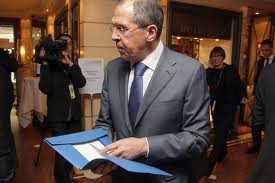
“Europe needs a peace pact”: Sergey Lavrov delivered a foreign policy thesis at the Munich Security Conference…

Violation of international law by NATO threatens the world order, says Russian Foreign Minister Sergey Lavrov. The Minister also proposed to conclude a “peace pact for Europe”, suggesting that this may serve as a starting basis, as he pointed out that the issue of European missile defense threatens to divide the branches of European civilization…

On Saturday in Germany, opened the 48th Munich Security Conference. Russia was represented by her country’s Foreign Minister Sergey Lavrov.

One of the main focus of the Minister made on the task of creating a Euro-Atlantic space of equal and indivisible security. According to him, Europe needs a peace pact, and they can become a European Security Treaty . “Europe needs a peace pact, an end to the era of the Cold War, as a broad co-operation can only be built on a platform of trust, – the Minister said. – As we all remember the famous Russian-American wisdom, “trust but verify” Such a pact should be legally binding. “

According to him, “the term would be to work towards building a common security space extensive, consisting of connected in” ring “of the regional segments, whose members were linked to the complex legal and political obligations.” “One of these segments would be the area of ​​the girth of our proposed Treaty on European Security (OSCE participating States), within which it would be very helpful to political cooperation between NATO and the CSTO, in favor of what we stand for many years, but never can achieve a clear answer, “- said the Minister.

Speaking about Russia’s role in global processes, Lavrov pointed out that on the world map there is another area that has such massive potential for economic development. “I mean, first of all, the translation of the Russian economy on the innovation track the use of this work, vast opportunities of Siberia and the Far East” – the minister said, adding that Europe should be interested in the success of this project – just as it had supported in his during the reforms of Peter the First.

According to “Interfax” , referring to the actions of external actors in relation to intra-state conflicts, Lavrov said: “The military-political instability in certain regions should not become a” magnet “for the application of force in terms of weakening the usual leverage the leading states to international events “. “Supporting one side of the internal conflict, the attempt to impose outside political structure of the scheme – a dangerous path leading to the expansion of areas of instability and enhance the elements of chaos in international relations. The examples are not far to seek, “- said the Minister.

“It is not advice from outside”

As the political situation in Russia, Lavrov said that the democratic process in the country should be dictated by internal needs, rather than outside advice. “Again and again the thesis of” incorporation “of Russia in the” advanced West “without developed traditions of centuries of foreign policy independence of our country: the pace and nature of democratic processes in our country will be dictated solely by internal needs, rather than outside advice,” – said Lavrov, adding that Moscow does not consider it justified a cautious, even suspicious, the attitude of European partners to the steps and plans for the development of Eurasian integration.

According to him, the decision of Russia, Belarus and Kazakhstan set an example for the deepening of integration processes in the post-directed “to expand the horizons of mutual cooperation.” Lavrov said that now “there is a relative narrowing of the impact and opportunities for countries that are usually referred to the historic West, the weakening of their role as the” engine “of global development.” “I do not want to say that Russia is experiencing in this regard some gloating, not least because the EU – our main trade and economic and investment partner,” – the minister said.

In addition, as reported by ITAR-TASS , Lavrov said that Russia will not participate in schemes that have the purpose of containment of China, “which is our good neighbor and strategic partner.” “The alignment of the opposing alliances – a recipe for the last period, which in modern terms could result in slippage to global catastrophe, – the Minister.

“The threat is the military position of NATO”

In his speech, Lavrov touched upon cooperation with NATO. In his words, Russia considers a threat from an alliance violation of international law and jurisdiction. “Russia does not mention the threat of NATO expansion – said the Minister. – Threat of war is NATO’s position that violates international law and jurisdiction. ” According to the Ministry of Foreign Affairs, “Russia sees this as a threat not only for themselves but also for the general world order.”

In this case, said the minister, Russia still can not get agreement from NATO the term “substantial combat forces” that the alliance has promised not to place on the territory of new members. “Military Infrastructure (NATO) is approaching us fast enough, despite the commitment after the collapse of the Soviet Union, NATO is not that the infrastructure will be located on the territories of new NATO members. So my question is regarding the elements of the missile defense system, whether it is covered under the scope of this obligation or not? But all our attempts to start a discussion in NATO, how big should these combat forces to become significant, does not succeed. NATO does not want to discuss it, “- continued the Russian Minister.

In this connection Lavrov sees no serious progress in the negotiations between Russia and the U.S. deciding missile defense system in Europe – European missile defense. The Minister stressed that in recent years we are talking about consultation, not full-fledged negotiations. Russia and NATO have agreed to cooperate on the draft European missile defense at their summit in Lisbon in 2010, but negotiations stalled over the refusal of Washington to confer legal security of the system being deployed not directed against the Russian deterrent. In late November last year, Russian President Dmitry Medvedev has announced a package of measures of military-technical and diplomatic nature that Russia will respond to the deployment of a missile defense system in Europe.

Lavrov said that Russia “welcomes all efforts to restore confidence” between the two countries and welcomed the publication of an international commission of experts of Euro-Atlantic security initiative (Euro-Atlantic Security Initiative, EASI). The Commission proposed an action plan to overcome the disagreements between Russia and the U.S. security, as well as the convergence in this area of ​​Russia and NATO. The report was presented on Saturday in Munich.

Lavrov said that the issue of European missile defense threatens to divide between the branches of European civilization. “Disturbing” call “is a problem of European missile defense, threatening to drive a wedge between the branches of European civilization. At the root of it all the same unwillingness to ensure equal and indivisible security in legally binding form, “- Lavrov warned.

“We’re not friends Assad”

During the discussions, “the margin” of the conference we were talking about the situation in Syria . The Minister recalled the appeals of Russia to the United Nations to prevent slippage of the situation in the country to civil war. “We fully support the peaceful protest demonstration in Syria, but the armed opposition uses them for its own purposes, – Lavrov said.

In Moscow, he said, there are no special concerns of Syrian President Bashar al-Assad, but there is concern about security in the world. “We’re not friends Assad, just as we were not friends of Colonel Gaddafi – said the head of the Russian Foreign Ministry. – But we do not accept claims to unilateral sanctions, which are taken without consultation with us, and especially the extra-territorial sanctions order. “

Concerning the Moroccan draft resolution in the UN Security Council, Foreign Minister stressed that Russia insists on the removal of ambiguities in the text. “We must … remove all ambiguity in the text of the resolution – said Lavrov. – Vnutrisiriysky dialogue should be conducted without preconditions. ”

According to him, in the Western draft resolution to a much greater degree of condemnation of the Syrian government than the opposition, and claims must be presented to both sides of the conflict. “Otherwise, we’ll take completely unrealistic, or position, or will submit a signal that the Security Council clearly takes one side in the Civil War,” – said the Minister.

The second drawback of the Western draft resolution, said Lavrov, is that on the one hand, it offers the Syrians to begin negotiations without preconditions, without having to prejudge the outcome, but, on the other hand, states that this dialogue will be conducted according to the schedule proposed by the League of Arab States (LAS). “Of course, the schedule of PAH should be taken into account, but you have to remove the contradiction between the requirement to carry out this chart at 100% and position on the inadmissibility prejudge the outcome” – he said.

Commenting on the supply of Russian weapons to Syria, Lavrov assured that they will not affect the balance of power in the Middle East region. “Whatever we sell Syria – this did not change the balance of power nor to the” Arab spring “, it does not affect the situation in the country, what we deliver – it’s not small arms, this is not what is used in the conflict” – he said.

Syria remains the largest exporter of Russian arms in the region. Now the stage of execution is a contract to supply the coastal defense systems “Bastion” with supersonic cruise missiles “Yakhont”. The largest contracts signed: supply 24 fighter jets and eight divisions MiG-29M/M2 air defense systems “Buk M2E”.

“In the fields,” Sergei Lavrov conference held informal bilateral meetings with U.S. Secretary of State Hillary Clinton and NATO Secretary General Anders Fogh Rasmussen. Discussed the problems of European missile defense, relations within the NATO-Russia Council and the situation in the UN Security Council.

The Munich Conference was founded in 1962 by German journalist Ewald von Kleist as a “meeting of defense officials,” the NATO member countries. Since 1999, it also involved political and military leaders from Central and Eastern European countries and representatives of the business. Users browsing this forum brings together an international panel of about 40 countries. The conference agenda includes the issues of combating international terrorism, UN reform and NATO, the resolution of the situation in hot spots, strengthening regional and global security.

In 2007 at the Munich conference with a keynote speech on foreign policy, which caused a huge international response by the President of Russia Vladimir Putin. The Forum is traditionally held numerous informal meetings, during which promising ideas being discussed in international security.

Windows to Russia!
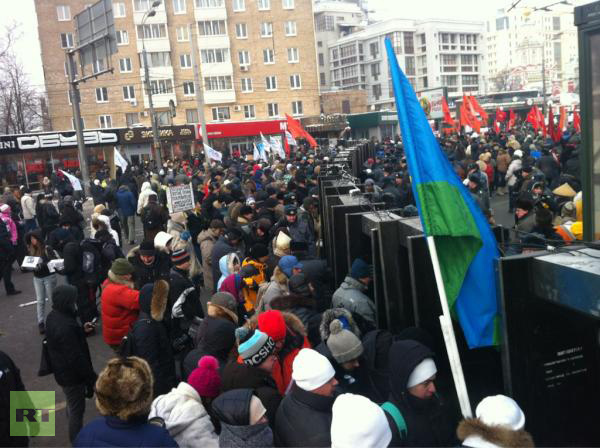
Russia – 36,000 Opposition Rally – 135,000 Pro Rally: Peaceful and calm…

Russia had rallies and they went off very peaceful today. Here is the live posting by RT as things happened. Sorry everyone it was kinda boring and very very cold… (-21 C)

15:45 MSK: RT ends its live feedback on Saturday’s protests in Russia. Have a nice day!

15:37 MSK: Around 20 people who attended various rallies in Moscow sought medical attention for hypothermia.

15:06 MSK: Police officials say around 175 thousand people attended rallies in Moscow on Saturday. According to their data, 36 thousand were on Bolotnaya Square and around 135,000 on Poklonnaya Hill.

14:52 MSK: Rally on Poklonnaya Hill over. Park Pobedy metro station is closed due to overcrowding

14:46 MSK: Next opposition rally to be held on February 26th, according to organizers.

14:43 MSK: Rally on Bolotnaya over, people are slowly leaving the square. Organizers say at least 120 thousand people attended, while official police estimates put the numbers at 38 thousands tops.

14:15 MSK: Watch live feeds from both Bolotnaya Square and Poklonnaya Hill on RT

14:04 MSK: According to police data, around 100 thousand people are attending the pro-Putin rally on Poklonnaya Hill.

13:55 MSK: Rally on Bolotnaya begins with people still flocking to the square.

13:37 MSK: As more people are arriving at Bolotnaya Square, which is situated on an island at Moscow River, police have deployed hovercraft. They are patrolling on the frozen river.

13:20 MSK:Observers by metal detectors on Yakimanka Street say at least 50 thousand people have passed through on their way to the rally. Police estimates are significantly lower at 23 thousand participants.

13:08 MSK:First group of protesters arrive on Bolotnaya Square, thousands more following.

12:57 MSK: Liberal Democrat rally over. Bolotnaya Square open to protesters.
12:47 MSK: Presidential candidate Mikhail Prokhorov has arrived at Yakimanka Street with some of his supporters.

­12:46 MSK: The Moscow Metro is having trouble accommodating all the people passing through stations closest to Yakimanka Street and Poklonnaya Hill. It’s like a special Saturday rush hour.

12:45 MSK: Latest turnout estimate by the police: 11,000 marching at Yakimanka, 35,000 at the Poklonnaya rally, 1,000 at Pushkin Square. Organizers of the Yakimanka march claim a higher turnout of 12-15,000.
12:40 MSK: Protesters in Yakimanka are displaying their creativity. There is a “human tank” among them wearing a cardboard turret over his head bearing the slogan, “tanks are not afraid of filth.” A giant crocodile is being carried on sticks by half a dozen protesters.

12:37 MSK: Police halt the flow of people onto Yakimanka Street for five minutes to prevent crowding.

12:31 MSK: The Poklonnaya Hill rally, which is scheduled to start in some 30 minutes, has attracted 15,000 people, according to police estimates.

12:31 MSK: The Liberal Democrat rally in Pushkin Sqare has 500 participants, police report.

12:31 MSK: Media estimate the number of people on the Bolotnaya march at 7,000 so far.

12:20 MSK: Protest march starts. Demonstrators carry banners displaying anti-government slogans and sing a popular 1980s song by Viktor Tsoy demanding change. The song was one of the emblems of the Perestroika era.

12:19 MSK: ­Police have set up 32 walk-through metal detectors at Yakimanka Street, the starting point for the march to Bolotnaya Square.
Metal detectors at Yakimanka Street (tweeted by @varlamov)

12:16 MSK: ­Moscow police are deploying some 9,000 officers on Saturday. They are to maintain public order and ensure that all the events pass off safely.

12:12 MSK: ­One of the key factors affecting the rallies will be the cold snap, or “General Moroz”, as it is jokingly called. The wave of extreme cold, which has seen temperatures dip to -20 degrees Celsius, could affect the turnout and pose a health risk to those taking part.

12:10 MSK: ­Meanwhile at Poklonnaya Hill, another rally is gathering. The activists at this event are protesting at what they see as a threat to political stability in Russia coming from the Fair Elections movement. They accuse the opposition of exploiting the public’s mood of protest in a bid to overthrow the government and seize power for themselves. A large section of the Russian media has labelled the event “a pro-Putin” rally, although the organizers have tried to distance themselves from the prime minister. Putin himself voiced his support of the rally, whose slogan is, “We have much to lose.”

12:08 MSK: ­Several presidential candidates had originally planned to deliver speeches at the rally, but later changed their minds. Businessman Mikhail Prokhorov said he would attend the event, but only in a personal capacity. Lib Dem leader Vladimir Zhirinovsky has organized its own rally, scheduled for the same time. Sergey Mironov of Fair Russia decided not to attend. Community leader Gennady Zyuganov is out of Moscow on Saturday.

12:06 MSK: ­The “Fair Election” movement has organized a march in central Moscow which is expected to end with a 30-minute rally at Bolotnaya Square, which in December was the scene of one of the biggest opposition demonstrations seen in modern Russia. Protesters angry at what they saw as a rigged parliamentary election are coming back to demand, that next month’s presidential poll is free and fair. The rally is being called “For Fair Elections!” Between 20-30,000 people are expected to turn out.

12:03 MSK: In Russia’s Far East and Eastern Siberia, a series of events have already passed off peacefully. But the main focus today is on Moscow’s two rallies, which are expected to draw the largest numbers.

12:01 MSK:There are a range of views being expressed as the election date approaches. Some are throwing their weight behind a particular presidential hopeful. Others are raising their voices against the political situation in the country. Yet others fear Russia is being dragged into chaos, as has happened in some Arab Spring countries.

12:00 MSK: Hello! It’s Saturday, February 4. Exactly a month from now Russia is to elect its new president. Today sees a number of political rallies across the country and even abroad. RT will be broadcasting regular news updates and keeping you informed through Twitter, Facebook and its website.

Windows to Russia!

Lets Go Communist! Lets Go! As the Wests Roots For the Communist…

In all the asthmatic Western media exclamations being directed at Russia at this moment in history over Putin and the Russian presidency coming up in March. The one affair, a lot of Western journalists have excused from their articles and fail to acknowledge 99% of the time, is that the strongest and best-organized political action force in Russia to counter Putin is none the less… The Communist Party!

Yes the dreaded, evil that we must wipe off the face of the earth, you know that communist party! Yes the one that Lenin, Stalin and Brezhnev all loved with open arms, which has a continued attitude of absolutism and adverse bread-and-butter policies!

Gennady Zyuganov has run the escapade since 1993, because everybody else with an aptitude and appetite for cold hard cash left the party to accomplish a quick buck…

Yes that communist party…

So while you root for who the Western press pushes for Russian president, as you sit in your home, as a armchair politician. Just realize who you root for, because it goes against all that you have been told all your life. I know that it goes against what I was told and I lived right there with you most of my life…

So – Lets Go Communist! Lets Go! Lets Go Communist! Lets Go! Lets Go Communist! Lets Go! Give me a C! Give me a O! Give me a M! Give me a M! Give me a U! Give me a N! Give me a I! Give me a S! Give me a T! What does that spell… Communist! Lets Go Communist! Lets Go! (Catchy cheer isn’t it?)

Hmm…

Kyle Keeton
Windows to Russia!

PS: I think that it would be interesting (maybe?) to see the communist get in power in Russia again! As Sveta would say, “That would be just right!” Sveta votes communist by the way…

We are getting the urge to go to the Russian Village…

Sveta and I are getting ready as soon as the weather breaks to take a trip to the village. I am going to live in the village this year for about two to three months. Boza will be with me and Sveta will be able to spend about a month there…

It is time to rebuild the worn out parts on the village home and our Volga car. In the village I will have the space and time to do that…

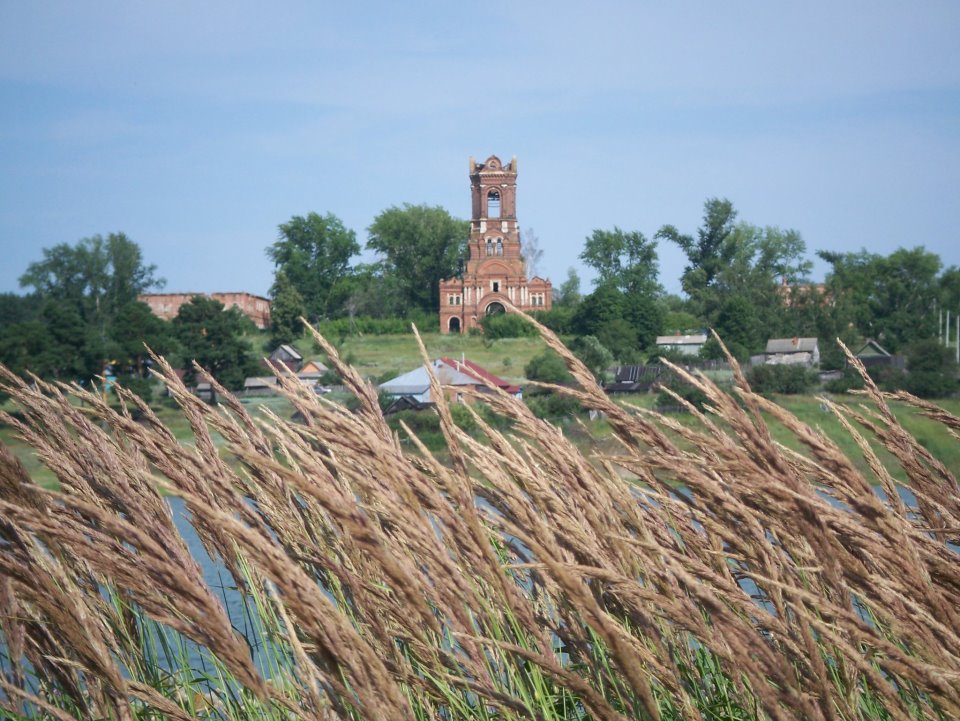
So I posted one of my favorite pictures of the village as it is seen through the grass across the lake. This year I want to do some fishing and eat fresh fish part of the time in the village… 🙂

Yes the village is as beautiful as the photo shows…

Kyle and Sveta
Windows to Russia!

Russia: Temples and Tulips of Kalmykia!

Map shows Kalmykia!

Hello,

On one of our trips, (the one that I lost all the pictures) we had the opportunity to go to Russia’s republic of Kalmykia which is the only region in Europe where Buddhism is the dominant religion. Temples were destroyed there during the Soviet era and Buddhism went into decline. But in a new age of tolerance, the steppe region is enjoying a religious renaissance. There are now 67 Buddhist temples in Kalmykia!

The Republic of Kalmykia (Russian: Респу́блика Калмы́кия; Kalmyk: Хальмг Таңһч) is a federal subject of the Russian Federation (a republic). The direct romanization of the republic’s Russian name is Respublika Kalmykiya, and that of the Kalmyk name is Xal’mg Tanghch. It is remarkable for being the only state in Europe where the dominant religion is Buddhism. It has also become famous because its current government has made it the chess center of the world. (Link)
One of the things that we remember about the area was the wild tulips. We had hundreds of pictures of fields of red and yellow tulips blowing in the wind. We drove for miles and miles and never got tired of seeing millions of wild tulips. We stopped and walked in the fields and it was truly fantastic. Sveta and I had a magical trip in those tulip fields. It is what fairy tales are made of…

Kalmykia was a wonderful part of the world and the people were so nice. We are looking forward to going back one day.

Kyle & Svet

comments always welcome.

The Conundrum of Iran…

This story by Leonid Savin, political scientist, Strategic Culture Foundation expert, was published in International Affairs magazine.

The EU oil embargo recently slapped on Iran and the threats voiced by the US and other Western countries to come up with further sanctions against the country led watchers to conclude that an armed conflict between Iran and the West finally became imminent.

The first potential scenario in the context is that the current standoff would eventually escalate into a war. The US forces in the Gulf area currently number 40,000, plus 90,000 are deployed in Afghanistan, just east of Iran, and several thousands of support troops are deployed in various Asian countries. That adds up to a considerable military potential which may still fall short of what it takes to keep a lid on everything if armed hostilities break out. For example, Colin H. Kahl argues in a recent paper in Foreign Affairs that, even though “there is no doubt that Washington will win in the narrow operational sense” (1), the US would have to take a vast array of pertinent problems into account.

At the moment, maintaining the status quo is not in the US interests, holds Stratfor, a US-based global intelligence agency: “If al Assad survives and if the situation in Iraq proceeds as it has been proceeding, then Iran is creating a reality that will define the region. The United States does not have a broad and effective coalition, and certainly not one that would rally in the event of war. It has only Israel …” (2) If the conflict with Iran takes the shape of a protracted bombing campaign and comes as a prologue to the occupation of the country, the US will need to strengthen its positions in adjacent regions, meaning that Washington will be trying to draw the Caucasian republics (Georgia, Azerbaijan) and those of Central Asia into the orbit of its policy and thus tightening the “Anaconda loop” around Russia.

An alternative scenario also deserves attention. The EU sanctions would surely hurt many of the European economies – notably, Greece, Italy, and Spain – by a ricochet. In fact, Spanish diplomacy chief José Manuel García-Margallo Y Marfil bluntly described the sanctions decision as a sacrifice (3). As for Iran, the oil blockade can cause its annual budget to contract by $15-20b, which generally should not be critical but, as the country’s parliamentary elections and the 2013 presidential poll are drawing closer and the West actively props up its domestic opposition, outbreaks of unrest in Iran would quite possibly ensue. Tehran has already made it clear it would make a serious effort to find buyers for its oil export elsewhere.

China and India, Iran’s respective number one and number three clients, brushed off the idea of the US-led sanctions momentarily. Japan pledged support for Washington over the matter but did not post any specific plans to reduce the volumes of oil it imports from Iran. Japan, by the way, was badly hit in 1973 when Wall Street provoked an oil crisis and the US guarantees turned hollow. Consequently, Tokyo can be expected to approach Washington’s sanction suggestions with utmost caution and to ask the US for unequivocal guarantees that the White House will be unable to provide. Right now the US is courting South Korea with the aim of having it cut off the import of oil from Iran.

The opposition mounted to the plans underlying the military scenario by China, Russia, and India seems to hold the promise of an alliance of countries seeking to tame the US hegemony and raging unilateralism. Stratfor analysts have a point saying that time is not on the US side, considering that the BRICs countries have some opportunities to influence the situation in the potential conflict zone by launching joint anti-terrorism and anti-piracy maneuvers in the Arabian Sea and the Persian Gulf etc.

Inducing the regime change in Iran, which is Washington’s end goal, still takes a pretext. The US has long been eying various factions in Iran in the hope to capitalize on the country’s existing domestic rivalries parallel to the employment of tested color revolution techniques such as the support for the Green Movement or the establishment of a virtual embassy for Iran. Richard Sanders, a vocal critic of the US foreign policy, opined that, at least since the invasion of Mexico in the late XIX century, the US permanently relied on the mechanism of war pretext incidents to compile justifications for its military interventions (4). US arch-conservative Patrick J. Buchanan cited in his opinion piece titled “Did FDR Provoke Pearl Harbor?” the fairly common view that the US financial circles knowingly provoked the Pearl Harbor attack to drag the US into a war with the remote goal of ensuring the dollar empire’s global primacy (5). The lesson to be learned from the history of the Vietnam War, namely the Gulf of Tonkin incident in which USS Maddox entered Vietnam’s territorial waters and opened fire on the boats of its navy, is that the initial conflict was similarly ignited by the US intelligence community, the result being that the US Congress authorized LBJ to militarily engage Vietnam (by the way, no retribution followed in June 1967 when the Israelis attacked USS Liberty, killing 34 and wounding 172). The morally charged concepts of humanitarian interventions and war on terror had just as well been invoked to legitimize downright aggressions against Yugoslavia, Iraq, and Afghanistan.

Speaking of the current developments around the Persian Gulf, Washington’s choice of pretexts for an aggression comprises at least three options, namely 1) Iran’s nuclear dossier; 2) an engineered escalation in the Strait of Hormuz; 3) allegations that Iran supports international terrorism.

The US objective behind the pressure on Iran over its nuclear program – to make everybody in the world accept Washington’s rules of the game – has never been deeply hidden. The abundant alarmist talk is intended to deflect attention from the simple truth that building a nuclear arsenal with the help of civilian nuclear technologies is absolutely impossible, but Matthew H. Kroenig from the Council on Foreign Relations recently went so far as to warn that Iran would some day pass its nuclear technologies to Venezuela (6). The motivation must be to somehow bundle all critics of the US foreign policy.

The Strait of Hormuz which is the maritime chokepoint of the Persian Gulf is regarded as the epicenter of the coming new war. It serves as the avenue for oil supplies from Iran, Iraq, Kuwait, Qatar, the Saudi Arabia, and the United Arab Emirates and is therefore being closely monitored by all likely parties to the conflict. According to the US Department of Energy, the 2011 oil transit via the Strait of Hormuz totaled 17 billion barrels, or roughly 20% of the world’s total (7). Oil prices are projected to increase by 50% if anything disquieting happens in the Strait of Hormuz (8).

Passing through the Strait of Hormuz takes navigation across the territorial waters of Iran and Oman. Iran grants as a courtesy the right to sail across its waters based on the UN Treaty on Maritime Goods Transportation.

It must be understood in connection with Washington’s recurrent statements concerning the Strait of Hormuz that in this regard the US and Iran have the same legal status as countries which penned but did not ratify the treaty, and thus the US has no moral right to references to the international law. Iran’s administration stressed recently after consultations with the national legislation that Tehran would possibly subject to a revision the regulations under which foreign vessels are admitted to the Iranian territorial waters (9).

Navies are also supposed to observe certain international laws, in particular, those defining the minimal distance to be maintained to vessels of other countries. It constantly pops up in the US media that Iranian boats come riskily close to US vessels but, as watchers note, provocateurs like the CIA-sponsored separatists from Iran’s Baluchistan could in some cases be pulling off the tricks in disguise.

Chances are that a part of the oil embargo plan is to make the West encounter oil supply problems and start constructing pipelines across Saudi Arabia, Bahrain, Oman, Yemen, Qatar, and Iraq as alternative routes reaching the shores of the Arabian, Red, and Mediterranean Seas. A few of these projects, the Hashan–Fujairah pipeline, for instance, are as of today in the process of being implemented. If that is the idea, the explanation behind Washington’s tendency to convince its allies to create a “safer” pipeline infrastructure is straightforward. Geopolitics being an inescapable reality, it does have to be taken into account, though, that the region’s countries remain locked in a variety of conflicts and, due to geographic reasons, Tehran would be a key player even if the pipelines are launched.

Since the new US military strategy implies focusing on two regions – the Greater Middle East and South East Asia – the issue of the Strait of Hormuz appears coupled to that of the Strait of Malacca which offers the shortest route for the oil supply from the Indian Ocean to China, Japan, South Korea, and the rest of South East Asia. The arrangement implicitly factors into the Asian countries’ decision-making related to Iran.

The precedent of “the war on terror” – a campaign during which the US occupied under dubious pretexts Iraq and Afghanistan at the costs of thousands of lives – must also be kept in mind. Ages ago, the White House sanctioned subversive activities against various parts of the Iranian administration, including the Guardians of the Islamic Revolution. Former CIA operative Phillip Giraldi writes that the US and Israeli agents have been active in Iran for quite some time and are responsible for the epidemic of the Stuxnet virus and the series of assassinations of Iranian nuclear physicists. The groups within Iran which aligned themselves with the country’s foes are the People’s Mujahedin of Iran, the Baluchistan-based separatist Jundallah whose leader Abdolmajid Rigi was arrested in February, 2010 by the Iranian security forces and admitted to cooperating with the CIA, and the Kurdish Free Life of Kurdistan (10).

In essence, a war against Iran – up to date a secret war – is underway. The problem the parties involved are trying to resolve is to find a way of prevailing without entering the “hot” phase of the conflict.

(Views expressed in this article reflect the author’s opinion and do not necessarily reflect those of Windows to Russia. Windows to Russiadoes not vouch for facts and quotes mentioned in the story)

1.     Colin H. Kahl. Not Time to Attack Iran. January 17, 2012.
http://www.foreignaffairs.com/articles/137031/colin-h-kahl/not-time-to-attack-iran?cid=nlc-public-the_world_this_week-link6-20120120
2.    Iran, the U.S. and the Strait of Hormuz Crisis. January 17, 2012. http://www.stratfor.com/weekly/iran-us-and-strait-hormuz-crisis?utm_source=freelist f&utm_medium=email&utm_campaign=20120117&utm_term=gweekly&utm_content=readmore&elq=b90cfbef7b1a402ea2f1fc384080fa15
3.    La UE acuerda vetar las importaciones de petroleo de Iran. 23.01.2012 http://www.lavanguardia.com/internacional/20120123/54245752767/ue-vetar-importaciones-petroleo-iran.html
4.    Richard Sanders. How to Start a War: The American Use of War Pretext Incidents. Global Research, January 9, 2012.
5.   
6.    Recent Events in Iran and the Progress of Its Nuclear Program. January 17, 2012. http://www.cfr.org/iran/recent-events-iran-progress-its-nuclear-program/p27090?cid=nlc-public-the_world_this_week-link5-20120120
7.     http://www.eia.gov/cabs/world_oil_transit_chokepoints/full.html
8.    Michael T. Klare. Danger Waters. January 10, 2012. http://aep.typepad.com/american_empire_project/2012/01/danger-waters.html#more
9.    Mahdi Darius Nazemroaya. The Geo-Politics of the Strait of Hormuz: Could the U.S. Navy be defeated by Iran in the Persian Gulf? Global Research, January 8, 2012. www.globalresearch.ca/index.php?context=va&aid=28516
10.    Philip Giraldi. Washington’s Secret Wars. 08 December 2011.

Windows to Russia!

The Soviets Made Champagne Also!

Hello,Windows to Russia!

I was drinking my morning cup of coffee and watching a video that Svet put on the Russian Video Blog!

A fact that I had no idea about, was that the Soviet Union made their own Champagne! I always thought that only the French had Champagne *(Champagne is a sparkling wine produced by inducing the in-bottle secondary fermentation of the wine to effect carbonation. It is produced exclusively within the Champagne region of France, from which it takes its name.)

‘Soviet Champagne’ was born 72 years ago, when Stalin signed a decree ordering production of a sparkling wine called ‘Sovetskoye Shampanskoye’. The first wineries appeared in the southern city of Rostov and later in Gorky (now Nizhny Novgorod), in central Russia.

I have feeling that the French do not accept that the Soviets had Champagne any more than it is accepted that America makes a Champagne. But Russia has carried on the tradition in full force and no New Years in Russia would not be complete with out the local Champagne. (Sparkling Wine)

A little history on the Soviet Champagne: Chemist Anton Frolov-Bagreev is the man considered to be the founding father of ‘Soviet Champagne’ he devoted his entire life to perfecting his technology. It seems that he even perfected a way to allowed for fermentation of the champagne in reservoirs, rather than in bottles as before. This allowed for mass production, making champagne a drink for the masses. Frolov attained his dream of popularizing the drink after the Second World War. For several years in the Soviet Union, champagne was even sold on tap (spigot) in the food stores next to the fruit juices!

Russia has continued and will continue with Champagne production the Soviet way and every New Years multiple millions of bottles are sold of the world famous Soviet Champagne.

So next year try a Soviet Champagne at the New Year…

Kyle & Svet

comments always welcome.

Russia: Remembering The Neutron Bomb?

Hello, While this is an old post of mine it still has much meaning in the world. It is a shame that we as a human race can not just have peace, happiness and calm…

I was drinking my morning cup of coffee and reading about a subject that brought back memories of an era, I hope stays gone. Thirty years ago the USSR informed the world it had successfully tested one of the deadliest weapons ever invented – a neutron bomb. The day has gone down in arms race history.

A neutron bomb is an enhanced radiation weapon (ERW); the killing mechanism is an intense burst of high-energy neutrons.

Its peculiarity as a thermonuclear weapon is that the energy emission is much slower than that of the usual thermonuclear blast.

So, the amount of energy used to create the blast wave and heat flash is much less, but the stream of neurons which destroys people and animals is many times stronger. At the same time, buildings and equipment are not affected at all.

I remember that In 1978 President Jimmy Carter halted neutron device production as concern grew over its effects on the arms race. I remember that it was another weapon that seemed to be used to scare us.

The Neutron Bomb was heavily propagandized in the USA and Russia. Both countries already had the means to destroy the world several times over with their nuclear arsenals. But the sound of a bomb that could destroy all life and leave the buildings intact made for many conversations in school and gatherings.
The image of walking the streets of a huge city devoid of life has been the basis for many sci fi books. This weapon just added to the imaginations of generations of youngsters from the USA and USSR!

Kyle & Svet

comments always welcome.

Russia’s Lavrov – Quote of the day: (Feb. 1st, 2012)

Russian Foreign Minister Sergei Lavrov said:

“The people who are obsessed with removing regimes in the region (Middle East), they should be really thinking about the broader picture. And I’m afraid that if this vigor to change regimes persists, we are going to witness a very bad situation much, much, much broader than just Syria, Libya, Egypt or any other single country.”

Oh how true he speaks! Please Western governments, stop and think about the games you play. For you – are why the innocents are dying in the name of democracy and regime change…

Kyle Keeton
Windows to Russia!

PS: Russia is firing the warning shots and now China has joined also. Warning shots are the civilized way of doing things. It seems strange to me that the only countries with the coolest heads and most common sense are the countries that America has labeled as evil and deadly. Think people think…

Walked the Dog and my tears froze in Moscow…

I am drinking a good cup of hot chicory and have the extra heater on. I got a little bit cold.: It was about -27 below Celsius as I walked the dog and my eyes started to tear up from the cold. That is when I realized that my left eye had frozen shut. Not badly, but still the eye lashes had frozen together. Then I realized that a tear had frozen on my cheek. Now that was so cool… (No pun intended!)

By the time we had gotten back from an hour long walk. The temperature had warmed up to about -25 below zero Celsius. (Yes a proverbial heat wave.) So I checked on Yandex what is -25 C in Fahrenheit? It is around -13 F… (Which means -27 C is around -17 F)

We probably stayed out to long and by the time we got back Boza was starting to feel the cold and was trying to keep any paw paw he could off the ground. He decided that two paws on the ground was the best answer… 🙂 (Better yet in my arms would be the best!) I could not feel my face and that seemed like a good time to go in…

Walking the dog in Moscow is always an experience and since I walk the dog a lot, I get lots of experiences…

That is why I love Russia and now I am going to go make a cream of chicken noodle soup for Sveta and I, for tonight on this bitterly cold evening…

Kyle Keeton
Windows to Russia!

PS: I see old ancient Babushkas walking around in this weather like it is nothing. I realize that they have spent their whole life in these conditions. They are battle hardened people that know no other way of life. Also when the sun shines, even at -25 below zero, the mommas have their kids out in the sun playing in the parks. The kids can not get up if they fall down due to all the clothes and coats, but that is what mom is for, to pick them back up as they flounder in the snow. Then the moms pull their kids around in sleds all day and do the shopping…

That is why I love Russia…