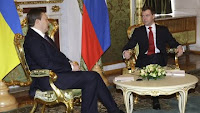
 PRESIDENT OF RUSSIA DMITRY MEDVEDEV: I would like to say a couple of words about what we did today before we take questions from the media. But before I do that, I want once again, in the presence of all the media representatives from Russia and Ukraine, to congratulate Mr Yanukovych on his official assumption of office as President.
It’s obvious that the results of the presidential elections [in Ukraine] were significant for us, to put it mildly. This is certainly a positive signal for the development of our relations. Millions of people who took part in the voting, voted for the development of relations between Russia and Ukraine, as Mr Yanukovych quite rightly put it.
Allow me to let you in on a little secret: during our bilateral negotiations Mr Yanukovych was absolutely right when he noted that millions of people in Russia and Ukraine proceed on the assumption that the presidents will not interfere with the development of Russian-Ukrainian relations. I couldn’t have put it better. But I hope that this belongs to a previous stage of development of our relations.
Today’s talks have confirmed the potential that exists for our relations. And in fact this applies to every aspect of them, because unfortunately in recent years relations between our countries have not just stagnated but have actually gone downhill. And now what we have in mind is not so much improving these relations, but reviving them, resuscitating them by the most drastic means possible.
So the President of Ukraine and I have agreed: developing this dialogue, bringing about a full-scale revival of relations between Ukraine and Russia, implies renewing the links between us, especially those between ministries and agencies, between our governments. This would of course include contacts between our respective parliaments, non-governmental organisations, in every area in which we interact.
That is why we have agreed and included in our joint statement our determination that in the very near future there will be a meeting of the Russian-Ukrainian Intergovernmental Commission, which represents a key element of our cooperation. This should take place in Kiev in the first half of 2010. Mr Yanukovych has invited us to come to Kiev. I hope that it will be a very productive visit.
So we will do everything in our power to restore Russian-Ukrainian relations so that they reflect active and mutually beneficial cooperation, and to make sure that a spirit of cooperation develops in every area. Of course there are areas where we still work hard, one of which is gas cooperation.
Our countries have already signed agreements and contracts, but we have agreed to instruct our governments and ministers to engage in full-scale discussions to facilitate cooperation in the energy field, both in the area of natural gas, because this is still a very important area for our cooperation, and on other energy issues.
We are confident that the implementation of major projects in this area, including in the energy sector and in infrastructure more generally, can benefit our peoples and encourage long-term investment, which is particularly important at the moment, in this period of economic crisis.
We talked about other important topics. Take aircraft industry, for example. The subject of cooperation between our countries’ aviation companies is still a valid one. We also have joint projects, such as An-70 [next-generation four-engine medium-range transport aircraft]. But it’s not just that. Our companies have managed to preserve their technological links, and we need to do everything in our power to ensure that these links are not destroyed by a government’s political shortsightedness or as a result of competition from other countries.
There is the subject of outer space, which was also addressed in our joint declaration. There is real potential here. I think that we might as well consider using our countries’ common navigation and time space based on Russia’s GLONASS [Global Navigation Satellite System]. We discussed other issues of economic cooperation. I don’t want to develop on all these now. I think that during the news conference we can come back to some of these things.
Of course we talked about regional cooperation and political interaction. We discussed some of the sensitive issues in our cooperation, in particular the stationing of Russia’s Black Sea Fleet in Sevastopol. In any case, we agreed – and this is reflected in a joint statement – that all consultations on the basis of agreements concluded in 1997 should continue.
Of course we want to pay particular attention to humanitarian cooperation based on the nature of the brotherly relations between our countries. These are our spiritual roots and the ties that bind millions of families together. Of course, in this sense, perhaps the most important is a truly spiritual project – our joint victory, the 65th anniversary of the Great Victory. Our veterans maintain active ties with Ukrainian front-line soldiers, and our duty is to do everything we can to help them to celebrate this holiday properly as brothers in arms together.
Mr Yanukovych just mentioned a good idea: perhaps we could organise a train for all the veterans. We will certainly work on this option. The idea has a lot to recommend it, especially if we can talk other countries into coming. We’ll be sure to talk to them about it.
I would also like to point out that for Russia Ukraine remains a key partner in the CIS. And of course we are very much interested in seeing the Ukrainian economy develop properly and that such a close neighbour manages to preserve its political stability. To facilitate normal economic cooperation (I mentioned this to the President of Ukraine) we are ready to assist in supporting Ukrainian interests in various international venues, including the G8, the G20 and international financial institutions.
All of these issues are conveyed in a summary form in the first document that the new President of Ukraine and I signed. We are just starting our work, so this document of course consists of rather general but nonetheless very important statements. All these statements must be backed up by specific arrangements, arrangements at the presidential, governmental and ministerial level, with active work being done in every area. If we achieve success in this sense, relations between Russia and Ukraine will return to their highest level.
Mr Yanukovych, you have the floor.
PRESIDENT OF UKRAINE VIKTOR YANUKOVYCH: Thank you.
Mr President, colleagues, friends, representatives of the media,
Today we really had a very fruitful and most importantly a frank exchange with Mr Medvedev, which I am sure will help us acquire a mutual, sensible and broad understanding of what needs to be done as soon as possible. We are well aware that the foundation of this future is based on the desire of the peoples of Ukraine and Russia to resolve many issues together, in conjunction. As we pointed out today, this new five-year period has made it possible for us to open, as they say, a new page in our relations. During the last five years we have come to appreciate our previous relations, which we somehow lost sight of in the grand scheme of things.
Of course during that time a great deal has changed. The entire world has been swept up in the financial crisis, and we have seen how hard it is to overcome these problems on one’s own. We need the partnerships that we have developed, we need to renew and extend our friendly relations.
The competitiveness of our economies constitutes the main challenge that Ukraine and Russia must address. But I want to say that I have followed very closely what Russia has done in recent years. I want to say that we had similar problems but that our approaches to them have been different. Of course the political stability that Russia has enjoyed enabled it to a certain extent to cope better than Ukraine did. I told Mr Medvedev that we are intent on catching up.
DMITRY MEDVEDEV: And we are ready to help.
VIKTOR YANUKOVYCH: I think that by actively cooperating with each other in every area, in what I would describe as the traditional areas of cooperation between Ukraine and Russia, we will be able to create the sort of synergy effect that has always existed between us. So our cooperation ties, our technological ties in the field of engineering, in almost every area – these are the things that will enable us to hit the ground running and create the sort of innovative technologies we need.
And then there’s modernisation, about which a great deal has been said recently in Russia, initiated by President Medvedev at a congress of United Russia … Let me assure you that we are very glad that our economies, as I just intimated, are very similar, and that we have a great deal to teach each other by sharing our experiences: in atomic energy, in rocket and space technology, and in a host of other areas.
The development of transport corridors is a very important issue that we must work together to solve. And I have put forward a proposal in this regard: Ukraine will host Euro 2012, and Russia will host the 2014 Winter Olympics in Sochi. Our cooperation on the development of transport corridors is more urgently needed than ever before, and we must make our countries as hospitable as possible in welcoming participants to these events and create conditions that will enable the whole world to see that Ukraine and Russia are advanced nations in the throes of rapid development.
We have decided to revisit the many issues that have been sort of balked in our relations so that we can resolve them in summary fashion. This applies to both simple and complex issues, including the demarcation of the border, the Black Sea Fleet, our natural gas relations. And I hope that, by the time President Dmitry Medvedev arrives in Ukraine on his state visit scheduled to take place in the first half of 2010, our representatives on the joint intergovernmental commission will have prepared a plan of action, and we can get down to work on those issues.
It’s very important. Of course our peoples and our partners are counting on this, because many of the issues in Ukrainian-Russian relations have a direct effect on Europe’s economy, and I would even say the global economy, as we are well aware. So the creation of a wide variety of plans for joint action, for example in agriculture, in the grain market, in the nuclear industry and a number of other areas will help us create the conditions for development and give us a clear understanding that our partnership is mutually beneficial. And obviously we need to get on with creating such conditions.
I want to reiterate that today I had the feeling that we are ready for a sharp turn.
DMITRY MEDVEDEV: In the right direction.
VIKTOR YANUKOVYCH: Yes, and I hope that we will do it.
Thank you.
DMITRY MEDVEDEV: Thank you.
QUESTION: Mr Yanukovych, we have repeatedly heard you speak in both Russian and Ukrainian as, in general, do most people in Ukraine. During your campaign, you spoke repeatedly about the status of Russian language in Ukraine. Now you are President: when and how will this problem be solved? You agree that this is indeed a problem; many Ukrainians do as well. And of course many are unhappy with the ban on broadcasting of Russian TV channels in Ukraine. Will these issues be resolved by legislative action?
And another question for Russia’s President: is Russia ready and willing to be present in Ukraine’s information space? Thank you.
VIKTOR YANUKOVYCH: I am going to answer very briefly. Currently a new coalition is forming in Ukraine. Naturally, a new Government Cabinet will be formed as well, and all these processes will begin.
But I am convinced that the Ukrainian people – a wise people, just like the Russian people – understands today, that people in Ukraine understand that we need to create comfortable living conditions for all nationalities who reside on our territory and, of course, to protect the rights of large numbers of Russian-speakers on our territory.
Ukraine ratified the European Charter [for Regional or Minority Languages] a long time ago, but since this time the relevant laws have not been adopted. We will adopt all necessary laws, and I will keep my presidential election campaign promise that I’ve given to the Ukrainian people in this regard; this issue will soon be resolved.
DMITRY MEDVEDEV: I have it a little bit easier than Mr Yanukovych: I do not need to form a coalition to resolve any problems. Our coalition is already formed, all the people are in place, and now we need to work, work, and work.
Regarding Ukrainian language and the Ukrainian information space: I think this is a completely justified topic. Because when we are concerned about the status of Russian language in our closest neighbour, of course we need to look at how we deal with Ukrainian language in Russian territory, and whether the conditions for learning Ukrainian exist, and what our information space looks like.
I therefore wish to inform you that I will soon meet with the heads of our media agencies who are about to implement a project to broadcast digitally throughout Russia (you know, we are moving towards digital) the channels of our closest friends and neighbours. And as I recall, there are one or two Ukrainian channels among them. In essence this will be a package that will eventually reach the widest range of the Ukrainian diaspora and in general all those in Russia who want to have access to information in Ukrainian. I think this will make a good contribution to the development of our relations.
VIKTOR YANUKOVYCH: And we will try to make this coincide with the anniversary of the birth of Taras Shevchenko [19th-century Ukrainian poet].
DMITRY MEDVEDEV: That’s right.
VIKTOR YANUKOVYCH: As we said in our joint memorandum.
QUESTION: Mr Medvedev, once upon a time in Russia people used to say: wake up and think first about what you have done for Ukraine. Tell me please, what are you willing to do for Ukraine today and in the near future? Thank you.
DMITRY MEDVEDEV: You know, even when our ambassador was not yet in Kiev, I still thought about Ukraine every morning. It was because I was thinking when to send Mr Zurabov [Russian Ambassador to Ukraine] there. Mr Zurabov just took office and presented his credentials – I think it was yesterday, or was it the day before? So we think about Ukraine before going to bed and when we wake up. But the problem is not only what we are thinking about, but what we are doing to further develop our relations. And now there are fundamentally different opportunities opening up.
In my opening remarks I said that we need to resuscitate Russian-Ukrainian cooperation, and for that I am ready to work very long hours, and give appropriate instructions to all our officials, all Russian authorities. There are no problems in this regard: the main thing is that we make a number of decisive steps in the very near future. That we promote cooperation in economic and political spheres, on security issues, regarding our relations with Europe, that we work to create a modern security space, including, for example, the preparation and signing of the relevant European instruments. So I think we need to intensify cooperation on all these issues. On our side there are no problems. I expect that our Ukrainian friends will also work day and night.
QUESTION: My first question is for the President of Ukraine. Mr Yanukovych, everybody noticed (including in Russia), that your first trip as President was to Brussels. Where is Russia in relation to Ukraine’s foreign policy priorities: first or second?
As for NATO, we know that in Ukraine people have already been collecting signatures for a referendum on joining the organisation. What about this referendum – will it take place?
Of course, we are all interested in your fundamental position on the Black Sea Fleet. Your predecessor flatly refused to admit that the fleet could remain where it is after 2017. What do you think?
I want to ask Russia’s President a question as well: will the Ukraine’s pro-European foreign policy adversely affect the development of Russian-Ukrainian relations?
DMITRY MEDVEDEV: Can I give a quick answer to that one? It won’t.
VIKTOR YANUKOVYCH: I went to Brussels because I was invited there for March 1, and to Russia on March 5. There was no opportunity to do it differently.
I can tell you that Mr Medvedev is empathetic both as a man and as president; the first few days as president of any country are always difficult in terms of where to go, etc. So I am gaining experience. But as we used to say, all roads lead to Moscow and I came here on March 5.
With regard to NATO. I have answered this question many times: as a European non-bloc-member country Ukraine will develop its relations with NATO in accordance with its national interests. And it will always be this way.
With regard to the Black Sea Fleet, this question has many distinctive features, as they say. And the history of this issue goes back a long way. Our two presidents have always reached a separate agreement on this topic. And both the people of Ukraine and the people of Russia accepted and understood this. I think that this is still the case today. I will not talk about the details now. Today the commission is working; Mr Medvedev and I are working. He understands the complexities of addressing this issue as the President of Russia, just as I do as President of Ukraine. While we understand the difficulties and problems, at the same time I think that we will soon resolve them in a way that will satisfy both Ukraine and Russia.
QUESTION: My question is to both presidents. Last year we celebrated the 300th anniversary of the Battle of Poltava, a historical battle for our peoples, both Russian and Ukrainian peoples. But unfortunately this event, this anniversary was not celebrated by the presidents of our countries.
This year marks the 65th anniversary of Victory. Will the presidents of Russia and Ukraine stand together at the Mausoleum or, perhaps, will President Medvedev be on Khreshchatyk [main street in Kiev, Ed.] with Mr Yanukovych to watch the parade?
And a separate question to President of Ukraine Viktor Yanukovych: your predecessor gave Stepan Bandera and Roman Shukhevych [leaders of the Ukrainian nationalist movement] the titles Hero of Ukraine. Please tell us whether the decrees conferring on them the title Hero of Ukraine will be cancelled by the 65th anniversary of Victory?
VIKTOR YANUKOVYCH: We agreed with Mr Medvedev that the 65th anniversary of Victory will be celebrated in Ukraine as well as in Russia and Belarus. Incidentally, I also talked with President Lukashenko about this.
We have a common understanding that the celebration of Victory Day is another one of those moments that we should celebrate together and that our peoples expect this of us. Therefore these celebrations will to some extent be synchronized. I will absolutely be in Moscow on the eve of May 9. On May 9 most likely … or rather, let me say straight out: on May 9 we celebrate this holiday in Kiev. And military parades will be held in all of Ukraine’s Hero Cities on that day.
What I think is most important is something we have not yet had time to talk about: I want us to somehow jointly agree on what we are doing to address the veterans’ social issues and synchronize this with our actions, because it is inadmissible to divide veterans into ‘theirs’ and ‘ours’. Our people all brought us victory in this terrible war.
With regard to the decrees issued by President Yushchenko: of course, they are high-profile and naturally they were not well-accepted neither in Ukraine nor in Europe. It is no accident that even within the European Union the European Parliament adopted a decision on this issue, and made a resolution [regarding reviewing the executive orders, Ed.]. There is a specific legal process governing this – Ukraine is going through it now – as well as a political process. And this decision will be made before the 65th anniversary of Victory.
DMITRY MEDVEDEV: I will now say two words. We did not celebrate the anniversary of Poltava with former President Mr Yushchenko, because he had other holidays and other occasions to celebrate, and he usually celebrated those. Of course, it is a pity that we did not do so together.
As to the 65th anniversary of Victory, Mr Yanukovych expressed himself very well. This really is our common, very important holiday, one that unites us and, I hope, will always unite us. And I fully support the President of Ukraine: we must think about how to better co-ordinate our support for veterans, because these people shed their blood for what was at that time our shared country, and they deserve our collective attention. We will look into this without fail.
Thank you.
Windows to Russia!

 It seems that one presidential election would not make that much difference. But when you had a leaders such as the last Ukraine president and Prime Minister you really have no where to go but up.


