We know who will win…

I find it interesting that I have received email after email from people I know in America and they all said the same thing. They said, “Republicans are going to win majority in the Senate and Congress and our country will go to hell!” 😉

Sorry but I think it has gone to hell in a hand basket already and will not find its way back; No matter who you elect from a two party system. Though that is not the real issue is it?

You all know who is going to win the election before hand and that holds true 99% of the time in an election in the USA. Elections are called 99% of the time, after only 2% to 12% of the vote is even in. Elections are called before the elections have happened. Elections are…

I like the Russian way much better and and least they have a president that the people respect and want…

Nuff said…

Posted by Kyle Keeton
Windows to Russia…

It’s Unity Day Holidays in Russia…

Unity Day; That is the holidays that we are celebrating and it means four days off in a row for Russians, well at least most Russians. The day’s name alludes to the idea that all of Russian society united to preserve Russian statehood when there was neither a tsar nor a patriarch to guide them, and they (rich and poor) unified together as one, against the evil that life sends to destroy you…

(By the way; This holiday replaces the Soviet November 7th holiday, that celebrated the anniversary of the Bolshevik Revolution…)

Good holiday to fit the times in this day and age. What with the west trying to destroy Russia by all means it seems…

So I have been lazy and ignoring the blog. Sveta and I have been simply goofing off, what with it freezing, snowing, raining, and overcast. What else is there to do?

 In Russian it is; Днем народного единства! (National Unity Day!)

Read this and it will tell you more about this holiday…

Posted by Kyle Keeton
Windows to Russia…

Holiday in Russia: November 4th, 2014: Unity Day…

I am going to take a holiday today as it is an official holiday in Russia. I asked Sveta what holiday is was and she told me, “Yeltsin made holiday!” So since that did not answer my question and Sveta who really dislikes the thinking and thoughts of Yeltsin (President of the Russian Federation, serving from 1991 to 1999.), I decided to look elsewhere and discover my desires for information, as I sipped a great cup of coffee here in Korolev, Russia…

So November 4 is a federal holiday in the Russian Federation. That means everything is closed, literally in Russia. If November 4 falls on a weekend, the public holiday usually moves to the following Monday…

That answered when, but I wanted why?

Why? – Unity Day commemorates a Russian uprising that extracted Moscow from Polish-Lithuanian occupation on November 4, 1612. In 1649, Russian Tsar Alexei Mikhailovich made November 4 a public holiday. Russians danced in the streets with joy and love until 1917. The holiday was ended abruptly and in 1918, the Bolsheviks reinstated a replacement holiday on November 7, to promote the Revolution of 1917. But during Yeltsin’s reign of power as president, November 4 once again became a public holiday (like in the old days) in 2005, the Russian Parliament removed November 7 from the list of official public holidays and introduced Unity Day and that is how it stands as of today…

I myself will tell you that mainly it is a day off holiday for most Russians. A day of rest and relaxation, but Sveta had to work today. For her IBM Servers at the bank never rest and she has to do certain functions and updates when everyone is gone…

What a bummer, so I decided to write on my books and then I decided to write this small article about November 4th, 2013: Unity Day in Russia…

Have a great cup of coffee! I just did… 🙂

Posted by Kyle Keeton
Windows to Russia…

Putin pulls the gloves off and tells it like it is; I mean, tells it like it is…

Putin: Valdai International Discussion Club’s XI session in Sochi on 24 October 2014…

The west has blinked and Russia has responded. Do and say what you want, but the west is a world of hurt and the most important speech in modern history has been given, just a few days ago. I watch the speech being given and I heard the words. I then thought about what I saw and heard. History is now being written and the west has no say in how it will be written (Unless they wake up from the self-induced narcissist syndrome.) This has become (As I have stated before!), a new world based on China and Russia and Russia is the body-guard…

Putin pulled the gloves off and love it or leave it, he is ready to box to the death…

Text of Vladimir Putin’s speech and a question and answer session at the final plenary meeting of the Valdai International Discussion Club’s XI session in Sochi on 24 October 2014…

It was mentioned already that the club has new co-organizers this year. They include Russian non-governmental organizations, expert groups and leading universities. The idea was also raised of broadening the discussions to include not just issues related to Russia itself but also global politics and the economy.

An organization and content will bolster the club’s influence as a leading discussion and expert forum. At the same time, I hope the ‘Valdai spirit’ will remain – this free and open atmosphere and chance to express all manner of very different and frank opinions.

Let me say in this respect that I will also not let you down and will speak directly and frankly. Some of what I say might seem a bit too harsh, but if we do not speak directly and honestly about what we really think, then there is little point in even meeting in this way. It would be better in that case just to keep to diplomatic get-together, where no one says anything of real sense and, recalling the words of one famous diplomat, you realize that diplomats have tongues so as not to speak the truth.

We get together for other reasons. We get together so as to talk frankly with each other. We need to be direct and blunt today not so as to trade barbs, but so as to attempt to get to the bottom of what is actually happening in the world, try to understand why the world is becoming less safe and more unpredictable, and why the risks are increasing everywhere around us.

Today’s discussion took place under the theme: New Rules or a Game without Rules. I think that this formula accurately describes the historic turning point we have reached today and the choice we all face. There is nothing new of course in the idea that the world is changing very fast. I know this is something you have spoken about at the discussions today. It is certainly hard not to notice the dramatic transformations in global politics and the economy, public life, and in industry, information and social technologies.

Let me ask you right now to forgive me if I end up repeating what some of the discussion’s participants have already said. It’s practically impossible to avoid. You have already held detailed discussions, but I will set out my point of view. It will coincide with other participants’ views on some points and differ on others.

As we analyze today’s situation, let us not forget history’s lessons. First of all, changes in the world order – and what we are seeing today are events on this scale – have usually been accompanied by if not global war and conflict, then by chains of intensive local-level conflicts. Second, global politics is above all about economic leadership, issues of war and peace, and the humanitarian dimension, including human rights.

The world is full of contradictions today. We need to be frank in asking each other if we have a reliable safety net in place. Sadly, there is no guarantee and no certainty that the current system of global and regional security is able to protect us from upheavals. This system has become seriously weakened, fragmented and deformed. The international and regional political, economic, and cultural cooperation organizations are also going through difficult times.

Yes, many of the mechanisms we have for ensuring the world order were created quite a long time ago now, including and above all in the period immediately following World War II. Let me stress that the solidity of the system created back then rested not only on the balance of power and the rights of the victor countries, but on the fact that this system’s ‘founding fathers’ had respect for each other, did not try to put the squeeze on others, but attempted to reach agreements.

The main thing is that this system needs to develop, and despite its various shortcomings, needs to at least be capable of keeping the world’s current problems within certain limits and regulating the intensity of the natural competition between countries.

It is my conviction that we could not take this mechanism of checks and balances that we built over the last decades, sometimes with such effort and difficulty, and simply tear it apart without building anything in its place. Otherwise we would be left with no instruments other than brute force.

What we needed to do was to carry out a rational reconstruction and adapt it the new realities in the system of international relations.

But the United States, having declared itself the winner of the Cold War, saw no need for this. Instead of establishing a new balance of power, essential for maintaining order and stability, they took steps that threw the system into sharp and deep imbalance.

The Cold War ended, but it did not end with the signing of a peace treaty with clear and transparent agreements on respecting existing rules or creating new rules and standards. This created the impression that the so-called ‘victors’ in the Cold War had decided to pressure events and reshape the world to suit their own needs and interests. If the existing system of international relations, international law and the checks and balances in place got in the way of these aims, this system was declared worthless, outdated and in need of immediate demolition.

Pardon the analogy, but this is the way nouveaux riches behave when they suddenly end up with a great fortune, in this case, in the shape of world leadership and domination. Instead of managing their wealth wisely, for their own benefit too of course, I think they have committed many follies.

We have entered a period of differing interpretations and deliberate silences in world politics. International law has been forced to retreat over and over by the onslaught of legal nihilism. Objectivity and justice have been sacrificed on the altar of political expediency. Arbitrary interpretations and biased assessments have replaced legal norms. At the same time, total control of the global mass media has made it possible when desired to portray white as black and black as white.

In a situation where you had domination by one country and its allies, or its satellites rather, the search for global solutions often turned into an attempt to impose their own universal recipes. This group’s ambitions grew so big that they started presenting the policies they put together in their corridors of power as the view of the entire international community. But this is not the case.

The very notion of ‘national sovereignty’ became a relative value for most countries. In essence, what was being proposed was the formula: the greater the loyalty towards the world’s sole power center, the greater this or that ruling regime’s legitimacy.

We will have a free discussion afterwards and I will be happy to answer your questions and would also like to use my right to ask you questions. Let someone try to disprove the arguments that I just set out during the upcoming discussion.

The measures taken against those who refuse to submit are well-known and have been tried and tested many times. They include use of force, economic and propaganda pressure, meddling in domestic affairs, and appeals to a kind of ‘supra-legal’ legitimacy when they need to justify illegal intervention in this or that conflict or toppling inconvenient regimes. Of late, we have increasing evidence too that outright blackmail has been used with regard to a number of leaders. It is not for nothing that ‘big brother’ is spending billions of dollars on keeping the whole world, including its own closest allies, under surveillance.

Let’s ask ourselves, how comfortable are we with this, how safe are we, how happy living in this world, and how fair and rational has it become? Maybe, we have no real reasons to worry, argue and ask awkward questions? Maybe the United States’ exceptional position and the way they are carrying out their leadership really is a blessing for us all, and their meddling in events all around the world is bringing peace, prosperity, progress, growth and democracy, and we should maybe just relax and enjoy it all?

Let me say that this is not the case, absolutely not the case.

A unilateral diktat and imposing one’s own models produces the opposite result. Instead of settling conflicts it leads to their escalation, instead of sovereign and stable states we see the growing spread of chaos, and instead of democracy there is support for a very dubious public ranging from open neo-fascists to Islamic radicals.

Why do they support such people? They do this because they decide to use them as instruments along the way in achieving their goals but then burn their fingers and recoil. I never cease to be amazed by the way that our partners just keep stepping on the same rake, as we say here in Russia, that is to say, make the same mistake over and over.

They once sponsored Islamic extremist movements to fight the Soviet Union. Those groups got their battle experience in Afghanistan and later gave birth to the Taliban and Al-Qaeda. The West if not supported, at least closed its eyes, and, I would say, gave information, political and financial support to international terrorists’ invasion of Russia (we have not forgotten this) and the Central Asian region’s countries. Only after horrific terrorist attacks were committed on US soil itself did the United States wake up to the common threat of terrorism. Let me remind you that we were the first country to support the American people back then, the first to react as friends and partners to the terrible tragedy of September 11.

During my conversations with American and European leaders, I always spoke of the need to fight terrorism together, as a challenge on a global scale. We cannot resign ourselves to and accept this threat, cannot cut it into separate pieces using double standards. Our partners expressed agreement, but a little time passed and we ended up back where we started. First there was the military operation in Iraq, then in Libya, which got pushed to the brink of falling apart. Why was Libya pushed into this situation? Today it is a country in danger of breaking apart and has become a training ground for terrorists.

Only the current Egyptian leadership’s determination and wisdom saved this key Arab country from chaos and having extremists run rampant. In Syria, as in the past, the United States and its allies started directly financing and arming rebels and allowing them to fill their ranks with mercenaries from various countries. Let me ask where do these rebels get their money, arms and military specialists? Where does all this come from? How did the notorious ISIL manage to become such a powerful group, essentially a real armed force?

As for financing sources, today, the money is coming not just from drugs, production of which has increased not just by a few percentage points but many-fold, since the international coalition forces have been present in Afghanistan. You are aware of this. The terrorists are getting money from selling oil too. Oil is produced in territory controlled by the terrorists, who sell it at dumping prices, produce it and transport it. But someone buys this oil, resells it, and makes a profit from it, not thinking about the fact that they are thus financing terrorists who could come sooner or later to their own soil and sow destruction in their own countries.

Where do they get new recruits? In Iraq, after Saddam Hussein was toppled, the state’s institutions, including the army, were left in ruins. We said back then, be very, very careful. You are driving people out into the street, and what will they do there? Don’t forget (rightfully or not) that they were in the leadership of a large regional power, and what are you now turning them into?

What was the result? Tens of thousands of soldiers, officers and former Baath Party activists were turned out into the streets and today have joined the rebels’ ranks. Perhaps this is what explains why the Islamic State group has turned out so effective? In military terms, it is acting very effectively and has some professional people. Russia warned repeatedly about the dangers of unilateral military actions, intervening in sovereign states’ affairs, and flirting with extremists and radicals. We insisted on having the groups fighting the central Syrian government, above all the Islamic State, included on the lists of terrorist organizations. But did we see any results? We appealed in vain.

We sometimes get the impression that our colleagues and friends are constantly fighting the consequences of their own policies, throw all their effort into addressing the risks they themselves have created, and pay an ever-greater price.

Colleagues, this period of unipolar domination has convincingly demonstrated that having only one power center does not make global processes more manageable. On the contrary, this kind of unstable construction has shown its inability to fight the real threats such as regional conflicts, terrorism, drug trafficking, religious fanaticism, chauvinism and neo-Nazism. At the same time, it has opened the road wide for inflated national pride, manipulating public opinion and letting the strong bully and suppress the weak.

Essentially, the unipolar world is simply a means of justifying dictatorship over people and countries. The unipolar world turned out too uncomfortable, heavy and unmanageable a burden even for the self-proclaimed leader. Comments along this line were made here just before and I fully agree with this. This is why we see attempts at this new historic stage to recreate a semblance of a quasi-bipolar world as a convenient model for perpetuating American leadership. It does not matter who takes the place of the center of evil in American propaganda, the USSR’s old place as the main adversary. It could be Iran, as a country seeking to acquire nuclear technology, China, as the world’s biggest economy, or Russia, as a nuclear superpower.

Today, we are seeing new efforts to fragment the world, draw new dividing lines, put together coalitions not built for something but directed against someone, anyone, create the image of an enemy as was the case during the Cold War years, and obtain the right to this leadership, or diktat if you wish. The situation was presented this way during the Cold War. We all understand this and know this. The United States always told its allies: “We have a common enemy, a terrible foe, the center of evil, and we are defending you, our allies, from this foe, and so we have the right to order you around, force you to sacrifice your political and economic interests and pay your share of the costs for this collective defense, but we will be the ones in charge of it all of course.” In short, we see today attempts in a new and changing world to reproduce the familiar models of global management, and all this so as to guarantee their [the US’] exceptional position and reap political and economic dividends.

But these attempts are increasingly divorced from reality and are in contradiction with the world’s diversity. Steps of this kind inevitably create confrontation and countermeasures and have the opposite effect to the hoped-for goals. We see what happens when politics rashly starts meddling in the economy and the logic of rational decisions gives way to the logic of confrontation that only hurt one’s own economic positions and interests, including national business interests.

Joint economic projects and mutual investment objectively bring countries closer together and help to smooth out current problems in relations between states. But today, the global business community faces unprecedented pressure from Western governments. What business, economic expediency and pragmatism can we speak of when we hear slogans such as “the homeland is in danger”, “the free world is under threat”, and “democracy is in jeopardy”? And so everyone needs to mobilize. That is what a real mobilization policy looks like.

Sanctions are already undermining the foundations of world trade, the WTO rules and the principle of inviolability of private property. They are dealing a blow to liberal model of globalization based on markets, freedom and competition, which, let me note, is a model that has primarily benefited precisely the Western countries. And now they risk losing trust as the leaders of globalization. We have to ask ourselves, why was this necessary? After all, the United States’ prosperity rests in large part on the trust of investors and foreign holders of dollars and US securities. This trust is clearly being undermined and signs of disappointment in the fruits of globalization are visible now in many countries. 

The well-known Cyprus precedent and the politically motivated sanctions have only strengthened the trend towards seeking to bolster economic and financial sovereignty and countries’ or their regional groups’ desire to find ways of protecting themselves from the risks of outside pressure. We already see that more and more countries are looking for ways to become less dependent on the dollar and are setting up alternative financial and payments systems and reserve currencies. I think that our American friends are quite simply cutting the branch they are sitting on. You cannot mix politics and the economy, but this is what is happening now. I have always thought and still think today that politically motivated sanctions were a mistake that will harm everyone, but I am sure that we will come back to this subject later.

We know how these decisions were taken and who was applying the pressure. But let me stress that Russia is not going to get all worked up, get offended or come begging at anyone’s door. Russia is a self-sufficient country. We will work within the foreign economic environment that has taken shape, develop domestic production and technology and act more decisively to carry out transformation. Pressure from outside, as has been the case on past occasions, will only consolidate our society, keep us alert and make us concentrate on our main development goals.

Of course the sanctions are a hindrance. They are trying to hurt us through these sanctions, block our development and push us into political, economic and cultural isolation, force us into backwardness in other words. But let me say yet again that the world is a very different place today. We have no intention of shutting ourselves off from anyone and choosing some kind of closed development road, trying to live in autarky. We are always open to dialogue, including on normalizing our economic and political relations. We are counting here on the pragmatic approach and position of business communities in the leading countries.

Some are saying today that Russia is supposedly turning its back on Europe – such words were probably spoken already here too during the discussions – and is looking for new business partners, above all in Asia. Let me say that this is absolutely not the case. Our active policy in the Asian-Pacific region began not just yesterday and not in response to sanctions, but is a policy that we have been following for a good many years now. Like many other countries, including Western countries, we saw that Asia is playing an ever greater role in the world, in the economy and in politics, and there is simply no way we can afford to overlook these developments.

Let me say again that everyone is doing this, and we will do so to, all the more so as a large part of our country is geographically in Asia. Why should we not make use of our competitive advantages in this area? It would be extremely shortsighted not to do so.

Developing economic ties with these countries and carrying out joint integration projects also creates big incentives for our domestic development. Today’s demographic, economic and cultural trends all suggest that dependence on a sole superpower will objectively decrease. This is something that European and American experts have been talking and writing about too.

Perhaps developments in global politics will mirror the developments we are seeing in the global economy, namely, intensive competition for specific niches and frequent change of leaders in specific areas. This is entirely possible.

There is no doubt that humanitarian factors such as education, science, healthcare and culture are playing a greater role in global competition. This also has a big impact on international relations, including because this ‘soft power’ resource will depend to a great extent on real achievements in developing human capital rather than on sophisticated propaganda tricks.

At the same time, the formation of a so-called poly centric world (I would also like to draw attention to this, colleagues) in and of itself does not improve stability; in fact, it is more likely to be the opposite. The goal of reaching global equilibrium is turning into a fairly difficult puzzle, an equation with many unknowns.

So, what is in store for us if we choose not to live by the rules – even if they may be strict and inconvenient – but rather live without any rules at all? And that scenario is entirely possible; we cannot rule it out, given the tensions in the global situation. Many predictions can already be made, taking into account current trends, and unfortunately, they are not optimistic. If we do not create a clear system of mutual commitments and agreements, if we do not build the mechanisms for managing and resolving crisis situations, the symptoms of global anarchy will inevitably grow.

Today, we already see a sharp increase in the likelihood of a whole set of violent conflicts with either direct or indirect participation by the world’s major powers. And the risk factors include not just traditional multinational conflicts, but also the internal instability in separate states, especially when we talk about nations located at the intersections of major states’ geopolitical interests, or on the border of cultural, historical, and economic civilizations continents.

Ukraine, which I’m sure was discussed at length and which we will discuss some more, is one of the example of such sorts of conflicts that affect international power balance, and I think it will certainly not be the last. From here emanates the next real threat of destroying the current system of arms control agreements. And this dangerous process was launched by the United States of America when it unilaterally withdrew from the Anti-Ballistic Missile Treaty in 2002, and then set about and continues today to actively pursue the creation of its global missile defense system.

Colleagues, friends, I want to point out that we did not start this. Once again, we are sliding into the times when, instead of the balance of interests and mutual guarantees, it is fear and the balance of mutual destruction that prevent nations from engaging in direct conflict. In absence of legal and political instruments, arms are once again becoming the focal point of the global agenda; they are used wherever and however, without any UN Security Council sanctions. And if the Security Council refuses to produce such decisions, then it is immediately declared to be an outdated and ineffective instrument.

Many states do not see any other ways of ensuring their sovereignty but to obtain their own bombs. This is extremely dangerous. We insist on continuing talks; we are not only in favor of talks, but insist on continuing talks to reduce nuclear arsenals. The less nuclear weapons we have in the world, the better. And we are ready for the most serious, concrete discussions on nuclear disarmament – but only serious discussions without any double standards.

What do I mean? Today, many types of high-precision weaponry are already close to mass-destruction weapons in terms of their capabilities, and in the event of full renunciation of nuclear weapons or radical reduction of nuclear potential, nations that are leaders in creating and producing high-precision systems will have a clear military advantage. Strategic parity will be disrupted, and this is likely to bring destabilization. The use of a so-called first global pre-emptive strike may become tempting. In short, the risks do not decrease, but intensify.

The next obvious threat is the further escalation of ethnic, religious, and social conflicts. Such conflicts are dangerous not only as such, but also because they create zones of anarchy, lawlessness, and chaos around them, places that are comfortable for terrorists and criminals, where piracy, human trafficking, and drug trafficking flourish.

Incidentally, at the time, our colleagues tried to somehow manage these processes, use regional conflicts and design ‘color revolutions’ to suit their interests, but the genie escaped the bottle. It looks like the controlled chaos theory fathers themselves do not know what to do with it; there is disarray in their ranks.

We closely follow the discussions by both the ruling elite and the expert community. It is enough to look at the headlines of the Western press over the last year. The same people are called fighters for democracy, and then Islamist; first they write about revolutions and then call them riots and upheavals. The result is obvious: the further expansion of global chaos.

Colleagues, given the global situation, it is time to start agreeing on fundamental things. This is incredibly important and necessary; this is much better than going back to our own corners. The more we all face common problems, the more we find ourselves in the same boat, so to speak. And the logical way out is in cooperation between nations, societies, in finding collective answers to increasing challenges, and in joint risk management. Granted, some of our partners, for some reason, remember this only when it suits their interests.

Practical experience shows that joint answers to challenges are not always a panacea; and we need to understand this. Moreover, in most cases, they are hard to reach; it is not easy to overcome the differences in national interests, the subjectivity of different approaches, particularly when it comes to nations with different cultural and historical traditions. But nevertheless, we have examples when, having common goals and acting based on the same criteria, together we achieved real success.

Let me remind you about solving the problem of chemical weapons in Syria, and the substantive dialogue on the Iranian nuclear program, as well as our work on North Korean issues, which also has some positive results. Why can’t we use this experience in the future to solve local and global challenges?
What could be the legal, political, and economical basis for a new world order that would allow for stability and security, while encouraging healthy competition, not allowing the formation of new monopolies that hinder development? It is unlikely that someone could provide absolutely exhaustive, ready-made solutions right now. We will need extensive work with participation by a wide range of governments, global businesses, civil society, and such expert platforms as ours.

However, it is obvious that success and real results are only possible if key participants in international affairs can agree on harmonizing basic interests, on reasonable self-restraint, and set the example of positive and responsible leadership. We must clearly identify where unilateral actions end and we need to apply multilateral mechanisms, and as part of improving the effectiveness of international law, we must resolve the dilemma between the actions by international community to ensure security and human rights and the principle of national sovereignty and non-interference in the internal affairs of any state.

Those very collisions increasingly lead to arbitrary external interference in complex internal processes, and time and again, they provoke dangerous conflicts between leading global players. The issue of maintaining sovereignty becomes almost paramount in maintaining and strengthening global stability.

Clearly, discussing the criteria for the use of external force is extremely difficult; it is practically impossible to separate it from the interests of particular nations. However, it is far more dangerous when there are no agreements that are clear to everyone, when no clear conditions are set for necessary and legal interference.

I will add that international relations must be based on international law, which itself should rest on moral principles such as justice, equality and truth. Perhaps most important is respect for one’s partners and their interests. This is an obvious formula, but simply following it could radically change the global situation.

I am certain that if there is a will, we can restore the effectiveness of the international and regional institutions system. We do not even need to build anything anew, from the scratch; this is not a “greenfield,” especially since the institutions created after World War II are quite universal and can be given modern substance, adequate to manage the current situation.

This is true of improving the work of the UN, whose central role is irreplaceable, as well as the OSCE, which, over the course of 40 years, has proven to be a necessary mechanism for ensuring security and cooperation in the Euro-Atlantic region. I must say that even now, in trying to resolve the crisis in southeast Ukraine, the OSCE is playing a very positive role.

In light of the fundamental changes in the international environment, the increase in uncontrollable and various threats, we need a new global consensus of responsible forces. It’s not about some local deals or a division of spheres of influence in the spirit of classic diplomacy, or somebody’s complete global domination. I think that we need a new version of interdependence. We should not be afraid of it. On the contrary, this is a good instrument for harmonizing positions.

This is particularly relevant given the strengthening and growth of certain regions on the planet, which process objectively requires institutionalization of such new poles, creating powerful regional organizations and developing rules for their interaction. Cooperation between these centers would seriously add to the stability of global security, policy and economy. But in order to establish such a dialogue, we need to proceed from the assumption that all regional centers and integration projects forming around them need to have equal rights to development, so that they can complement each other and nobody can force them into conflict or opposition artificially. Such destructive actions would break down ties between states, and the states themselves would be subjected to extreme hardship, or perhaps even total destruction.

I would like to remind you of the last year’s events. We have told our American and European partners that hasty backstage decisions, for example, on Ukraine’s association with the EU, are fraught with serious risks to the economy. We didn’t even say anything about politics; we spoke only about the economy, saying that such steps, made without any prior arrangements, touch on the interests of many other nations, including Russia as Ukraine’s main trade partner, and that a wide discussion of the issues is necessary. Incidentally, in this regard, I will remind you that, for example, the talks on Russia’s accession to the WTO lasted 19 years. This was very difficult work, and a certain consensus was reached.

Why am I bringing this up? Because in implementing Ukraine’s association project, our partners would come to us with their goods and services through the back gate, so to speak, and we did not agree to this, nobody asked us about this. We had discussions on all topics related to Ukraine’s association with the EU, persistent discussions, but I want to stress that this was done in an entirely civilized manner, indicating possible problems, showing the obvious reasoning and arguments. Nobody wanted to listen to us and nobody wanted to talk. They simply told us: this is none of your business, point, end of discussion. Instead of a comprehensive but – I stress – civilized dialogue, it all came down to a government overthrow; they plunged the country into chaos, into economic and social collapse, into a civil war with enormous casualties.

Why? When I ask my colleagues why, they no longer have an answer; nobody says anything. That’s it. Everyone’s at a loss, saying it just turned out that way. Those actions should not have been encouraged – it wouldn’t have worked. After all (I already spoke about this), former Ukrainian President Yanukovych signed everything, agreed with everything. Why do it? What was the point? What is this, a civilized way of solving problems? Apparently, those who constantly throw together new ‘color revolutions’ consider themselves ‘brilliant artists’ and simply cannot stop.

I am certain that the work of integrated associations, the cooperation of regional structures, should be built on a transparent, clear basis; the Eurasian Economic Union’s formation process is a good example of such transparency. The states that are parties to this project informed their partners of their plans in advance, specifying the parameters of our association, the principles of its work, which fully correspond with the World Trade Organization rules.

I will add that we would also have welcomed the start of a concrete dialogue between the Eurasian and European Union. Incidentally, they have almost completely refused us this as well, and it is also unclear why – what is so scary about it?

And, of course, with such joint work, we would think that we need to engage in dialogue (I spoke about this many times and heard agreement from many of our western partners, at least in Europe) on the need to create a common space for economic and humanitarian cooperation stretching all the way from the Atlantic to the Pacific Ocean.

Colleagues, Russia made its choice. Our priorities are further improving our democratic and open economy institutions, accelerated internal development, taking into account all the positive modern trends in the world, and consolidating society based on traditional values and patriotism.

We have an integration-oriented, positive, peaceful agenda; we are working actively with our colleagues in the Eurasian Economic Union, the Shanghai Cooperation Organization, BRICS and other partners. This agenda is aimed at developing ties between governments, not dissociating. We are not planning to cobble together any blocs or get involved in an exchange of blows.

The allegations and statements that Russia is trying to establish some sort of empire, encroaching on the sovereignty of its neighbors, are groundless. Russia does not need any kind of special, exclusive place in the world – I want to emphasize this. While respecting the interests of others, we simply want for our own interests to be taken into account and for our position to be respected.

We are well aware that the world has entered an era of changes and global transformations, when we all need a particular degree of caution, the ability to avoid thoughtless steps. In the years after the Cold War, participants in global politics lost these qualities somewhat. Now, we need to remember them. Otherwise, hopes for a peaceful, stable development will be a dangerous illusion, while today’s turmoil will simply serve as a prelude to the collapse of world order.

Yes, of course, I have already said that building a more stable world order is a difficult task. We are talking about long and hard work. We were able to develop rules for interaction after World War II, and we were able to reach an agreement in Helsinki in the 1970s. Our common duty is to resolve this fundamental challenge at this new stage of development.

Thank you very much for your attention.

Post by Kyle Keeton
Windows to Russia…

P.S. – Now that is telling it like it is and I support Russia and China in whatever comes with the new and changing winds, blowing around the world. No games just facts and truth; Now that is called laying it all out in the open and everything that I have complained about has been verified and much more exposed. God bless Russia…

One thing I am good at is destroying cellphones…

So far in my life, a cellphone (or is it cell phone?) never survives. I try to be careful and I try to treat it with loving hands. I guess big paws are not easy on delicate things. Regardless my cellphones seem to die an untimely death, be it my fault or someone else fault, such as when I was hit by the truck 4+ years ago…

Sveta seems to be able to use a single phone for all her life, though I did replace a case on her phone, after she cracked the cover. But still it worked for her even with the crack in the case…

texet-my-phoneSo as I say goodbye to one more phone and toss its carcass in the never-never land of a big box. I look at my next victim. A Texet tm-511r, a phone that is supposed to survive water, a 5 story fall from a building and many other things. It did not survive being beat with a hammer directly upon its exterior, but I think that I will refrain from smashing it with a hammer, not even I am that terrible acting toward a cellphone…

Therefore, under 3000 rubles and guaranteed for a year by the factory, which is a Russian company and that may just give me an advantage to keep a phone going for more than a few months at a time…

It has a 2700 мАч battery, which gives it about 24 hours of talk time and 7 weeks of standby time. That is important to me, for we travel a lot and charging is not always easy to do. It has Russian and English language only and a Russian and English keypad. As the company says, “Made for Russians!”

We will see. I hope it makes it, for it really feels good in the hand and has good reception, sound and is solid as a rock…

I am going to cross my fingers this time; oops better not for that will make it easier for me to drop…

Post by Kyle Keeton
Windows to Russia…

Modern Day America: One Step Away from the Third Reich by John Stanton…

Unbeknownst to most Americans the United States is presently under thirty presidential declared states of emergency. They confer vast powers on the Executive Branch including the ability to financially incapacitate any person or organization in the United States, seize control of the nation’s communications infrastructure, mobilize military forces, expand the permissible size of the military without congressional authorization, and extend tours of duty without consent from service personnel. Declared states of emergency may also activate Presidential Emergency Action Documents and other continuity-of-government procedures which confer powers on the President, such as the unilateral suspension of habeas corpus—that appear fundamentally opposed to the American constitutional order. Although the National Emergencies Act, by its plain language, requires the Congress to vote every six months on whether a declared national emergency should continue, Congress has done only once in the nearly forty year history of the Act.” Patrick Thronson, Michigan Journal of Law (2013, Vol 46).

A bit of irony, perhaps, that on November 4, 2014—as Americans go to the polls to cast their ballots for a slate of politicians at the local, state and federal levels—the august citizens of the United States will also celebrate the birth of the National Security Agency (NSA).

On November 4, 1952 the NSA was created by a Presidential Executive Order signed by then president Harry Truman. Earlier that year, in January 1952, Truman’s state of the union address focused on the Korean War, the global Soviet-Communist threat, the “Iran oil situation”, and the need to increase the production of US military equipment for use by American forces, and for transfer to Western European Allies. Truman called on Americans to seek guidance in the God of Peace even as a brutal shadow war was being waged by the United States to eliminate popularly elected “leftist” governments.

In 1953 Dwight D. Eisenhower was elected to the American presidency and with him came John Foster and Allan Dulles, two political appointees who would, it turns out, seek the counsel and expertise of “former” Nazi executioners, scientists and intelligence operatives. J Edgar Hoover, then director of the Federal Bureau of Investigation (FBI), was already on the case using whatever resources were at his disposal—including Nazis–to hunt down unionists, communists, dissenters and radicals wherever they might be. According to the UK’s Guardian newspaper, Truman had this to say about Hoover and his FBI, “We want no Gestapo or secret police. FBI is tending in that direction. They are dabbling in sex-life scandals and plain blackmail… Edgar Hoover would give his right eye to take over, and all congressmen and senators are afraid of him.”

From 1953-1961, Eisenhower, as Commander in Chief, constructed a nascent military-intelligence-law enforcement-industrial complex influenced directly by Nazi ideology and technological know-how. No wonder he warned the world about his creation, the military-industrial complex. At one time in the early 21st Century it was uncomfortable to call out America’s ties to the Nazis. But that has changed particularly with the release of Eric Lichtblau’s The Nazis Next Door (2014) and The Collaboration by Ben Urwand. It has also been confirmed by the overthrow of a nationally elected leader in Ukraine—Victor Yanukovych–and the open support of neo-Nazi groups largely responsible for that event. Is it a coincidence that the head of the CIA, John Brennan, visited with the neo-Nazi usurpers not long after the coup given the CIA’s history?

Do You Want to Know a Secret, do, da, do?

According to Lichtblau, writing in the New York Times, “The full tally of Nazis-turned-spies is probably much higher’, said Norman Goda, a University of Florida historian…but many records remain classified even today, making a complete count impossible. U.S. agencies directly or indirectly hired numerous ex-Nazi police officials and East European collaborators who were manifestly guilty of war crimes, he said. Information was readily available that these were compromised men. The wide use of Nazi spies grew out of a Cold War mentality shared by two titans of intelligence in the 1950s: Mr. Hoover, the longtime F.B.I. director, and Mr. Dulles, the C.I.A. director.”

Over at Antiwar.com, in “Federal Agencies Just Doing Whatever They Want Now”, Lucy Steigerwald comments wryly on Lichtblau’s findings. “…the CIA hid their precious assets from Nazi hunters and prosecutors trying to deport then-old men in the 1980s and even into the ‘90s. Most disturbing, one of Holocaust architect Adolf Eichmann’s little buddies, Otto von Bolschwing, was protected until 1982, when he conveniently died of a brain disorder before he could be deported or prosecuted. Famously, Nazi rocket scientists were picked up by America to prevent their expertise from falling into Soviet hands. Maybe an exception to the prickly feeling that letting heinous war criminals off the hook is not what America was supposed to be doing when it won the good war in a heroically-sepia montage could be made for geniuses like Wernher Von Braun. Von Braun was a rocket scientist and “honorary” SS member under the Nazis, and he helped America get to the moon (which is neat, so that apparently makes his debated level of involvement/enthusiasm for the party acceptable.) What exactly did von Bolschwing contribute to America after happily joining the SS in 1933 to make ignoring his crimes worthwhile? What’s the purpose of this kind of grim revelation? There are several.

One, they diminish the moral high ground about the Second World War that the US clings to desperately to this day. Yes, everyone who isn’t literally Adolph Hitler gets to feel pretty good about themselves, so anyone not allied with Hitler must be doing the right thing. Yet, helping to plan the Final Solution is forgivable if the CIA really wants you around. Another more contemporary reason to be horrified by this revelation is that it is just one outrage of many. Sharing the CIA’s dark corner is most of the other big-name, secretive agencies. For the past 18 months, the National Security Agency’s (NSA) massive campaign of spying has been big news. Less prominent were stories that suggest the Federal Bureau of Investigation (FBI) and Drug Enforcement Administration (DEA) are also playing the part of secretive, unaccountable rulers.”

Welcome to the Reich, American Style

William Binney, former NSA employee and whistleblower, stated that the NSA had gone “totalitarian”. In an interview with DW he likened the NSA and the US government to the Third Reich.

Binney: “Sure, they haven’t gone that far yet [as the Nazis and East German Stassi], but they tried to shut down newspaper reporters like Jim Risen…Look at the NDAA Section 1021, that gave President Obama the ability to define someone as a terrorist threat and have the military incarcerate them indefinitely without due process. That’s the same as the special order 48 issued in 1933 by the Nazis, [the so-called Reichstag Fire Decree]. Read that – it says exactly the same thing. These were totalitarian processes that were instituted…Totalitarianism comes in the form first of knowledge of people and what they’re doing, and then it starts to transition into using that power against people. That’s what’s happening – in terms of newspaper reporters, in terms of crimes. That’s a direct violation of our constitution.

DW: But surely the difference is that there was an ideological regime behind the Stasi and the Nazis.

Binney: You mean like putting people like John Kiriakou in prison for exposing torture and giving the torturers immunity? That’s what our country’s coming to. That’s what we did. That’s disgraceful. The motives of totalitarian states are not exactly the same every time, but they’re very similar: power, control and money…We’re focusing now on everyone on the planet – that’s a change from focusing on organizations that were attempting to do nasty things. When you focus on everybody, you’re moving down that path towards population control.”

Ingeniously Produced from Concentration Camps: Data “Comes to Light”

Many advances in warfare can be traced to Nazi innovations built on the backs of tortured souls. For example, air and ship crew survivability in frigid seas is just one of them: “…the Germans noted the terrible loss of critical personnel in sudden cold water immersion accidents. The sinking of the Bismarck and loss of airmen who bailed out alive and well into the cold North Sea during the Battle of Britain caused their physiologists and aviation medicine physicians to examine the problem. They commenced a large Research and Development program, which in part was the cause for the infamous Dachau experiments. They were the first to observe the “after drop” or continuation in reduction of body core temperature after being withdrawn from the cold water. They also experimented with survival suits and the Deutsches Textilforschunginstitut in München-Gladbach, ingeniously produced one that provided the insulation using soap bubbles which appears to have gone into limited service.”

Another example is the development of the military aircraft “ejection seat”. In Achtung! Schleuder-Sitzaparat by Chris Carry, German engineering was far afield of American efforts in pilot safety. “With the acquisition by the US of both German databases in egress research and actual examples of the German Heinkel explosive cartridge ejection seat immediately after the war had ended, the US began to vigorously attempt to gain greater knowledge in this overlooked area of aviation technology. The new American developmental research spurred on by acquisition of German wartime data branched off into two distinctly different approaches towards the same end, one taken by the US Air Force and one by the US Navy.”

Exceptionalism and Innovative Torture Techniques Led to Technological Advances

How could human beings engage in such hideous experiments on other human beings? Well, that is a time tested formula: Indoctrinate the masses into thinking that all others besides, say, Americans, are inferior, unexceptional, demons and insects. The world is witnessing just that as the US government, its allies and its media and academic proxies seek to reduce the Russians, Arabs, Chinese, Iranians, and the immigrants, unemployed and impoverished in the United States down to the level of parasitic microbes.

Just how does that mentality work?

For that answer we turn to the UK’s Telegraph for an article written in 2008 by Richard Evans. “The answer springs from the fact that medicine was both dominant in the world of science under the Third Reich, and closely allied to the Nazi project… After all, German medical science had uncovered the causes of several major diseases and contributed massively to improving the health of the population over the previous decades. Surely, therefore, it was justified in eliminating negative influences as well? What underpinned this behavior was a widespread belief that some people were less than human, relegated to a lower plane of existence by their inherited degeneracy – or their race. For German doctors, a camp inmate was either a racially inferior subhuman, a vicious criminal, a traitor to the German cause, or more than one of the above. Such beings had no right to life or wellbeing – indeed, it was logical that they should be sacrificed in the interests of the survival and triumph of the German race, just as that race had to be strengthened by the elimination of the inferior, degenerate elements within it.”

Evans continues on describing the torture: “SS doctors used inmates to test treatments for injuries sustained in battle, cutting open their calves and sewing bits of glass or wood or gauze impregnated with bacteria into the wounds, sometimes even smashing the prisoners’ bones with hammers to create a more realistic effect; again, the results were presented to scientific conferences without anyone offering any criticism of the methods employed. Perhaps the most enthusiastic user of human guinea pigs was the ambitious young SS doctor Sigmund Rascher, who employed camp inmates at Dachau to test the human body’s reactions to rapid decompression and lack of oxygen, in an attempt to help pilots forced to parachute out of their planes at high altitudes. He called some of his research sessions “terminal experiments”. He measured the time it took his subjects to die as their air supply was gradually thinned out. He showed his work, which led to the deaths of between 70 and 80 prisoners, to a conference of Luftwaffe medical experts in September 1942. The following month, Rascher presented the results of another experiment to a conference of 95 medical scientists in Nuremberg. This time, he showed how long inmates dressed in Luftwaffe uniforms and life jackets could survive in cold water, simulating conditions in the North Sea. The average time that elapsed before death, he reported, was 70 minutes. None of those listening to him raised any ethical objections.”

Albert Camus offers a sort of prayer for these dark times. “All I ask is that, in the midst of a murderous world, we agree to reflect on murder and to make a choice. After that, we can distinguish those who accept the consequences of being murderers themselves or the accomplices of murderers, and those who refuse to do so with all their force and being. Since this terrible dividing line does actually exist, it will be a gain if it be clearly marked. Over the expanse of five continents throughout the coming years an endless struggle is going to be pursued between violence and friendly persuasion, a struggle in which, granted, the former has a thousand times the chances of success than that of the latter. But I have always held that, if he who bases his hopes on human nature is a fool, he who gives up in the face of circumstances is a coward. And henceforth, the only honorable course will be to stake everything on a formidable gamble: that words are more powerful than munitions.”

John Stanton writes on national security and political matters. Reach him at captainkong22@gmail.com

Post by Kyle Keeton
Windows to Russia…

Coffee Thoughts: October 30th, 2014…

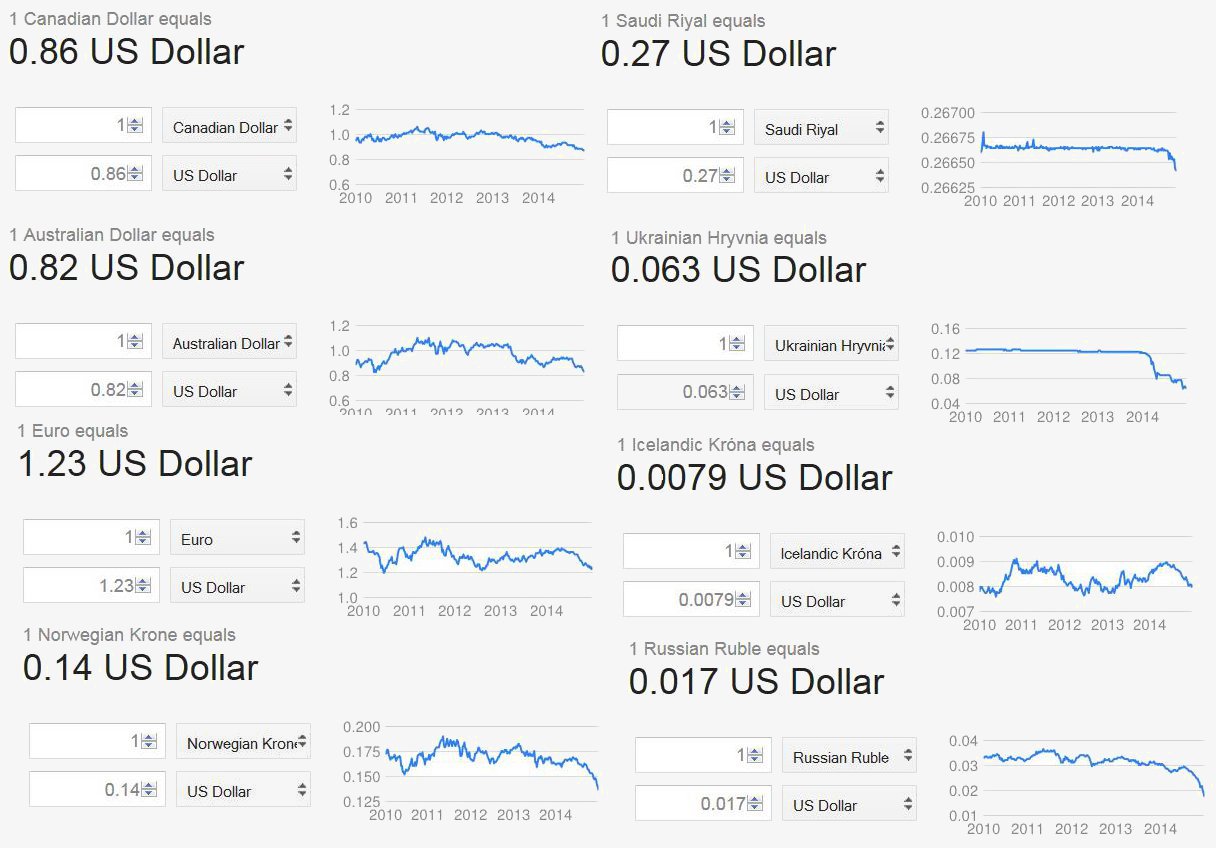
Today just some rambling thoughts that may or may not matter to anyone but me. The coffee is really good though and getting cheaper by the day here in Russia. Soon I will stock up after the price gets to 10 year lows. Love that coffee…

* * * * * * * * * *

The west is in a full-scale media war against the east and it is centered around Russia and China. We have even gone so far as to blame everything happening lately on Russia and I suspect that Russians will be eating their babies before long, just like we were told that the Soviets ate their babies many years ago. Just like we tell everyone that North Korea eats their babies and henceforth, I assume that even China ultimately will eat her babies also…

Makes me think about the word integrity and neither main definition applies to the west in any way whatsoever…

* * * * * * * * * *

Ukraine wants free gas, not gasoline, gaz! Gas like in heating gas and gas for your stove… They want Russia to cough it up free…

Ukraine is a failed state…

* * * * * * * * * *

Here is something to go with what I said yesterday in my post

ST. PETERSBURG, October 30. /TASS/. Two new diesel-electric powered submarines of the Varshavyanka family have been laid down at the Admiralty Shipyards in St Petersburg. They were designed by the Rubin design bureau of maritime technologies and they round out a series of six new submarines for the Black Sea Fleet. On the whole, more than 40 new ships — strike submarines, missile carrying frigates, corvettes based on stealth technologies, amphibious ships, and auxiliary sea craft — will be entered on the Navy’s tables of equipment before the year-end and the bulk of them has been built at shipyards of Russia’s Northwest.

Enough said about that…

* * * * * * * * * *

1. Vice president of the US Biden has admitted that we had to embarrass the EU to force them to sanction Russia…

Joe Biden said that: “It is true – they [European countries] did not want to do that [impose sanctions against Russia] but again it was America’s leadership and the President of the United States insisting, oftentimes almost having to embarrass Europe to stand up and take economic hits to impose cost,” the vice president said.

Do you find it strange that we admit to being bullies? I do…

2. The US dropped Russia from GPS access and since that also includes rare earth materials, this action hurts the US and not Russia. Russia has its own system called GLONASS and it is what I use also. It is not the GPS, but the rare earth materials from Russia are virtually non-replaceable for the US. So who does that hurt in the long run? Yes – The US…

* * * * * * * * * *

Here is my main thought for today…

The US is pursuing what must be the most destructive goal of global control that has ever been implemented. It is really an all or none strategy and that strategy has no exit to get out encase everything collapses, as it is doing with rapidity everyday…

We (America) are on a collision course with the whole world and it is an all or nothing situation…

I am not happy about this tactic and neither is the rest of the world. The show down is coming and that is when fair-weather friends will peel away from the American people and government…

Have a nice day…

Post by Kyle Keeton
Windows to Russia…

Shipbuilders Full Steam Ahead…

I have talked about this several times; Russia has been building warships, submarines and other warfare watercraft as fast as they can. One is finished and another hull is laid. I have mentioned that Russia is building ships 24 hours a day, seven days a week 356 days a year…

Not just warships, but all kinds of ships…

Dmitry Medvedev: “We need not only a powerful navy, but also civilian fleets that can tackle navigation and transportation tasks, Arctic development, the numerous shelf projects, and the production of marine biological resources. The President and the Government adopted decisions and issued instructions to this end.”

Say what you want and think what you want, but as I have expressed about the agricultural revolution happening in Russia. I am expressing also about the industrial revolution happening in Russia…

I see factories, warehouses and other plants being raised outside of many cities. I see a completely different world than when I came to Russia and it is growing fast. I see Russian products from cell phones to toothbrushes that were never in the stores, but in the last few years, Russian products have exploded on the market and they are well built, cheap and decent…

Just letting you know what is happening in Russia…

Post by Kyle Keeton
Windows to Russia…

Couple of Pictures for Monday, October 27th, 2014…

When I walk in Moscow, Russia; I find interesting obstacles that should never be there. This line of clothes above is at my chest height and blocking the main sidewalk. I know the babushka who did it and the clothes are way above her head and she thinks everyone else is her size. Though Boza did not find the clothes line a problem… 🙂

25102014398

I thought I would toss in a photo taken at the Egypt international airport. It really was in the zone of everyone who was checked for bombs and guns (notice Duty Free Signs in the background,) but as I watched there was ways to circumvent the security and a whole bunch of locals did just that. That part did not bother me, but what did was the stealing and lowlife crud going on. I watched several times, young men try to tug on women’s purses and see if they would notice that someone was paying attention. Interesting place if you want to study crime. I had plenty of time to watch, as I guarded our bags and Sveta ran around shopping…

Worse than Ukraine by far…

Just some interesting images from our life in Russia…

Post by Kyle Keeton
Windows to Russia…

Why we ended up in Egypt…

I guess I need to explain and that is what I started to do yesterday and I delayed the post until today. I had 10 comments about why I was stupid enough (and many other choice words included,) to go to Egypt when I have talked about the fact that Russia has banned travel to Egypt in the past? The article has one comment left, because it was the only comment that did not call me and Sveta everything but white people and 5 of them included death threats. File thirteen is the appropriate place for trash, therefore they end up in file 13…

Egypt was a byproduct of a rout of tourist companies all over Europe going belly up and we happened to be on the outlier area of the bankruptcies. Our company while sound, lost their charter flights due to lack of participation to Tunisia and we got our money back. Money that was reserving a trip to Tunisia and it was at our favorite spot, but alas it was not to be and no other Tunisia trips were available. At least from Moscow…

Then as it was the last few minutes of the ball game and Sveta had already had vacation approved. We had to find an alternate route. After exhausting all other options we found one chance at warm seas and warm weather; Egypt!

As much as Tunisia is a dream, Egypt was a nightmare. Though I will honestly say that the Red Sea (Sure looked blue to me – very blue! Food color blue!) is probably the most incredible sea I have ever been in and the marine life is just phenomenal. I got to personally explore live coral formations and observe the sea life that lives amongst the coral. There were areas that allowed me to just float with my snorkel and watch a world beneath the waves. The fish come right up and look in you mask as you silently float around. Magnificent…

So it was not a lose, it was just a disappointment to me that should have been a trip of a lifetime. I will say that it makes me totally appreciate Tunisia…

Due to it being Egypt and American controlled, whereas Tunisia is French controlled, I was very silent about going to Egypt. For I knew that issues will arise and I went under the radar, so to speak. This is a sad state of affairs in our world when I can express where I travel as long as it is non U.S affiliated puppet regime…

I was going to also today talk about Blue Light special, but as one commenter put it, “Ha ha, we all love a bargain, but at what price?”

Enough said and I made my point! All Blue Light Specials line up for Egypt, its cheap…

Post by Kyle Keeton
Windows to Russia…