How to say it in Russian?


Small English-Russian Dictionary from Svet

Part I


The idea of small English-Russian Dictionary comes to us after we analyze what people look for about Russia. Very often they wanted to know something very easy and nice like “I love you!” or “Happy Birthday!”

How to say it in Russian?
English word How Russians would write it How Russians would pronounce it
Hello! Здравствуйте! Zdravstvujte!
Hi! Привет! Privet!
Nice to see you! Рад(а) тебя видеть! Rad(a) tebya videt!
Thank you! Спасибо! Spasibo!
Take care! Береги себя! Beregi sebya!
Best wishes! Всего наилучшего! Vsego nailuchshego!
I love you! Я тебя люблю! Ya tebya lyublyu!
Happy Birthday! С Днём Рождения! S Dnyom Rozhdeniya!

Sunrise to Freedom, The Russian Village


This is a typical Russian Village. 12 people live here now and 10 years ago 30 lived here. Many Russian Villages are almost gone. This one had a Monastery for women and the bell tower is some of the remains. There are no roads to the village except a dirt trail, that even a 4 wheel drive would have trouble on.

I myself want to live in such a Village. They have electricity but no running water. The air is clean and refreshing. The water tastes wonderful.

The village homes are falling down and crumbling. Nature is reclaiming the old Village one inch at a time. Within 10 more years I think the Village will be gone.

I find that sad.

Windows to Russia!

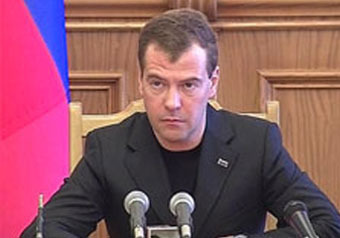
Medvedev Makes a Strong Statement About the Olympics During a Meeting!

March 1, 2010,
Gorki, Moscow Region

Beginning of Meeting with Leaders of United Russia Political Party

PRESIDENT OF RUSSIA DMITRY MEDVEDEV: Colleagues, the time has come to examine the latest round of new appointments. This week, as I understand it, we are starting with the candidates for the post of governor of Kemerovo Region. Later, we will have the candidates for governor in a few other regions to consider too.

Mr Gryzlov, you have the floor.

CHAIRMAN OF THE UNITED RUSSIA SUPREME COUNCIL AND SPEAKER OF THE STATE DUMA BORIS GRYZLOV: Thank you, Mr President. We have examined candidates for the post of governor of Kemerovo Region and we want to present three nominees to you: Valentin Mazikin, currently first deputy governor of Kemerovo Region, Sergei Neverov, a deputy of the State Duma of the Federal Assembly, and the incumbent governor, Aman Tuleyev. All three candidates are connected to United Russia. Neverov and Tuleyev are members of the party, and Mazikin is a supporter of United Russia. All three candidates are equal in merit, and so the choice is yours to make.

DMITRY MEDVEDEV: Good, thank you for this presentation. In accordance with the law I will make my proposal in line with the established procedure.

Is there anything else?

BORIS GRYZLOV: There is one other matter. The Olympic Games in Vancouver have just ended. Over these last two weeks we have followed out team’s performance very closely. I think, talking about Russians’ national idea, you could say that one of the things that unites us is a desire to always be first. It is all the more sad therefore to see that our country only reached eleventh place in the overall medal count. This is a worse result than Russia achieved in the first Olympic Games it took part in back in 1912. In other words, this is our worst result ever. I think this is a systemic failure. Of course, the sports officials should take responsibility for this. We have the Sochi Olympics ahead and I think that every day is valuable now and we need to decide how we are going to go about preparing for these Olympics.

We would like to hear your opinion on this situation, because United Russia is ready to get involved in the efforts to get our athletes ready for the Games.

DMITRY MEDVEDEV: Yes, and you should get involved. This is a national affair, something we all need to get involved in. I think it is still too early to make a final analysis, but I will make three points nonetheless.

First, without question we need to thank our athletes who did produce results, who came through a tough competition to take victory. Sadly, they are fewer than we hoped. The team’s performance was uneven, but no matter what the overall result those who achieved victory deserve the highest praise. Whatever the case, I will therefore meet with our Olympic team and congratulate them, and I also hope to receive the information I need to go ahead with awarding state decorations to those who particularly distinguished themselves.

Second, it is essential that we now proceed smoothly with the preparations for Sochi Olympics. Work is already underway, but it has to continue in two areas. First, and most important, we need to complete the infrastructure for the Games. We have already made considerable progress in all different areas in this respect, and I will soon receive an update report on the situation when the Council for Sport meets in March.

Second, taking into account what happened in Vancouver, we need to radically change the way we train our athletes. Unfortunately, as is clear even to non-specialists now, we were able to keep riding along on the basis of what was developed and achieved during the Soviet period, but this is no longer possible today. We have lost the old Soviet school now. There is no need to idealise it. Quite simply, it no longer exists, but we have not yet built a new school to replace it, even though we have been investing unprecedented levels of funding in sport, and this is also an indisputable fact. This shows that money alone cannot solve all the problems. Money is certainly important and is an essential condition, but it does not solve everything. The results of these Olympics highlight the real problems that we face.

We therefore need to rethink the way we train our athletes. The cornerstone of the system should be the athletes themselves, not the federations, which in some cases are like big fat cats, and not their heads, or even the coaches, for all our immense respect for their work, but ultimately, it is the athletes who produce the results and they must therefore be the centre of attention.

Finally, I cannot but agree with you that those in charge of preparing for these Olympics need to take their share of responsibility for the results. This is obvious. I think that those responsible, some of them at least, should take the brave decision to submit their resignations and step down. If they do not find within themselves the resolve to do so we will help them.

But this is not the most important thing. Most important is to prepare for the 2014 Olympics, and we need to pour all our effort into this work. This is not the time to sink into despair. Of course we were all upset, all had our share of negative emotions, but we need to put this behind us now and move on, get ready for the 2014 Olympics. Look at Canada’s brilliant performance. Who would have guessed that Canada (even though it is a good sporting nation and so on) would win so many gold medals, take first place in the gold medal count? No one expected this. I think the Canadians themselves probably did not expect it. Now we also have just as much chance of putting on a good performance at the 2014 Sochi Olympics. So, let’s get to work on this.

Here is a BBC article on this meeting!
http://news.bbc.co.uk/2/hi/europe/8543560.stm

Windows to Russia!

Svetlana Takes Pictures of Moscow, Russia!

Above – Everyday you will meet such people – wonderful isn’t it… Click read more and see more of Svet’s pictures!

Above – Going on two stories of Icicles…

Above – It is cold and the birds are puffed up…

Above – This is what happens when an American car is brought to Russia – The LADA’s gang up on them…

These are just some of the pictures that Svetlana has taken. We have a photo blog of Russia that might interests you “Russian Photo Blog“. In that Blog we have hundreds of pictures that Svetlana has taken and even a few of my own…

Windows to Russia!

Russia Says: No – We Did Not Forget The Tanks!


Where else can you go and find 200 tanks unguarded and hatches unlocked? But Russia…

It seems that last November, at a tiny railway station near Yekaterinburg in Russia’s Urals. About 200 tanks were unloaded from the rail cars and left near the station. The people living there say that the tanks seem to be in good order and anyone can get inside to feel like a real tank operator. They say that the only thing missing is ammunition for the tanks weapons…

Now I myself, really wish that I could go see these tanks. It seems they are the T-72 model of tank. There are some other types of armored weapons but the brunt of the 200 vehicles are tanks.

The spokesperson for Ural’s Military Command of the Russian Army, Dmitry Burdakov, said that the vehicles have not been forgotten and were stationed where they are on purpose while being relocated. He promised to complete the relocation by mid-March, saying that every tank will go under its own power to a central location. (Link)

Could you imagine 200 tanks being left out in the open in America – unguarded and open? (Much less being within driving range of a huge city.)

No – I really can not imagine that happening. Everyone would hot wire them and take a ride, I know I would want to… 🙂

That is why I love Russia!

Windows to Russia!

Russia Today and "CrossTalk"

“CrossTalk” is the newest addition to the RT program lineup. This TV debate club presents hot-topic discussions on politics, business, news makers, global trends, present-day conflicts, dangers and challenges of modern world. His guests are politicians, journalists, scientists – anyone who influences the decisions changing our world or plays a key role in forming public opinion.


We are going to run some of Peter Lavelle’s videos on his Crosstalk show. He has a lot of them so we will start with his latest one and if you so desire to see more follow the link and you can see his archives…

Otherwise come back and check out what videos of his that I post on Windows to Russia!

Windows to Russia!

The 2nd Superpower – Opinion By Alexei Bayer

The St. Petersburg Times – Opinion – The 2nd Superpower: “Few people around the world foresaw the collapse of the Soviet Union or the demise of communism. But back in 1981, Robert Tucker, a prominent neocon and an old-school U.S. isolationist, surprised our graduate seminar at an international affairs school by suggesting not only that the Soviet empire might be on its last legs, but that if and when it crumbled it would not be such a great thing for the United States.

Having just emigrated from the Soviet Union, I was convinced that communism would endure forever and that the old men ruling the Kremlin were winning the Cold War. But if the Soviet Union were to disappear, I didn’t think there would be much to regret.” (Read More)

Windows to Russia!

The "Klim Voroshilov" – The Ghost!

This is a good video and these guys have their work cut out for them. It seems to me that a better surviving remains could be found (?) but I guess you make do with what you have and in this case they are going to have to make a lot of parts by hand.

I found one thing interesting, they said that they could have gotten it to start if they wanted too…

The Klim Voroshilov!

Windows to Russia!

Medvedev and Interview With Paris Match!


February 25, 2010,
Gorki, Moscow Region (recorded on February 18, 2010)

Interview to the French Magazine Paris Match

OLIVIER ROYANT: Mr. President, thank you very much for receiving us today at your residence. In a few days you will celebrate the second anniversary of your election to the post of the President, and you will actually be in Paris. This year is the year of Russia in France, and it is a very important moment.

Could you give any symbolic examples of cooperation between our countries, and what do you expect from your visit to France?

DMITRY MEDVEDEV: It is a pleasure to see you today, especially on the eve of my visit to France, a major visit, and to discuss Russian-French relations. Indeed, the relations between our countries have been developing for many centuries. There have been many historical events when ways of Russia and France crossed. The history of our states have witnessed both bright moments and sometimes problems, which also brought us together, but in the end the scope of cooperation has been tremendous. A classic example is the life of Queen Anna, daughter of Yaroslav the Wise, who got married to HenryI, king of France. However, it was long ago, though this fact is quite remarkable.

To my mind, France played a much more prominent role with regard to Russia in the eighteenth and nineteenth centuries. It seems to me now that there was no other language in our country’s history that enjoyed such great popularity, almost on a par with Russian, the official language. Neither German nor English, although popular during certain historical periods, has played a role similar to that played by French, say, in the late eighteenth– early nineteenth centuries, when almost all educated people in Russia spoke French just as good as they spoke Russian. This, of course, was the result of a general interest shown by Russia’s elite of the time in the French culture, philosophy and the finest works of French art. However, this interest has not diminished anyway, so these centuries were by no means lost. As far as the twentieth century is concerned, our cooperation and relationships have become even closer at that time. This process started during World WarI, followed by the Russian revolution, which triggered the first wave of mass emigration to France, mostly to Paris; in fact, millions of people fled to France. Many of them led a rather difficult life, sometimes even tragic, but their decision to settle in France was no coincidence. They probably believed that in France they would feel themselves closer to home than in any other place; we can see mental similarities behind this. Then, we were allies during World WarII. After that, decades of rather fruitful relationship followed, even during the Soviet Union era. For example, we maintained very good high-level relations during that period, and the attitude towards General Charles de Gaulle, which was very respectful at that time, remains the same nowadays.

To my mind, the new Russia enjoys a very good partnership, a strategic partnership with France. We are no longer divided by ideological differences. This does not mean we have no disputes at all, but we actually maintain very good and positive relationships with the French administration, including my personal contacts with President Sarkozy. When we reach an agreement, President Sarkozy always keeps his promises, which is something every politician should be able to do.

OLIVIER ROYANT: During your visit do you plan to negotiate the purchase of a Mistral-class warship?

DMITRY MEDVEDEV: You know, Russia has always been a major producer of military equipment, and we still are one of the largest suppliers of military equipment from Kalashnikovs to, say, S300, an antimissile defence system. But there are areas where we can learn and see what other countries are making. By the way, this would be useful for our defence industry as well, because it needs to maintain its competitive edge anyway. We therefore have interest in buying advanced models, including warships.

OLIVIER ROYANT: Do you have any personal recollections about your visits to France?

DMITRY MEDVEDEV: Of course, I do! And they are very vivid, indeed! I think it was in 1991, and it was my first visit to France. Though it was originally a visit to discuss cooperation between St Petersburg and Paris businessmen, it was also a chance to see Paris. I’ve heard a lot about Paris, read a few interesting books, including by French authors who described the morals and beauties of Paris. Yet, reality was beyond my expectations, because when I first came to Paris, I understood that this city is absolutely unique, considering that I had been living all my life in St Petersburg, then Leningrad, which is also a beautiful and quite European city. But the special atmosphere of Paris, a walk along the Champs-Йlysйes, eating in small restaurants, all this just a week before Christmas, with all that illumination and the Eiffel Tower, – I was very impressed. I remember returning home so excited I just couldn’t stop talking about my impressions of Paris. In other words, in reality it was, indeed, far more impressive than any pictures.

At that time I had just started my legal career and worked in the city administration, and I was very impressed by the atmosphere in which business issues were discussed. I liked it because we could discuss things not just in the dull office, but also in restaurants over lunch or dinner, or during walks. Somehow I enjoyed this easy way of discussing business issues.

OLIVIER ROYANT: The point is that now we are gradually recovering from the crisis. So, it is interesting to hear your comments on what lessons could be learned from this crisis? You know that Asia is already on its way towards the recovery from the crisis while Russia has been largely dependent on exports of hydrocarbons. Now how do China, India and Brazil recover from the crisis? And how in this context can you describe the situation in Russia?

DMITRY MEDVEDEV: The lessons to be learned are clear. First, the crisis highlighted our weaknesses: our economy’s dependence on raw materials. But we had been able to understand that ourselves. Yet, the fast and deep recession was quite unpleasant.

And second, of course, is that it is impossible to overcome such global crisis on one’s own. It is impossible to imagine a situation when there is paradise in France and everything is bad in China, because these are global actors, who influence each other. It is very important that we finally learn to speak the same language in the most direct sense of this word– the language of the economy. We discussed these issues many times in the G8 and in the G20. For instance, I personally discussed these issues with the French President. We should create a new financial architecture for all. In our case, everything is clear: we should modernize our economy, we should achieve growth based on other sources, not just raw materials, we should develop high technologies, we should, essentially, create a new segment in our national economy. This is the goal, I personally work on that, and I have established a special presidential commission, and this is our strategy for the nearest future. Of course, the ‘hydrocarbon’ economic growth fuelled by oil and gas sales will continue for some time, but it should not be our universal way of development. We must have other sectors in our economy, powerful and comparable in size.

OLIVIER ROYANT: You belong to the generation of the statesmen who speak in a straightforward manner, like Nicolas Sarkozy. You seriously criticized the situation in Russia, you spoke of the flaws, corruption and other things. But it is important what do you think about it now, are you disappointed by the slow progress?

DMITRY MEDVEDEV: Of course, I am disappointed, like many of our citizens, by the fact that we are not developing as fast as we would have liked, and that the problems we are all so tired of do not disappear as quickly as we would have hoped. The living standards are not improving as fast as we want them to, and corruption remains one of our most serious concerns and most vulnerable spots. I am not quite satisfied with the investment climate in our country either, and with the way technological changes are taking place in the economy.

What needs to be done? We need to work. We need to work every day, to give clear, strict instructions, to shake up officials, to meet with businessmen, to talk to our partners and learn from their good practices. By the way, that is why Ilike the initiative to establish the so-called “Partnership for Modernization” of Russia that was put forward during the last EU summit.

OLIVIER ROYANT: Russia’s new military doctrine says that NATO is perhaps a threat even greater than the proliferation of nuclear weapons, terrorism, etc. Do you think that we are sliding back to the Cold Warera?

DMITRY MEDVEDEV: No, I don’t think so. It is not about NATO, and our military doctrine does not treat NATO as the main military threat. It is about the never-ending enlargement of NATO through absorbing the countries that used to be part of the Soviet Union or happen to be our closest neighbours. It definitely creates certain problems, because NATO, whatever one may say, is a military alliance.

Everything is quite clear here. We have our own defence strategy and we have Armed Forces tailored to fit a certain configuration. But if a military alliance, which is, by the way, our partner in general, keeps on moving even closer to our borders, if missile defence or something else is being reconfigured, it is a good enough reason for us to be concerned. I think this is an absolutely open and correct position. Itdoes not mean that we are sliding back to the Cold War, but we must take this into consideration.

Also, I would like to say that major European actors, the Eurogrands, so to say, France in particular, have taken a well-balanced position on this issue, and we have always been grateful to France for such a balanced position with regard to NATO enlargement.

But we are also facing challenges that we should meet together with NATO– the proliferation of weapons of mass destruction, including nuclear weapons, terrorism and drug trafficking.

OLIVIER ROYANT: When President Obama speaks about a nuclear-free world, is this your goal too?

DMITRY MEDVEDEV: I applaud him. Most important is that other countries, including France, agree with President Obama and me as well.

OLIVIER ROYANT: Twenty years passed since the fall of the Berlin Wall. How do you perceive the Soviet times, because for the West these were mostly “dark” years, but as far as Russians are concerned, it often looks like they feel nostalgia for those times, nostalgia for a more secure life, for a different life.

DMITRY MEDVEDEV: Strictly speaking, nostalgia generally means being homesick. And, speaking about my personal emotions, I was born in the Soviet Union – that was how our state was called at that time. But here we should learn to separate the emotional and the rational sides. I was born and grew up in the Soviet Union and received my education at that time. But the society we had back then, its ideology and principles are absolutely alien to me. And that is why emotionally many memories of those times are dear and pleasant to me, but if we consider the social foundations of that period, let alone the economy, Iwould not like to return to that past at all, even for a moment.

OLIVIER ROYANT: How would you describe your relations with Vladimir Putin, because once Mr Putin said that you are “people of the same blood”, and what future do you see for yourself in connection with the 2012 presidential elections?

DMITRY MEDVEDEV: Regarding the blood type, I think Mr Putin was right: we do have the same blood type in the medical sense of the word, as we found out recently. (L a u g h t e r)

As regards the political future, no one can really tell. But, naturally, we are responsible people, and we will no doubt discuss with him the political future of our country and our place in it. In any case, so far we have an effectively functioning alliance that is, in my opinion, good for our country.

In general, it is very good when President and Prime Minister have good relations. It is worse when these relations are different. Don’t you think so?

OLIVIER ROYANT: I’m almost through with my questions, just a couple more, if you don’t mind. Everybody think that Russia can be the key to solving the Iranian nuclear problem. How do you feel about this situation? Are you concerned? Do you believe that there can be a way out of this situation?

DMITRY MEDVEDEV: I think that Iran’s own responsible behaviour is the key to solving this problem. We believe that Iran should adapt its nuclear programs to meet the requirements of international organizations such as IAEA; on the other hand, we want it to conduct its nuclear activities in a manner that is transparent in terms of control.

As yet, unfortunately, there are a lot of problems here. Therefore, we continue our consultations with key parties to the negotiations and we are ready to contribute to this process together, with France as well.

OLIVIER ROYANT: But still, how do you feel about it? Are you concerned or …?

DMITRY MEDVEDEV: Of course, I’m concerned. Everybody is concerned about it now. I have spoken to many leaders from the Middle East and European countries, and all of them express their concern. And the Russian Federation is no exception. Iran is geographically close to us. It’s our neighbour.

If something very serious happens, it will lead to a humanitarian disaster, let alone other problems for the entire region.

OLIVIER ROYANT: Your interests include rock music and photography. Your wife is well known for her interest in fashion and involvement in the activities of the Russian Orthodox Church. What is the Medvedev “philosophy”?

DMITRY MEDVEDEV: All of what you have mentioned.

But sometimes I do feel like catching a break, doing something different. So I have several things that I find interesting, at least for the time being, and they do include both music and photography. I like music and listen to it quite a lot in my free time. And like any other normal person, I do read books. Sometimes, Iwatch movies, including, by the way, French ones. I like French cinematography, because it is much closer to ours. I have nothing against Hollywood – Hollywood is good, too. Yet French cinematography is something much closer to our Russian perception, to our highly sensitive Russian soul.

By the way, I admire how French cinema has been developing. I think it is the experience that Russian cinema should definitely build on. It’s a pity I cannot enjoy French movies in French. I have always regretted learning English instead of French or German, and I will tell you why. When I was in the legal profession I had to read a lot of books and legislations of France and Germany, which are much closer to ours, especially the civil law, than the English law. Similarly, the Code Napoleon is also obviously best read in the original.

OLIVIER ROYANT: And now two years after taking office, do you feel like a happy man?

DMITRY MEDVEDEV: Not two years, actually. It will be two years since my election during my visit to Paris, but I took office in early May.

You know, I believe that everyone should be happy to serve their country, the country that they love, and to try to do good too, especially at such a high level. From this point of view I am definitely happy. Lack of time, however, is the other side of the story. But what can I do about it.

OLIVIER ROYANT: Do you feel disappointed by the image of Russia that is sometimes created in some European and other countries when they start talking, for example, about the Caucasus and human rights issues? Would you like to improve the situation?

DMITRY MEDVEDEV: Well, to tell the truth, sometimes it makes me feel really bad, but I understand one thing. On the one hand, it could be possible to highlight different things but, on the other hand, these problems persist and the fact that our foreign friends are writing about them is yet another reason for us to set about addressing these issues.

OLIVIER ROYANT: Do you think that the G20 leaders are at their best, that they are keeping up with the modern times?

DMITRY MEDVEDEV: I would hate to hurt the feelings of the leaders who gather around this table because I am one of them.

You know, I can say just one thing, which is quite simple and everybody is talking about it. Twenty years ago it was impossible to imagine that the leaders of the United States, France, the Soviet Union, China and some other nations would sit down at the same table to discuss global economy.

Yet, this is what we have today, and we are making decisions. These decisions are not ideal, perhaps, but nonetheless, they are decisions, not just declarations. Therefore, I think that on the whole we can find a common language, although some issues could be resolved more promptly. And we still have many things to do. That’s why we plan to meet twice this year.

This Year the Victory in the Patriotic War Celebration may also be the Great Amnesty!

I found this to be extremely interesting:

MOSCOW, February 25 (Itar-Tass) — About 45,000 people may be amnestied on the occasion of the 65th anniversary of the Victory in the Great Patriotic War, the chairman of the State Duma Committee for Civil, Criminal, Arbitration and Procedural Legislation, Pavel Krasheninnikov, who also co-chairs the Association of Russian Lawyers, said at a meeting of the association’s presidium on Thursday.

“We propose to announce amnesty on the occasion of the 65th anniversary of the Victory in the Great Patriotic War, but the number of amnestied convicts (subject to the amnesty) should not be very wide,” he said. Alongside, Krasheninnikov believes that war veterans, elderly people and disabled people, as well as people, who did not commit grave crimes, should be subject to amnesty.

“According to the preliminary estimates, we believe that the amnesty may embrace 300,000 citizens, about 45,000 people will be released from penitentiaries,” he said.

I went Hummm…

Windows to Russia!